

Breaking bones in childhood more than doubles the odds of it happening again as an adult, study finds
- Written by Kim Meredith-Jones, Senior Research Fellow, University of Otago
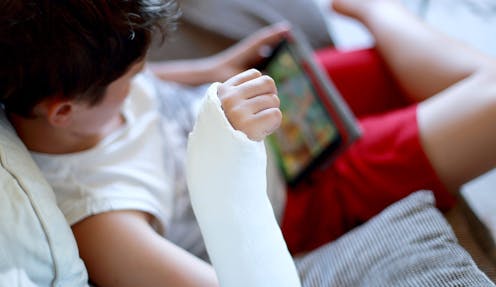
Breaking a bone in childhood is not just a rite of passage. It could be a warning sign of future fracture risk and osteoporosis.
A history of prior fracture is one of the strongest predictors of future fractures, yet current guidelines used to determine osteoporosis risk ignore childhood fractures.
We investigated the history of fractures in a group of middle-aged people who are part of the Dunedin Study, a comprehensive longitudinal project that has continued for five decades.
We found people who broke a bone more than once in their childhood had more than double the odds of breaking a bone as an adult. In women, this also resulted in lower bone density at the hip at age 45.
The people in our study are young for investigating fracture risk and osteoporosis, but if lifestyle changes to improve bone density can be implemented earlier in life, it may have the greatest impact on lifelong bone health and the reduction of osteoporosis risk.
Childhood fractures predict osteoporosis risk
About one in two children break a bone during childhood, with almost a quarter of boys and 15% of girls suffering multiple fractures. But we don’t currently fully understand why some children repeatedly break bones or whether this will predict adult bone health.
There are several reasons why children fracture a bone. Previous research has shown that kids who fracture tend to live in poorer households, have high levels of vigorous exercise, are overweight or have a high body mass index, vitamin D insufficiency, low calcium intakes and may experience physical abuse.
Children who fracture repeatedly may also have especially fragile skeletons, they may be “accident-prone”, or their bone fractures may occur during sport or physical activity. But an important question is whether kids who break bones have temporary reductions in bone strength during rapid growth, or if these bone weaknesses continue into adulthood.
Read more: Teens who hit puberty later could face bone health issues later in life, studies suggest
The people we studied are all part of the unique Dunedin Study, which tracked the development of a thousand babies born in Ōtepoti Dunedin between April 1972 and March 1973. Study members have been assessed repeatedly every few years since, on a wide range of topics including risk-taking behaviours, sport participation, physical abuse, child and adult deprivation, among others.
They’ve also repeatedly undergone face-to-face interviews asking about injuries, including fractures since they were children. This means we can compare their medical fracture history in middle age with their own recollections from childhood.
Importantly, because the Dunedin Study also collects comprehensive information about other factors that may explain why some children suffered repeated fractures, we could include these aspects in our analyses.
Read more: Vaccine resistance has its roots in negative childhood experiences, a major study finds
What we found
Both boys and girls who suffered more than one fracture as a child were more than twice as likely to fracture as an adult. Also, those who were fracture-free in childhood tended to stay so in adulthood.
Among females, childhood fractures were associated with lower bone mineral density at the hip later in life, but this was not the case among males.
Many other studies have sought to determine whether children who sustain a single fracture during childhood have skeletal fragility that persists into adulthood. Our study is the first to demonstrate an increased risk of adult fracture in both males and females who repeatedly fracture in childhood.
Exactly why this is the case is not clear though. The persistent risk was not associated with other behavioural factors, such as risky behaviour, demographics, obesity, childhood abuse or sports participation.
Why this matters
Although we don’t know the exact mechanisms for this increased risk of fracture in adulthood, the results could be used to raise awareness for those most at risk. Parents of children who repeatedly fracture in childhood should be informed about various ways to prevent persistent skeletal fragility with age.
Behavioural changes such as increased weight-bearing activity, optimal intake of calcium and vitamin D and increased protein and dairy consumption are all beneficial interventions that can be initiated early and maintained throughout the lifespan.
Osteoporosis tends to affect adults after middle age. We hope to continue investigating the relationship between childhood fractures and adult bone health in this very special population of people as they age, to find out whether these links persist after menopause in women or affect lifelong risk in men.
Authors: Kim Meredith-Jones, Senior Research Fellow, University of Otago

















