

Aboriginal people have spent centuries building in the Darling River. Now there are plans to demolish these important structures
- Written by Michael Westaway, Australian Research Council Future Fellow, Archaeology, School of Social Science, The University of Queensland
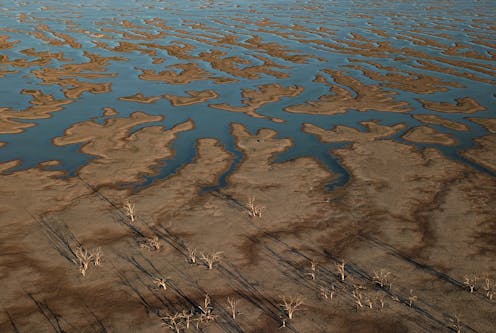
Apart from managing the land, Indigenous people have also managed waterways, including the Murray River and the Darling/Baaka River, for thousands of years.
Like many Indigenous peoples of Australia, the Barkandji people of the Baaka manipulated and enhanced the river and floodplain ecosystems of their country.
Now, our research on stone, wood and earthen fish traps and fish weirs on the Baaka and its floodplains reveals how these aquatic resources were managed, grown and stored by the Barkandji.
These structures, and the cultural practices that sustain them, are still significant to the Barkandji people – but they’ve been severely affected by colonisation, and remain at risk from government commitments to irrigation.
Reconstructing the Baaka’s Aboriginal past
To study the structures in the Baaka we relied on archaeological methods, Barkandji knowledge and oral history, and written accounts from early settlers and explorers.
We found most of the wooden or earthen fish traps on the Baaka’s floodplains have not endured and aren’t archaeologically visible. There are, however, some existing and remnant stone traps – which were once common along the 1,200km channel.
These structures were encountered by explorers, ship pilots, graziers and other settlers who travelled along the Baaka between Wentworth and Bourke.
The first threat to the traps were paddle steamers
The first paddle steamer travelled in 1861 up the Baaka from Wentworth at the Murray-Darling junction to Brewarrina on the Barwon River. It was piloted by Captain William Randell, and was unable to pass over the fish traps due to a lack of draught over the rocks.
This voyage initiated the famous paddle steamer trade that continued into the 1940s. Rocks in the river often stopped these vessels from navigating at low water levels, and they occasionally even sank.
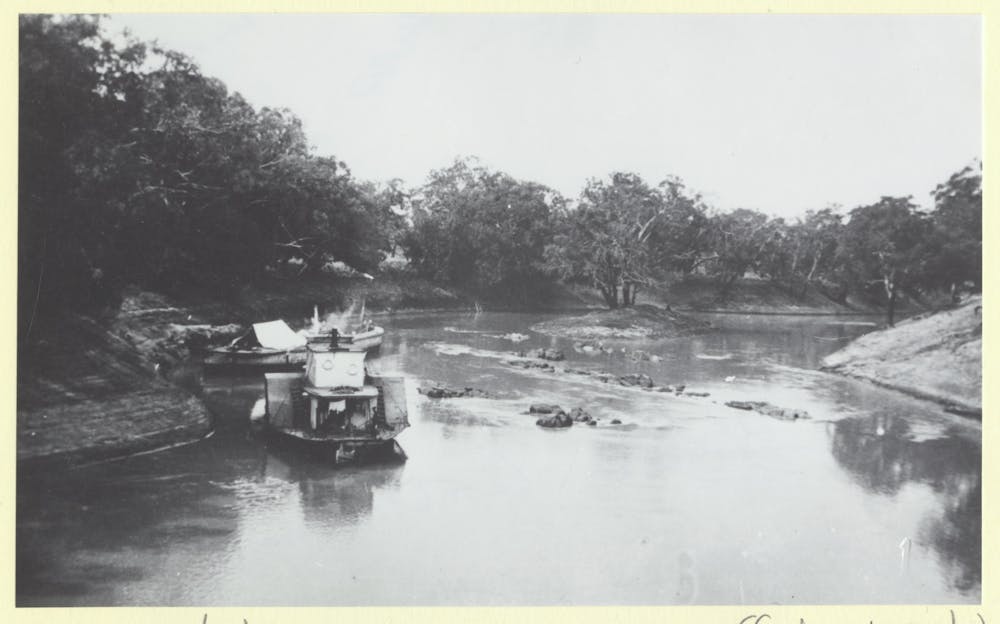
This prompted government-resourced teams to force a passage through by blasting the rocks with dynamite. This blasted rock can still be seen at some outcrops, including areas that have the remains of fish traps or are known to have once had them. Indigenous people built new traps in these areas, often using the blasted rock.
During the 20th century, a series of low-level weirs were built at the small towns along the river to secure water supplies. Settlers sought the same river features to build weirs that Indigenous people did when choosing sites for stone fish traps, so many weirs were built on outcropping rock.
These weirs tended to have loose boulders on the downstream side to hold the weir wall in place. At Wilcannia, the Indigenous workers who carted and placed the rocks at the weir later made them into stone fish traps, which are still used today.
They are made in steps going up the weir wall, helping fish climb the wall like a modern fish ladder.
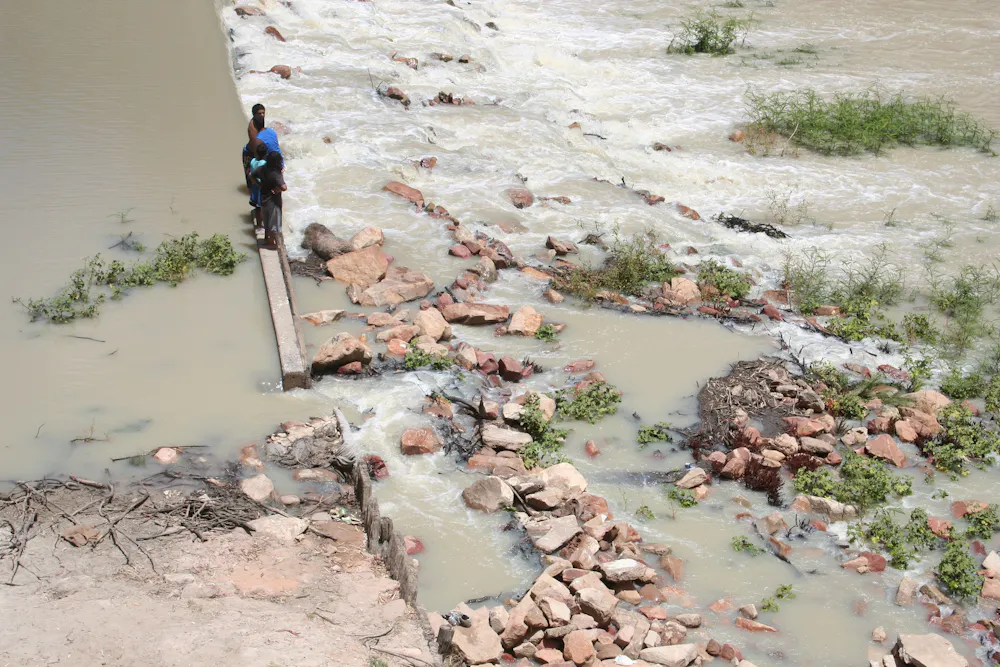 The Wilcannia weir stone fish traps are still used by young Barkandji people.
Sarah Martin
The Wilcannia weir stone fish traps are still used by young Barkandji people.
Sarah Martin
Taking too much water for irrigation
During the last two decades an increasing amount of water has been removed for large-scale irrigation from the Baaka and its northern tributaries. By 2019, excessive water extraction had virtually dried the Baaka and Barwon rivers from Wentworth to Collarenebri – a route more than 2,000km long.
Read more: Excessive water extractions, not climate change, are most to blame for the Darling River drying
The mass fish kills at Menindee in 2018–2019 showed the devastating effects of removing so many of the small to medium flows that kept the ecosystem functioning.
This extended dry river resulted in the near extinction of many species, including river snails, mussels, catfish and silver bream. Also, without water in the river, the Barkandji could not use their fish traps or pass along knowledge of their history and significance.
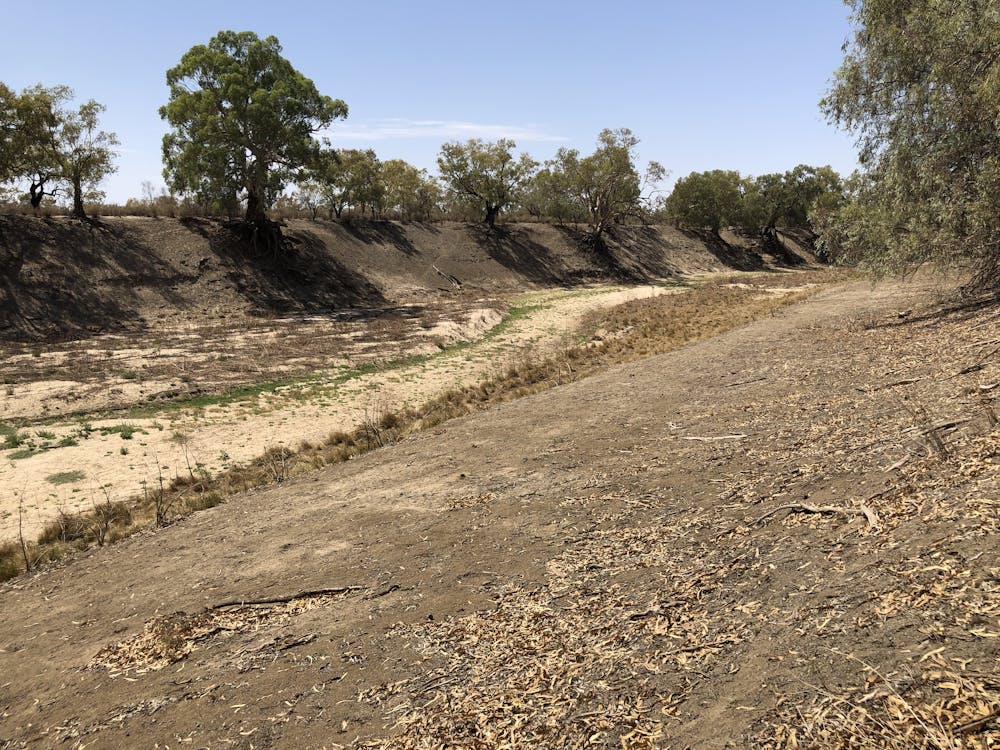 The Baaka dried up due to excessive water extraction. Pictured here is an area at Wilcannia in 2019.
Sarah Martin, Author provided
The Baaka dried up due to excessive water extraction. Pictured here is an area at Wilcannia in 2019.
Sarah Martin, Author provided
The New South Wales government’s response to the crisis now presents a new threat to the fragile fish traps. In 2019 the government passed legislation to fast-track new water infrastructure, despite strong evidence it needs to reduce the amount of water allocated to irrigation.
The legislation enables new dams and new (higher) weirs. The old weir at Wilcannia, which has been used by Indigenous people as a series of fish traps for at least 60 years, will be partly demolished and will no longer function as a fish trap. This is despite the Indigenous community’s strong opposition.
The legislation also allows for the “re-establishment of natural rock weirs on the Darling River between Bourke and its junction with the Murray River”. This suggests all the rock outcrops in the Darling Baaka were originally weirs that stretched like a wall across the river and held water back (before being blasted to allow paddle steamers to pass).
But our field survey coupled with historical material indicates most rock outcrops were originally uneven, with openings and numerous loose rocks. This allowed water to flow through and over the rocks at different river heights, enabling the fish traps to work and helping sustain the ecosystem.
Read more: Bushfire arson: prevention is the cure
How should the river be managed?
Fish traps set by Aboriginal people along the Baaka offer valuable insight into how this precious body of water could be managed. The first thing is the river needs its “low and medium flows” protected.
Historically, Aboriginal people have held ceremonies (and to some extent still do) to mark mass migrations of fish such as golden perch and silver bream that travel upstream to spawn. These fish have to be able to travel up and down the river unimpeded. As seen at the Wilcannia weir, fish traps assist with this.
There are also several benefits from water flowing over and through fish trap stone walls. The walls increase flow turbulence, reduce silting, improve water quality and are “keyed” to let small fish through. They also provide a rocky habitat that effectively forms “multi-storey apartments” for invertebrates such as yabbies and river snails.
Stone fish traps are also often found in association with shallow aquifer springs, with one recorded trap built around a spring. This is evidence of fish management; the fresh spring water attracts fish and acts as a refuge during drought.
Local Indigenous people also understand the necessity of regularly filling floodplain lakes, swamps and billabongs. They previously enhanced these water bodies by using temporary wooden and earthen weirs – providing fish reserves, fish nurseries and rich and diverse habitats for aquatic life.
These structures kept aquatic plants and animals safe to seed the river with life when floods came down after dry periods. They held water to replenish the shallow aquifers that create springs and soaks in the river.
Water managers have so far largely ignored the potential for Indigenous knowledge to facilitate the sustainable management of the Baaka. Yet Indigenous people living along the Baaka have known about how its water moves long before scientists did.
The NSW government’s proposed infrastructure will not only endanger the remnants of culturally significant fish trap structures, but also impact the river’s ecology. Unless Indigenous people’s experience and knowledge are taken seriously, the Baaka and its precious resources may be depleted beyond the point of saving.
Acknowledgment: we would like to thank our colleague Sarah Martin, who led the research paper this article is based on, and whose contributions were invaluable in gathering these findings.
Authors: Michael Westaway, Australian Research Council Future Fellow, Archaeology, School of Social Science, The University of Queensland

















