

Time is arrested in Gail Jones' beautiful new novel of war and art, Salonika Burning
- Written by Tanya Dalziell, Professor, English and Literary Studies, The University of Western Australia

The first pages of Gail Jones’ beautiful new novel, Salonika Burning, offer a vision. The image is of a city on fire, watched by soldiers at a distance who despite, or perhaps because of, their familiarity with devastation, are transfixed “with indecent pleasure” by the sight.
There is a perverse beauty in obliteration that the soldiers intuit. The novel partly turns on this tension as it grapples with how to represent loss and the absurdity of “humans and beasts, crisscrossing the globe so that men could line up to slaughter each other”.
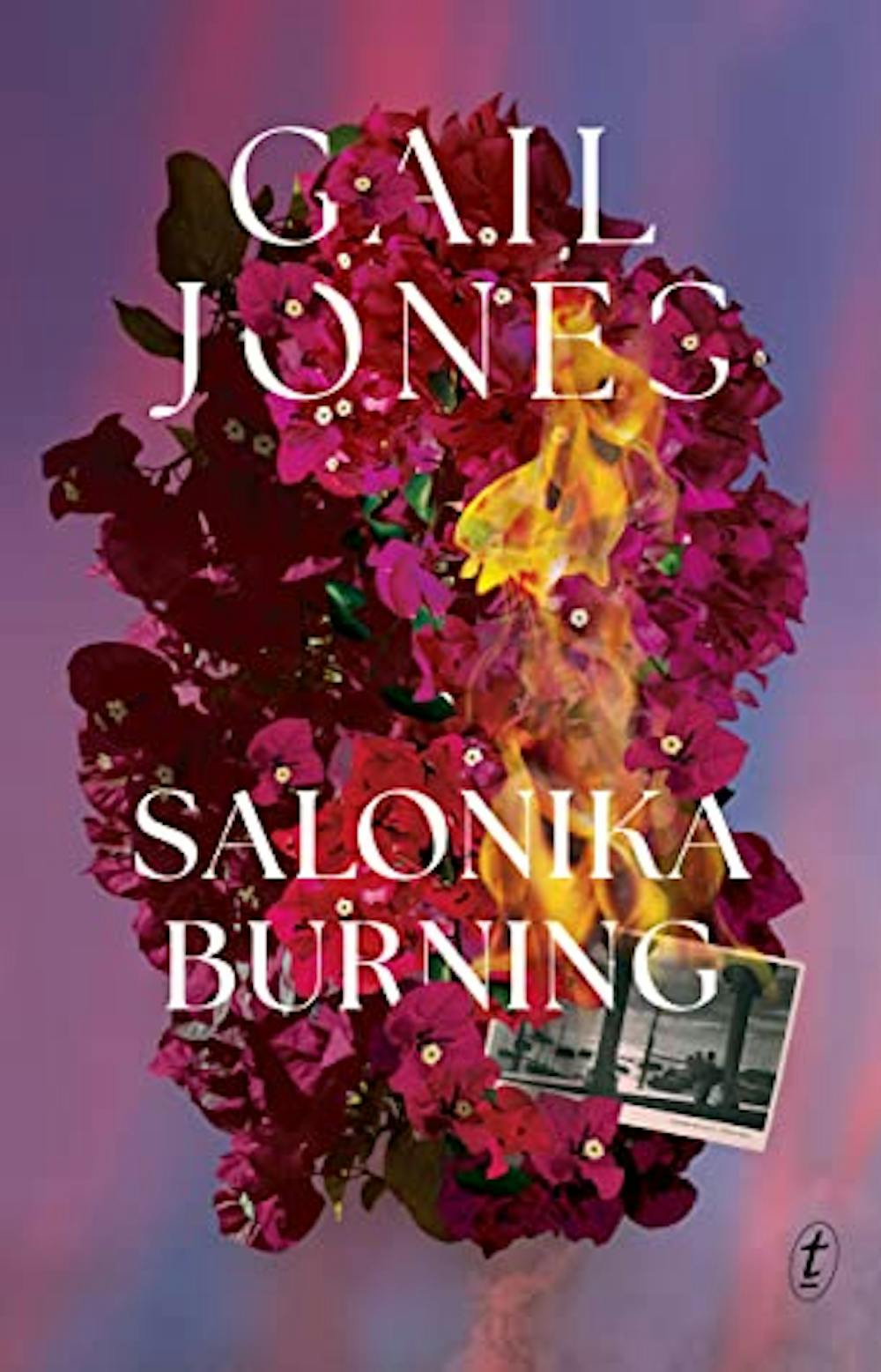
Review: Salonika Burning - Gail Jones (Text)
As such, Salonika Burning continues Jones’ narrative searching for what rises up from engulfing loss and also the troubling, necessary role of art as imaginative witness.
Sixty Lights (2004), an earlier novel by Jones, similarly begins with a scene that distresses the book’s protagonist Lucy Strange both for its detail – a man is horribly killed – and her apprehension of it. As she recalls the man’s bloodied body, Lucy also involuntarily remembers her response to the death: “She simply could not help herself: she thought of a photograph”. The story that follows reflects on the potential of art to access what might be nominated a truth of loss, while also alert to the deceptions, distortions and possibilities of the visual.
Whereas Sixty Lights is set in the colonial mid-19th century, Salonika Burning occurs in Macedonia, the first world war’s eastern front. And like another of Jones’ novels, Five Bells (2011), it tells the stories of four main characters. Olive, Grace, Stella and Stanley are very loosely based on two Australians and two British who worked as volunteers near Salonika during the war. The historical record suggests they never met; in Jones’ novel their lives slowly come to intersect.
Olive, Grace and Stella work in various capacities for the suffragette Scottish Women’s field hospital. Grace, a surgeon, attends to dying men, amputating, bandaging, repressing. Stella is an unrecognised writer and most often finds herself holding a steaming tea kettle rather than dispatching patriotic war stories to newspapers, until she succumbs to the delirium of malaria.

Read more: World politics explainer: The Great War (WWI)
Olive, from wealthy Sydney, owns and drives an ambulance in which she carries supplies and the injured. Stanley is in medical service with the Royal Berkshire Infantry. A man of religious conviction who attends lovingly to his brigade’s mules, he is also an artist, and lends to the novel his aesthetic commitment.
On walking through the ruins of Salonika early in the narrative, he unexpectedly sees a pile of mirrors, soaked from attempts to extinguish the fire, and glimpses “shifting angles and surfaces”.
Echoing the opening scene, but with a change in scale, Stanley’s private epiphany amid destruction gives him pause: “Angle, not daub”, he thinks. This seemingly incidental rumination on artistic composition is the novel’s ethical and narrative guide. And its importance is underscored by a meaningful point of difference offered early in the novel.
Almost in passing in the book’s opening pages, the war artist, “William T. Wood, of Putney, renowned for his paintings of English flowers”, is mentioned as another witness to the aftermath of the Salonika fire. He observed the ruination from the vantage of an air balloon, and daubed his impressions in “signature pastels”. Jones’ novel insists on undoing Wood’s “pretty lies of art” and their premise, or promise, of disconnected observation.
It does this by taking seriously Stanley’s insights into “angles” and the unexpected, incomplete knowledge they might offer in the face of a world at war; accident (a stray ember is thought to have destroyed Salonika); the confusion of death; and carried grief.
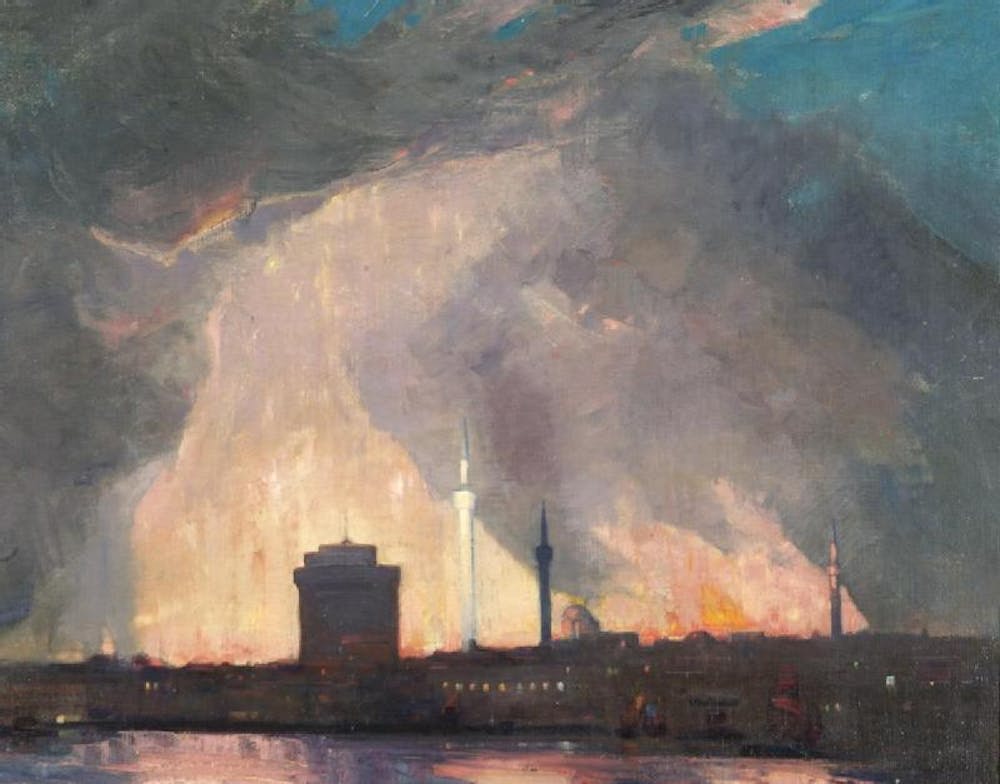 Salonica – the Great Fire, the famous White Tower in the foreground, by William Thomas Wood.
Wikimedia Commons
Salonica – the Great Fire, the famous White Tower in the foreground, by William Thomas Wood.
Wikimedia Commons
The book addresses in small sections each character in turn. And the overall effect of these shifting approaches and reflections is a layering and looping of experience that creates connection but does not impart Wood’s imputed omniscience.
Pastels, too, are to be found wanting in the face of malarial mosquitoes; decomposing rabbit carcasses sent from well-meaning Melburnians as part of the war effort; and bodies blown open, their soft, wet interiors exposed.
Instead, it is patterning, both structurally and in terms of recurring motifs – the mirror, a boy selling icons, snatches of song – that gives the narrative its shape.
Indeed, for a story ostensibly centred on war and the fiery razing of a cosmopolitan city, plot and action are remarkably absent. It’s not that nothing happens in the novel – terrible circumstances are diffused through every part – but the overriding sense is of suspension.
At a few points in the novel, Grace, whose quiet recitations of German grammar serve as a comforting incantation, ruminates on the etymology of the word “lull”, wondering if it might be connected to lullaby but also recognising the meanings it accrues in wartime.
She writes in a letter to her brother, stationed elsewhere, “how this was considered a time of lull in the fighting”. And the novel responds to this notion to honour what is missed by Wood’s detached daubs, which are said to render invisible “human or animal figures”.
The narrative is careful and patient, unfolding and lacing the stories that call forth individual memories, which a view from a balloon (or the Zeppelins that appear in the skies of Macedonia and London) cannot hope to capture.
Women wait for the near-dead to be brought to their hospital tents for futile medical treatment and pastoral care. And in its deliberateness – the sequencing of words is such that sentences are slowed to realise this lull formally as well as affectively – the narrative is resolutely attentive to an arrested present time.
The characters do refer to other times, a time when “the war was over”. And yet, there is a pervading idea in the novel that war perforates historical time, much as Welshman David Jones writes of his war experience in the modernist prose-poem, In Parenthesis (1937), which Jones references in her acknowledgements. Jones writes part-cryptically in his volume’s preface:
This writing is called ‘In Parenthesis’ because I have written in a kind of space between – I don’t know between quite what – but as you turn aside to do something and because for us amateur soldiers … the war itself was a parenthesis – how glad we thought we were to step outside its brackets at the end of ’18 – and also because our curious type of existence here is altogether in parenthesis.
Salonika Burning has its characters in “a kind of space (and time) between”. Stella, in her illness, thinks that the “day had moved on without her”; Stanley wonders “[h]ow much time had passed?” and reflects on the questioning of eternity by the metaphysical poet-priest, John Donne:
What if this present were the world’s last night?
It is only when a shocking event occurs that time shifts; Stella imagines “a kind of ruffle in time … all that occurred was compressed and incredibly fast”, so dissimilar to the rest of the novel.
 And for all Grace’s close attention to the materiality of the body – men’s groins are a “bloody mush” – this lull is amplified and exemplified by the evanescent smoke that drifts throughout the book.
Salonika smoulders; the smoke from the cigarettes the women inhale to mark their fleeting rest-time wafts; the wounded soldiers’ deaths are attested to by fuming curlicues that cigarettes emit from stilled lips.
As with the extraordinary novel it permeates, smoke gestures towards our curiously parenthetical existence, of which the time of war is an especial, appalling reminder.
Authors: Tanya Dalziell, Professor, English and Literary Studies, The University of Western Australia
And for all Grace’s close attention to the materiality of the body – men’s groins are a “bloody mush” – this lull is amplified and exemplified by the evanescent smoke that drifts throughout the book.
Salonika smoulders; the smoke from the cigarettes the women inhale to mark their fleeting rest-time wafts; the wounded soldiers’ deaths are attested to by fuming curlicues that cigarettes emit from stilled lips.
As with the extraordinary novel it permeates, smoke gestures towards our curiously parenthetical existence, of which the time of war is an especial, appalling reminder.
Authors: Tanya Dalziell, Professor, English and Literary Studies, The University of Western Australia 
















