

50 years after Gough Whitlam established diplomatic relations with China, what has changed?
- Written by Tony Walker, Vice-Chancellor's Fellow, La Trobe University
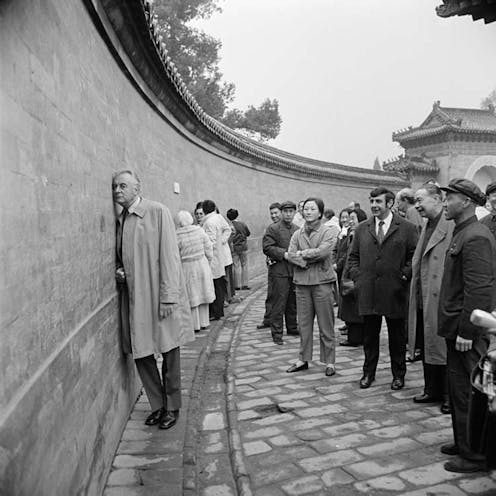
In the annals of Australian foreign policy, it is arguable that no moment in history has been as significant as December 21 1972. With the possible exception of the ANZUS Treaty of 1951, no other document matches the formal agreement establishing full diplomatic relations between Australia and China 50 years ago this week.
In the maelstrom of events in the meantime, it is easy to forget where we were in 1972, and where we are now in relation to the emerging dominant power in our region.
History is important to better comprehend the present.
Whitlam opens the door
In July 1971, Australia’s then opposition leader, Gough Whitlam, effectively rolled the dice politically by going to China. The trip was ostensibly to discuss trade. In reality the purpose was to lay the ground for full diplomatic recognition should he become prime minister after the 1972 election.
Read more: 50 years ago today, Gough Whitlam was elected. There are some lessons for Albanese in what came next
Whitlam took a calculated political risk in an environment in which a perceived China “threat” remained a useful wedge in the conservative political arsenal.
The Whitlam visit could hardly have been more propitious. No sooner had he left China and discussions with Premier Zhou Enlai than it was revealed that Henry Kissinger, then national security adviser to US President Richard Nixon, had paid a secret visit to China to negotiate the terms for Nixon’s mission to Beijing and Shanghai the following year.
Before the Kissinger visit became public knowledge, then Prime Minister William McMahon claimed Whitlam had been played “as a fisherman plays a trout” by Zhou. As it turned out, McMahon had hooked himself. Whitlam was well on the way to becoming Australia’s 21st prime minister, if he was not destined for that outcome anyway.
Then, as now, China played an outsize role in Australian domestic politics.
Establishing diplomatic relations
This brings us to a document of great significance in the country’s diplomatic history.
On December 21 1972, envoys to Paris of Australia and China initialled the Joint Communique of the Australian Government and the Government of the People’s Republic of China Concerning the Establishment of Diplomatic Relations between Australia and China.
The document’s title was portentous, its implications momentous.
After 23 years, from the moment Mao Zedong had, on October 1 1949, proclaimed the People’s Republic from the Gate of Heavenly Peace overlooking Tiananmen Square, Canberra ended the fiction the Kuomintang regime on Taiwan represented all of China.
The Labor government was elected on December 2. Whitlam and his deputy, Lance Barnard, governed as a duumvirate at first until a full ministry was sworn in. Formalising relations with China was high on the Whitlam-Barnard agenda.
What is striking, and sometimes overlooked, in the December 21 document is the extent to which the formula for dealing with the vexed Taiwan issue differed little from other such agreements with China entered into by comparable countries.
Canada had established full diplomatic relations on similar terms under the Pierre Trudeau Liberal government in 1970. The United Kingdom, Germany and Japan all did so in 1972. France and China had exchanged ambassadors in 1964.
In other words, Australia was aligned with its Western friends.
The key words in the December 21 communique as they relate to Taiwan are these:
The Australian Government recognises the Government of the People’s Republic of China as the sole legal Government of China, acknowledges the position of the Chinese Government that Taiwan is a province of the People’s Republic of China […].
In President Jimmy Carter’s announcement of diplomatic relations with China on December 15 1978, Washington settled on a simpler formula that amounted to the same thing in one important respect. Both the Australian and American communiques “acknowledge” China’s claim in relation to Taiwan.
The Government of the United States acknowledges the Chinese position that there is but one China and Taiwan is part of China.
In Documents on Australian Foreign Policy: Australia and Recognition of the People’s Republic of China, 1949-1972, Australia had argued hard for the neutral word “acknowledges”, as opposed to Beijing’s demand that the definite “recognises” be used.
In the end Australia prevailed, after giving ground on its preferred option of “takes note” of China’s position on Taiwan.
In Chinese translation, “acknowledges” is less neutral than it is in English and is closer in meaning to “recognises”. Such are the vagaries of diplomatic-speak.
An interesting sidelight to the Whitlam visit to China in 1971 is that in 1954, as the new member for Werriwa, he had called for recognition of China in his first speech.
As Stephen Fitzgerald, who accompanied Whitlam on his initial foray to China and later became Australia’s first ambassador the China, put it in The Australian Financial Review:
He believed we must accept that China is a permanent and significant part of the international landscape, whatever its government or what we think of it […]
All these years later, that seems like a reasonable proposition.
An evolving relationship
Viewed from the vantage point of the 50th anniversary of the establishment of diplomatic relations, what is most striking is how far and fast the relationship has evolved since 1972.
This is to the point where history has found it difficult to keep up. No-one – not Whitlam, nor Mao, nor Zhou, and certainly not the rest of the world – could have foreseen what would happen in the meantime.
In 1972, China’s GDP stood at US$113.69 billion. Per capita, GDP was US$132. A vast segment of mainly rural-dwelling Chinese lived in poverty. China’s economy then was less the size of Italy’s, and a fraction that of the US.
Australian trade with China, mostly wheat, totalled about US$100 million. In other words, it was negligible.
A half century later, China’s economy is the world’s second largest. GDP in 2021 was US$17.7 trillion compared with the United States’ US$23 trillion. What is most remarkable, however, is the stratospheric growth in per capita GDP – from US$132 in 1972 to US$12,556 in 2021.
At the same time, Australian trade with China, including services, had leapt to A$188.9 billion in 2021 with imports of A$93.3 billion. Chinese students in Australia last year totalled 170,741, up 30% on the pandemic-affected year before.
Read more: Grattan on Friday: A lot may be changing in China-Australia relations, but a lot is staying the same
Occasions such as the 50th anniversary of diplomatic relations provide an opportunity to take stock of what has been achieved and to reflect on what lies ahead.
This includes the epic challenge of managing relations with a rising power that is squeezing Australia’s cornerstone security ally in our immediate region.
Based on an extraordinary last five decades economically, it would be foolish to bet against China’s continued rise and rise. If nothing else, that has been the China lesson of a remarkable past 50 years.
Authors: Tony Walker, Vice-Chancellor's Fellow, La Trobe University

















