

Global coal use in 2022 is reaching an all-time high, but Australia is bucking the trend
- Written by Andrew Blakers, Professor of Engineering, Australian National University
In a year marked by record-smashing floods, fires, heatwaves and droughts, the urgent need to act on climate change has never been more apparent. And yet, the International Energy Agency (IEA) has found coal burning for electricity generation will reach record levels this year.
Why? Largely because rising natural gas prices, due to sanctions on Russia, is driving demand for less expensive coal to fill the gap in energy supply. The report finds Russia’s invasion of Ukraine has “sharply altered the dynamics of coal trade, price levels, and supply and demand patterns in 2022”.
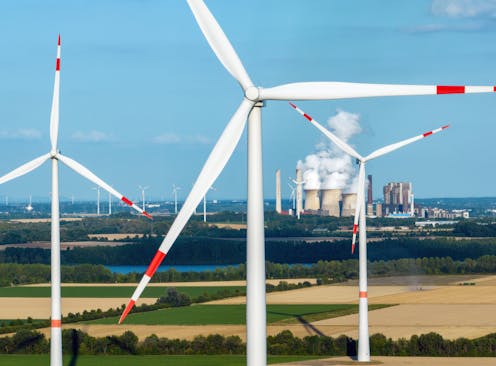
The good news, however, is the world’s coal use has peaked – and will soon rapidly decline. This is because new solar and wind power station capacity is being installed 18 times faster than new coal. In many countries such as Australia, retiring coal power stations are being replaced by solar and wind.
Coal use in Australia’s National Electricity Market (NEM) peaked in 2008. Since then, the proportion of coal in the NEM electricity mix has fallen from 86% to 59%, and this decline is accelerating.
So why is Australia ahead of the pack in weaning itself off coal? And what lessons can we offer the rest of the world?
What the report found
The IEA report, released last week, suggests global coal use will rise 1.2% this year, surpassing 8 billion tonnes for the first time and the previous record set in 2013. Indeed, China, India and Indonesia, the three largest coal producers, will all hit production records this year.
If there’s a silver lining, we’ve reached peak coal, and it’s only down from here. However, severe climate damage will result from a prolonged tail end of the coal industry.
The IEA found despite high prices for coal, there is no sign of big investment in export mining projects. And this, it says, “reflects caution among investors and mining companies about the medium- and longer-term prospects for coal”.
Read more: 22 ways to cut your energy bills (before spending on solar panels)
Renewables to dethrone ‘King Coal’
In 2021, about 250 gigawatts of new solar and wind generation capacity was installed worldwide compared with only 14 gigawatts of net new coal generation capacity.
Thus, new solar and wind capacity is being deployed 18 times faster worldwide than net new coal capacity. So it follows that solar and wind generation will rapidly overtake coal generation, as most existing coal power stations will grow old and retire before 2050.
In many countries – such as Australia, the United States and Germany – old coal power stations are being retired faster than new coal power stations are being built. In most countries, new renewable generation capacity (mostly solar and wind) is being installed much faster than net new coal capacity.
Policy changes around the world has also reduced investment in new coal power stations. For example, the Asian Development Bank no longer lends to build new coal-fired power stations.
The cost of coal per tonne has increased from around US$100 before 2021 to US$400 now. This is also supressing interest in the construction of new coal power stations.
Solar and wind generators dominate new power station construction. Solar and wind generators comprise three quarters of global net new generation capacity, and 99% of new capacity in Australia. This is because they are cheap compared with fossil, nuclear and other renewable technologies.
This market dominance of solar and wind is compelling evidence that they’re the most competitive and practical method of deploying new electricity generation capacity today. Power generation from solar photovoltaics, for instance, increased by 22% last year compared to 2020 levels.
By 2031, at current solar deployment growth rates of 20-25% per annum, we expect the global installed capacity of solar energy to pass the combined capacity of nuclear, hydroelectricity, gas and coal.
Australia is the global pathfinder
Australia is a global solar and wind pathfinder. As solar and wind power rapidly ousts coal, we’re demonstrating how decarbonising the electricity sector is relatively straightforward.
In Australia, solar and wind production in the National Electricity Market rose from nearly zero in 2008, to 9% in 2017, and to 26% in 2022.
The federal government wants renewables to comprise 82% of electricity in the National Electricity Market by 2030. Hydro currently accounts for about 7% of the market, leaving 75% for solar and wind. The rest – 18% – would come from coal and fossil gas combined.
On a per capita basis, Australian solar generation per capita is about double that of its nearest rivals – Germany, Japan and the Netherlands.
Along with most of the global population, Australia is located in the Earth’s so-called “sunbelt” (less than 40 degrees of latitude). In this region, sunshine is abundant. For northern countries outside of the sunbelt, wind energy (including offshore wind) is abundant.
To supply energy all year round, electricity from solar and wind generation needs to be stored for later use. This problem has been solved thanks to the development of pumped hydro and storage batteries.
Where Australia must do better is to stop allowing new fossil gas mining projects for export, which are greenhouse intensive both when the gas is burnt and also because of leakage of methane – a potent greenhouse gas. Gas supplies only 7% of generation in Australia’s National Electricity Market.
A solar and wind energy future
Most countries have vastly more solar and/or wind than needed to meet their energy needs without relying on imports - even densely populated countries such as Japan, Indonesia and Nepal. Sourcing most energy supplies from their own solar and wind boosts nations’ resilience in the event of war, pandemics, natural disasters and trade disruption.
The compelling economic advantage of solar and wind is now clear. But in many countries, there are impediments to their rapid deployment.
This includes fossil fuel subsidies, and a lack of an open electricity market that allows the low cost solar and wind to be discovered by the energy market.
Solar and wind are by far the most prospective options to achieve deep and rapid decarbonisation. Australia is leading the way, and the rest of the world must soon follow.
Read more: Batteries of gravity and water: we found 1,500 new pumped hydro sites next to existing reservoirs
Authors: Andrew Blakers, Professor of Engineering, Australian National University

















