

What happens to your body on a long-haul flight?
- Written by Tony Schiemer, Commercial Pilot | Aerospace Medicine Specialist | Clinical Lecturer, University of Adelaide
If crowded airports are a sign, Australians are keen to get back into the skies. And if you’re flying long haul, in a few years you could have an even longer option.
Qantas has announced from late 2025, it will fly passengers on non-stop flights from Australia’s east coast to London that would see you in the air for more than 19 hours in one stretch. That’s compared with current flights that take the best part of 24 hours but are broken up into shorter legs.
So what will happen to your body during one of these longer flights? Is it any different to what happens when you fly long-haul now?
Read more: In for the long-haul: the challenge to fly non-stop from Australia to anywhere in the world
1. You can become dehydrated
Dehydration is common on long-haul flights. It can explain why your throat, nose and skin can feel dry on an aeroplane. The longer the flight, the greater the risk of dehydration.
That’s because of low levels of humidity in the cabin compared with what you’d expect on the ground. This is mostly because a lot of the air circulating through the cabin is drawn from the outside, and there’s not a lot of moisture in the air at high altitudes.
You also risk dehydration by not drinking enough water, or drinking too much alcohol (alcohol is a diuretic, resulting in an increase in fluid lost).
So drink water before you jump on the plane. During the flight, you’ll also need to drink more water than you usually would.

Read more: Health Check: how do I tell if I'm dehydrated?
2. The cabin can play havoc with your ears, sinuses, gut and sleep
As the cabin pressure changes, the gas in our bodies reacts accordingly. It expands as the aircraft climbs and pressure decreases, and the opposite occurs as we descend. This can lead to common problems such as:
earaches – when the air pressure either side of your eardrum is different, placing pressure on the eardrum
headaches – can be caused by expanding air trapped in your sinuses
gut problems – just accept that you’re going to fart more.
You can also feel more sleepy than usual. That’s due to the body not being able to absorb as much oxygen from the cabin air at altitude than it would on the ground. Slowing down is the body’s way of protecting itself, and this can make you feel sleepy.
The good news is that most of these problems won’t necessarily be more pronounced on longer flights. They’re mainly an issue as the plane climbs and descends.
Read more: Health Check: what happens when you hold in a fart?
3. You could develop blood clots
Blood clots, associated with being immobile for long periods, are usually a big concern for passengers. These include clots that form in the leg (deep vein thrombosis or DVT) that can travel to the lung (where it’s known as a pulmonary embolism).
If you don’t move around on the plane, and the more of the following risk factors you have, the greater the chance of blood clots developing:
older age
obesity
previous history or a family history of clots
certain types of clotting disorders
cancer
recent immobilisation or surgery
pregnancy or recently given birth
hormone replacement therapy or oral contraceptive pill.
According to a review in 2022, combining data from 18 studies, the longer you travel, the greater the risk of blood clots. The authors calculated there was a 26% higher risk for every two hours of air travel, starting after four hours.
So what about the risk of clots on these longer flights? We won’t know for sure until we start studying passengers on them.
Until that evidence comes in, the current advice still applies. Keep moving, stay hydrated and limit alcohol consumption.
Read more: Explainer: what is deep vein thrombosis?
There’s also evidence for wearing compression stockings to prevent blood clots. These stockings are said to promote blood flow in the legs and to help blood return to the heart. This would normally happen by muscle contractions from moving or walking.
A 2021 Cochrane review combined the results of nine trials with 2,637 participants who were randomised to wear compression stockings (or not) on flights lasting more than five hours.
No participants developed symptomatic DVTs. But there was evidence people who wore the stockings considerably reduced their chance of developing clots without symptoms, and we know that any clot can potentially grow, move and subsequently, cause symptoms.
 Compression stockings reduce your risk of developing a DVT, according to a review of the evidence.
Shutterstock
Compression stockings reduce your risk of developing a DVT, according to a review of the evidence.
Shutterstock
So if you are concerned about your risk of developing blood clots, see your GP before you fly.
Usually if you do develop a blood clot, you won’t know about it until after the flight, as the clot takes time to form and travel. So keep an eye out for symptoms after the flight – pain and swelling in a leg (often just the one), chest pain, coughing and shortness of breath. And seek emergency health care if you do.
Read more: Blood clots: five reasons they may happen
4. Then there’s jet lag, radiation, COVID
Then there’s jet lag, which is a stranger to few of us. This is a disconnect between the time your body thinks it is and the time by the clock, as you cross time zones.
Longer flights mean you are more likely (but not always) to cross more time zones. Jet lag will usually become more problematic when you cross three or more, especially if you’re travelling east.
Read more: Travelling these holidays? Follow tips the Socceroos use to conquer jet lag
And if you take long-haul flights very often, it’s reasonable to assume that the longer you’re in the air, the greater the exposure to cosmic radiation. As the name suggests, this is radiation that comes from space, which may increase the risk of cancer and reproductive issues. We don’t know what level of exposure is safe.
However, unless you fly frequently it’s unlikely to be a problem. If you’re pregnant or have other concerns, have a chat to your GP before you fly.
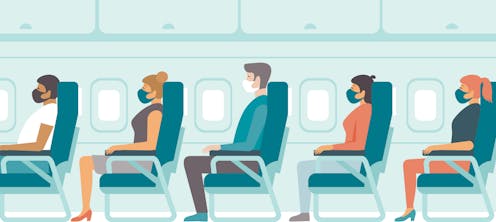
And don’t forget COVID. Take the usual precautions – wash your hands regularly, wear a mask and don’t fly if you’re unwell.
Read more: Want to cut your chance of catching COVID on a plane? Wear a mask and avoid business class
In a nutshell
Research into how the body reacts to these longer, non-stop flights between Australia and Europe is in its early stages. Teams in Australia are looking at this now.
Until then, if you’re taking a regular long-haul flight, the advice is relatively simple.
Follow the advice the airlines give you, and see your GP before you travel if necessary. During flight, make that extra effort to move about the cabin, drink water, wear a mask and practise good hand hygiene.
And see a doctor immediately for any worrying symptoms after your flight, as blood clots can take hours or even days to form, grow and move along your veins.
Read more: Which medicines don’t go well with flying?
Authors: Tony Schiemer, Commercial Pilot | Aerospace Medicine Specialist | Clinical Lecturer, University of Adelaide
Read more https://theconversation.com/what-happens-to-your-body-on-a-long-haul-flight-183034

















