

Why a shift to basing vehicle registration fees on emissions matters for Australia
- Written by Hussein Dia, Professor of Future Urban Mobility, Swinburne University of Technology
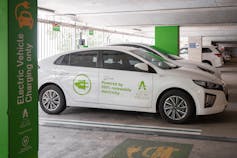
The ACT is changing how it calculates car registration fees. Instead of being based on a car’s weight, the fee the owner pays will be based on the greenhouse gas emissions it produces.
Up to now, owners of cleaner but typically heavier electric vehicles have paid more for registration than those of high-polluting but lighter vehicles powered by petrol or diesel engines. Emissions-based fees will reverse that situation.
The ACT was already offering two years of free registration for electric vehicles up to mid-2024. Under the new policy, from May 25 this year, owners of new and used electric vehicles will pay a discounted fee once their two years of free registration is over. The remaining car fleet will transition to the new system on July 1 2024.
An emissions-based registration fee is a sensible policy worth adopting Australia-wide. It’s already in place in many other nations that have much higher uptakes of electric vehicles.
Read more: Australia is failing on electric vehicles. California shows it's possible to pick up the pace

Why is this policy change important?
Transport is Australia’s third-largest – and fastest-growing – source of greenhouse gas emissions. Cars produce about half of these transport emissions.
Most of Australia’s vehicles use polluting fossil fuels. A switch to electric vehicles, coupled with a transition to renewable energy, is vital for Australia to meet its commitments to tackle climate change.
One of the quickest ways to reduce transport emissions is to accelerate the current slow uptake of electric vehicles. In 2022, Australian sales totalled 39,353. There are now about 83,000 light electric vehicles on our roads.
Read more: Let buyers jump the queue for electric cars by importing them directly
Although sales almost doubled between 2021 and 2022, they represented only 3.8% of all new vehicle sales in 2022. That’s well below the global average of 12-14%. And it’s way behind world leader Norway where 87% of cars being sold now are electric.
In China, about 5.67 million electric cars, or a quarter of all new cars, were bought in 2022. By the end of the year, 35% of the cars being sold were battery-powered or plug-in hybrids. In the UK, more than 265,000 electrical vehicles were registered in 2022, a 40% increase on 2021.
The global outlook for electric vehicles remain strong. Total sales of 8.6 million vehicles are expected in 2023. That’s expected to rise to almost 12 million by 2025.
Australia will pass the milestone of 100,000 electric vehicles on the road this year. But that’s well short of the target of 1 million by 2027 set by an industry alliance headed by the Electric Vehicle Council, and the Albanese government’s target of 3.8 million by 2030. Best practice policies will help to accelerate the transition.
The importance of the new policy is that it will help to reduce costs for buyers. Cost is one of the main barriers to buying an electric vehicle in Australia. In 2022, less than 20% of electric vehicles sold for less than A$65,000. While some Australians are willing to pay the hefty price tag, it remains an obstacle for others.
Government interventions play a big role in reducing purchase costs and annual fees. Higher taxes on polluting vehicles are also likely to impact consumer choice so more drivers make the switch.
Read more: New electric cars for under $45,000? They're finally coming to Australia – but the battle isn't over
What is best practice in emissions-based vehicle policies?
Policies that reduce registration fees and provide tax benefits to electric vehicle owners have been widely implemented overseas during the past few decades.
Norway first introduced registration fee exemptions in 1990. This, along with a range of other measures and incentives, helped to increase electric vehicle sales to 50% of the market in 2020, and 79% by 2022. No other nation comes close.
In the European Union, 21 of 27 member countries levied car taxes partially or totally based on CO₂ emissions in 2022.
The EU-wide policies provide a range of financial benefits to owners of electric vehicles. They apply to both vehicle acquisition (value-added tax, sales tax, registration tax) and vehicle ownership (annual circulation tax, road tax).
How much difference can these policies make?
A number of studies of the effectiveness of CO₂-based car taxation policies have found evidence they contribute to lowering transport emissions.
For example, Ireland first introduced an emissions-based car taxation policy in 2008. An analysis of its impacts found it produced a cumulative CO₂ saving of 1.6 million tonnes from 2008 to 2018.
In 2018, Irish-licensed vehicles travelled a total of 47.5 billion kilometres. The study found average carbon intensity of the car fleet had reduced from 189gCO₂/km in 2007 to 164gCO₂/km in 2018. It would have been 168gCO₂/km without the tax intervention, according to the analysis.
A similar study that evaluated Norway’s CO₂-based taxes found them to be powerful policies applied aggressively at levels ten times the EU Emissions Trading System quota prices. The analysis found these policies also delivered other improvements, with the largest impacts being reductions in air pollution.
What else needs to be done in Australia?
A measure such as introducing an emissions-based registration system is a step in the right direction. But to be effective it needs to be part of a holistic national effort to accelerate adoption of electric vehicles.
In 2023, Australia needs to speed up efforts on two major initiatives that were introduced in 2022.
The federal government began consultations on Australia’s first National Electric Vehicle Strategy last September. More than 500 submissions were received, representing the views of over 2,150 Australian individuals and organisations.
Commitments were also made to develop an ambitious set of mandatory fuel-efficiency standards to help increase the supply of electric vehicle models.
Read more: The road to new fuel efficiency rules is filled with potholes. Here's how Australia can avoid them
Both initiatives are key policy pillars of an effective strategy to reduce transport emissions.
Building on this momentum and urgently implementing bold policies will demonstrate Australia’s commitment to embrace the transition to electric vehicles and accelerate emission reductions.
Authors: Hussein Dia, Professor of Future Urban Mobility, Swinburne University of Technology

















