

Massive outages caused by Cyclone Gabrielle strengthen the case for burying power lines
- Written by Timothy Welch, Senior Lecturer in Urban Planning, University of Auckland
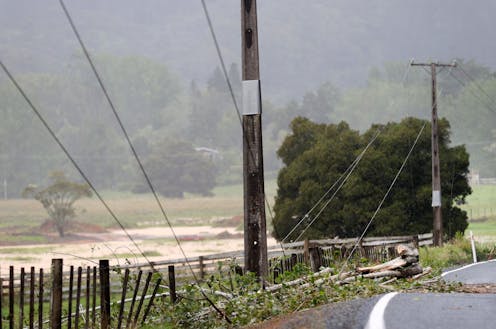
Another extreme weather event has highlighted the weak points in New Zealand’s critical infrastructure. As Cyclone Gabrielle ripped across the North Island, nearly 225,000 people lost power.
The cause is relatively obvious: many houses and buildings are connected to the power grid by overground power lines. Overhead wires, a common sight around many suburbs, are highly vulnerable to extreme weather events. When the winds pick up, limbs and trees fall, and power lines are dragged down.
But one solution is equally obvious: bury the power lines. With the threat of more frequent storms of increasing intensity, the risk to households, businesses and personal safety demands this option be seriously considered.
Power outages mean more than just the inconvenience of a dark house or a dead mobile phone battery. Many things we rely on, like fibre internet, home WiFi or even our ability to make emergency calls, depend on an electrical connection.
Loss of power puts refrigerators and freezers full of valuable food at risk. And many people rely on electricity for lifesaving medical devices in their homes. Battery backup only offers a short-term solution. When the power goes out, lives and livelihoods are put in danger.
Costs and benefits
Perhaps the main argument against burying power lines is the cost. And it’s true, putting thousands of kilometres of cable underground isn’t cheap. The fact is, reliable infrastructure is expensive.
However, while overhead power lines are cheaper to install in the short term, they carry a higher maintenance cost and are less reliable – especially in storms. If the cost to households and businesses from a loss of power is also considered, the economics of burying power lines become much more palatable.
Read more: Cyclone Gabrielle: how microgrids could help keep the power on during extreme weather events
Another argument against burying power lines is that in areas prone to earthquakes, underground lines are more vulnerable or more difficult to repair. This was certainly the case in the Canterbury earthquakes a decade ago.
However, studies have shown that better routing and reinforcement of underground lines can mitigate that risk. Major earthquakes are also far less common than weather events that damage overhead wires.
Earthquake-prone Japan recently announced a plan to bury 4,000km of powerlines by 2025. In shaky California, one utility company plans to spend US$10 billion burying power lines to prevent fires.
Denmark, Switzerland, Germany and the Netherlands have all buried most of their power lines. Unsurprisingly, they also have the lowest “system average interruption duration index” (SAIDI) values – a measure of the average duration of power outages per customer.
All four countries have a SAIDI value of less than 25, meaning the average customer experienced a power outage of fewer than 25 minutes. By comparison, Auckland’s electric distribution business Vector has a SAIDI of 161.9; Christchurch’s Orion scored 57.4; while the country overall averaged over 204 minutes per customer for an outage.
Spend now, save later
There are other good safety reasons for burying power lines, too. Even without trees nearby, power lines can arc in high winds, causing showers of sparks to rain down and potentially ignite fires. This happened in 2020 with the Lake Ōhau Alpine Village fire that burned 5,000 hectares and 65 structures and caused NZ$35 million in insurance losses.
Broken power lines carry massive voltages, which can maim or kill people. Falling power poles crush people and cars. Single-vehicle crashes into power poles also frequently result in critical and fatal injuries, and large power outages.
Utility poles can obstruct or narrow footpaths, making paths less accessible, particularly for people in wheelchairs. Overhead wires are often cited as an eyesore, and trimming trees around power lines is both ugly and damaging to the trees.
Read more: Slippery slopes: why the Auckland storm caused so many landslides – and what can be done about it
Right now, however, the most pressing reason for burying power lines is visible all around. At this point, it’s not clear how extensively cyclone Gabrielle damaged the power lines, but it will likely take days or weeks, not hours, to restore power to everyone.
In the coming weeks, workers will fan out across the North Island into precarious locations, lifted high above the ground in cherry pickers to mend lines and restore power. The work puts their own health and safety at risk, and we could eliminate this danger too with underground power lines.
Clearly it isn’t a good option for everywhere. High-powered transmission lines that bridge large spans in undeveloped areas are likely not viable economic candidates for under-grounding. But the long-term benefits of burying lines in cities and towns far outweigh the upfront costs. It should be given serious consideration before the next “storm of the century” hits.
Authors: Timothy Welch, Senior Lecturer in Urban Planning, University of Auckland

















