

Ride-share companies are losing billions, so why their interest in unprofitable public transport?
- Written by Neil G Sipe, Honorary Professor of Planning, The University of Queensland
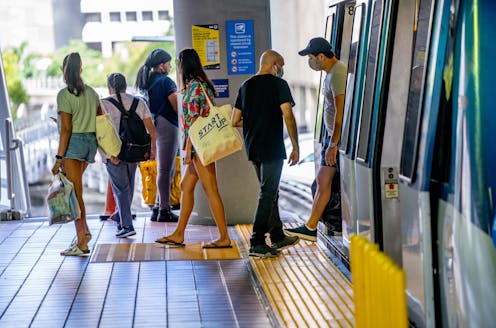
Why do Uber, Lyft, Didi, OLA and other ride-sharing companies want to partner with public transport agencies? For Uber and Lyft, the reason is simple: their business plans were based on eventually using driverless vehicles to eliminate their main cost, the labour cost of the driver. But human drivers won’t be replaced for some time.
While many of these companies have raised lots of cash from venture capitalists, they are burning though it at an alarming rate. Uber made a loss of US$8.8 billion in 2022. Lyft, Uber’s main competitor in the United States, lost US$1.28 billion.
These companies, collectively known as transportation network companies (TNCs), have two options to become profitable. They need to increase how much they charge for their services, or find other revenue streams. So most have ventured into e-bikes and e-scooters, food and freight delivery and public transport.
Uber aims to become the “Amazon of transportation” by creating a one-stop platform for all transport services — known as mobility as a service (MaaS). Its move into public transport is a natural progression.
Uber added trains, buses, planes and car rentals to its UK app last April. While it’s not providing these services, the aim is to partner with other transport providers so customers can use the Uber app to buy tickets. If this service succeeds, Uber intends to expand it to other countries.
Read more: Victorians won't miss myki, but what will 'best practice' transport ticketing look like?
There are more than 4 trillion passenger miles taken on public transport annually. Given this volume, surprisingly few public transport agencies make money. One of the few is in Hong Kong, due to the operator developing the large amount of property it owns around its stations.
Public transport is subsidised because it is essential for our cities; they couldn’t function if everyone used a car to get around.
So how do ride-sharing companies think they can make money by getting involved in public transport? Do they know something they aren’t revealing?
How widespread are these partnerships?
By 2019 Uber had about 20 such agreements and Lyft about 50. Neither company has disclosed whether the number of agreements has increased or decreased in the post-COVID environment.
Uber’s 2021 report, Towards a New Model of Public Transportation, identifies four main areas of co-operation with public transport agencies.
The most common is the integration of public transport information into the TNC app. Uber has done this on a limited scale, including Sydney where its app has provided public transport information since mid-2019.
The second most common area of co-operation involves providing first mile, last mile transport – transferring a commuter between a public transport stop and their home or destination – or providing transport in areas with low public transport frequency. Dallas, in 2015, was the first city to subsidise short shared Uber rides to and from a train station. Dallas transport officials said it cost US$15 per rider on one of their buses, but only US$5 per rider with Uber.
The third area is enabling users to buy public transport tickets on their Uber app. The first of just a few operating examples was in Denver in 2019, followed by Las Vegas in January 2020. A year later a consortium of 13 small transit agencies in Ohio and northern Kentucky was added to this Uber feature.
The fourth area is as a substitute for public transport. To date there is only one example – in Innisfil, Ontario. Innisfil had no public transport, but needed a service for its growing population. The town engaged Uber to provide a bus service. Within a year it was carrying about 8,000 passengers a month.
Read more: All your transport options in one place: why mobility as a service needs a proper platform
What’s stopping more public transport deals?
Are such partnerships a good idea? While there are some advocates among public transport officials, many others remain sceptical. Their reasons include:
ride-sharing reduces public transport patronage
concerns about whether these companies want to cooperate or divert riders
enticing people from public transport to ride-share vehicles has increased traffic congestion
these companies historically have not shared their data
the agencies don’t want to become dependent upon companies whose financial viability is questionable – how can they make money and continue this cooperation when public transport agencies cannot?
Read more: Can an app change Australia's car culture? Only if all moving parts work together
So why do some public transport agencies sign up?
What is the motivation for public transport agencies co-operating with these companies? For large public transport agencies it’s about improving operations related to:
increasing public transport use by subsidising rides to and from commuter rail, bus and tram stations
late-hours services when it is expensive to run routes, or to provide services where public transport routes are not operating
increased mobility due to having multiple transport options
paratransit, a supplement to public transport that provides individualised rides without fixed schedules or routes, which is costly for public transport agencies because they lack vehicles of the right size and the ability to respond efficiently to demand.
However, most of these partnerships can be found in smaller cities. This is because small improvements – such as ride-sharing replacing a low-use bus route – can have a significant impact on their budgets.
Another trend emerging from the pandemic is that public transport agencies are rethinking how they operate and how they can improve services. While some have partnered with transportation network companies, other have decided to implement TNC-like services in house in an effort to increase ridership.
Read more: What if Opal and Myki became one? It'd help more of us than you'd think
While things were evolving rapidly before the pandemic, progress slowed due to lockdowns and more people working from home. How these companies will fare in a post-COVID environment is still unclear, including whether travellers will use them as a substitute for some public transport services, particularly on low-frequency routes and for first mile, last mile trips.
The companies have indicated the goal of these partnerships is to get people out of their cars. If they can make it easier for people to use public transport, then it is good for these companies because people might buy fewer cars and use more of their services in the future.
Read more: The battle to be the Amazon (or Netflix) of transport
Authors: Neil G Sipe, Honorary Professor of Planning, The University of Queensland

















