

councils' efforts to protect wildlife from roaming pets are hampered by state laws
- Written by Sarah Legge, Professor of Wildlife Ecology, Australian National University
How we manage pet cats in our suburbs is in the spotlight. As the estimated number of pet cats in Australia passes 5 million, people are increasingly aware of the damage cats do to wildlife.
One-third of owners already keep their cats securely contained 24 hours a day. This has major benefits for cat welfare and prevents cats killing and disturbing wildlife. But that leaves the other 3.5 million or so pet cats free to roam for at least part of the day or night.
In Australia, local government is responsible for regulating our feline pets, but little is known about how this works in practice. We sent a survey to every local council in Australia to understand their approaches to managing pet cats and how these could be improved. We received responses from 240 councils (45%).
Councils across Australia reported managing pet cats is a challenge. But many are adopting regulations that to help protect local wildlife and improve the wellbeing of pet cats. However, state laws, especially in Western Australia and New South Wales, are making it difficult for local councils to manage pet cats well.
Cats kill more than their owners realise
Why the big deal? Many cat owners think their moggy is blameless. “I don’t think my cat goes out that much and I never see any dead animals,” they often say. This is largely untrue.
Research shows the impact of pet cats is much bigger than people realise. Many cats don’t bring home what they kill, or bring back only a very small proportion (15% on average), so their owners aren’t aware of the majority of the wildlife toll. Radio-tracking studies have shown a large proportion of cats are out on adventures when their owners thought they were inside.
On average, each roaming, hunting pet cat in Australia kills 40 native reptiles, 38 native birds and 32 native mammals per year.
Read more: One cat, one year, 110 native animals: lock up your pet, it's a killing machine
Our suburbs are now home to around 55 cats per square kilometre. That adds up to about 6,000 native animals killed per square kilometre per year in our suburbs alone. The national wildlife death toll from pet cats is well over 300 million native animals per year.
Even when roaming cats don’t kill animals, they have negative impacts on wildlife by spreading diseases and because wildlife must spend more time hiding or escaping instead of feeding and caring for young.
Read more: Cats carry diseases that can be deadly to humans, and it's costing Australia $6 billion every year
As well as hunting wildlife, roaming pet cats can increase feral cat populations if unwanted litters are abandoned.
Seeing wildlife, like blue-tongued lizards and fairywrens, in our gardens and local parks is something we all cherish. How we manage pet cats can either jeopardise our co-existing wildlife or help to safeguard it. So we set out to examine how pet cats are being managed across the country.
What are councils doing about it?
Our survey found almost all local councils require pet cats to be microchipped. Three-quarters require them to be registered. Just over half require desexing and limit the number of cats that can be kept per household.
These approaches are very important to manage pet cats and constrain their numbers and should be extended to all local government areas. However, these measures do not prevent pet cats roaming.
Concern about the impacts of roaming cats has led almost one-third of councils to introduce cat-free areas, cat curfews and containment requirements at all or some places in their local government area. Where adequately policed, these measures appear to be working.
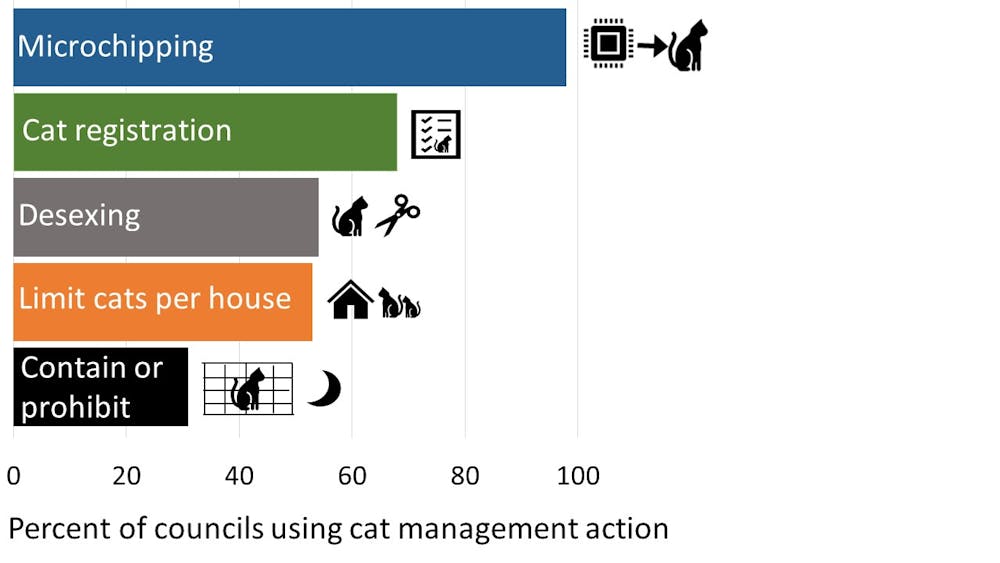 The percentages of local councils that use each of the cat management actions.
Elizabeth Lindsay/Threatened Species Recovery Hub
The percentages of local councils that use each of the cat management actions.
Elizabeth Lindsay/Threatened Species Recovery Hub
These approaches are most common in city areas of the ACT, Victoria and South Australia, and on some islands. The number of local government areas using this approach has grown markedly over the past five years, partly in response to growing awareness of the impacts of pet cats on wildlife.
For example, Adelaide Hills Council (SA) and Victoria’s Knox City Council brought in 24-hour containment last year. There are plans to do the same on Phillip Island (Victoria) later this year. Bruny Island (Tasmania) and Kangaroo Island (SA) both require cats to be contained. In NSW, Tweed Shire has designated some recently built and future suburbs, which are next to bushland with high conservation value, as cat-free.
Christmas Island has gone further. All pet cats are desexed and the community has agreed not to bring in any more, so their numbers on the island are gradually dwindling.
Read more: Why do our dogs and cats bring us dead animals?
Some state laws stand in the way of better protection
Many local councils would also like to adopt containment regulations and no-cat areas as part of strategies to protect local wildlife. However, the overarching laws on domestic animal management are set at the state level. If these laws don’t allow local government to set and then police cat containment bylaws, then the local councils can be hamstrung.
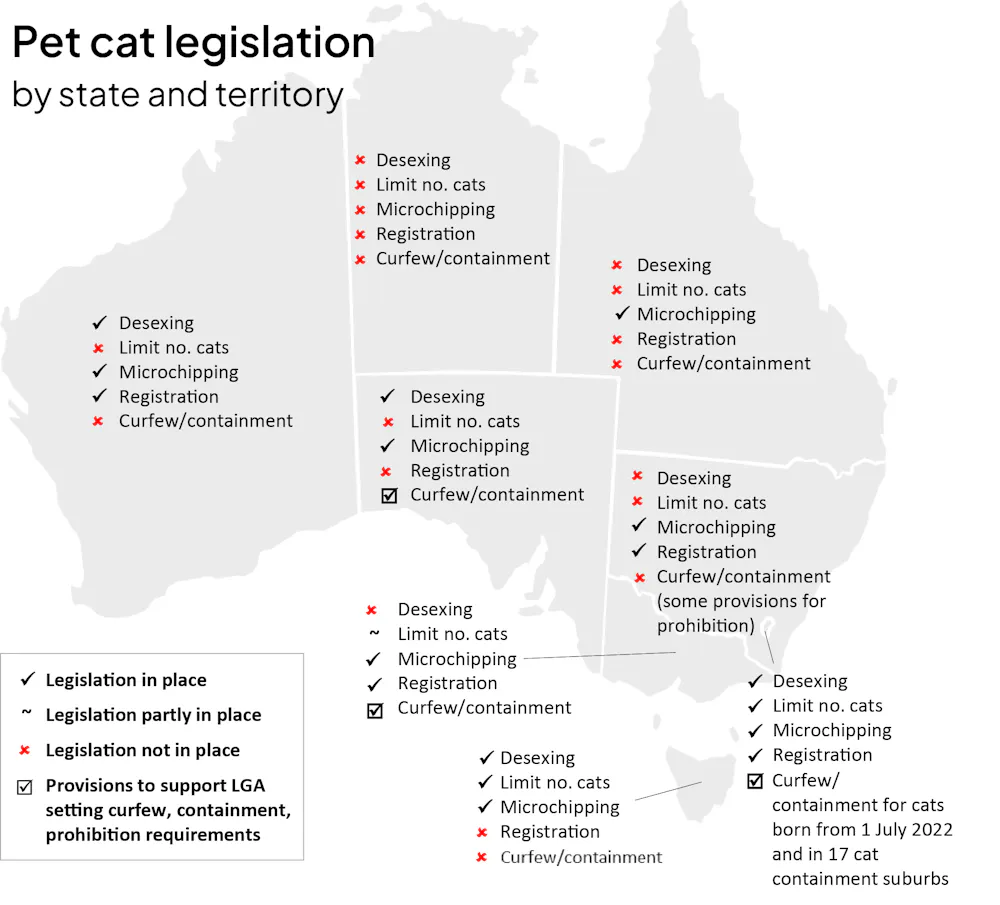 State and territory laws regarding pets are highly variable and can either help or hinder local councils’ efforts to enact and enforce cat restriction bylaws.
Elizabeth Lindsay/Threatened Species Recovery Hub
State and territory laws regarding pets are highly variable and can either help or hinder local councils’ efforts to enact and enforce cat restriction bylaws.
Elizabeth Lindsay/Threatened Species Recovery Hub
Local councils in WA and NSW complained most often about this situation. They want changes to state laws to make it easier for them to set and police local rules about cat containment or cat prohibition.
In SA, local governments noted inconsistencies in cat containment provisions between councils make implementation and enforcement challenging. A statewide approach using the SA Dog and Cat Management Act would be more effective.
To support fair and effective management of pet cats we recommend all states and territories adopt strong and nationally consistent legislation to enable responsible pet cat management.
This should be supported by enhanced community awareness programs and support for owners and their pets to make the transition to a new, contained lifestyle. Outcomes for local wildlife and for cat welfare and health should also be monitored.
Protecting wildlife and caring for our delightful pets can both be achieved if we rethink what it is to be a cat owner and support local government to manage these issues for the whole community.
Authors: Sarah Legge, Professor of Wildlife Ecology, Australian National University

















