

We need to break the cycle of crisis in Aotearoa New Zealand’s arts and culture. It starts with proper funding
- Written by James Wenley, Lecturer, Theatre Programme, Te Herenga Waka — Victoria University of Wellington
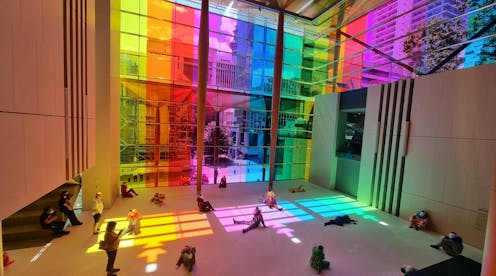
In times of crisis, arts, culture and creative experiences play an essential role. Whether through a music gig, a performing arts festival, a visual art exhibit or a well-thumbed book – these bring joy, comfort and relief in troubled times.
Taking part in creative activities and events boosts individual and collective wellbeing, brings communities together, and keeps our social bonds in tune.
But the full potential of arts, culture and creativity to create positive social change has been held back by cycles of crisis in Aotearoa New Zealand’s creative sector.
The government’s recent announcement of a NZ$22 million top-up to arts funding body Creative New Zealand Toi Aotearoa offers temporary relief to a financially strained sector, but this short-term measure exposes the absence of a wider strategy from Manatū Taonga Ministry for Culture and Heritage.
It is time for a long-term national Ngā Toi Arts and Culture strategy to provide a much-needed circuit breaker.
Compounding events
Aotearoa’s arts and cultural sector remains on an emergency footing following the past three years of pandemic disruption.
Auckland’s Silo Theatre made the audacious call to “cancel” 2023 and its usual programming, saying:
The impacts of the pandemic on our sector are serious and long lasting […] funding for the arts is shrinking, audience attendance is down the world over […] practitioners are burning out and leaving the sector for better pay and greater security. The time for transformation is now.
Arts companies going ahead with live work face the prospects of COVID and climate crisis cancellations.
The Royal New Zealand Ballet was forced to cancel the entire Auckland season of Venus Rising (a production that had already been postponed four times) during the recent summer COVID wave in December 2022.
This month’s flooding in Auckland and the devastation wrought by Cyclone Gabrielle present yet more setbacks for our arts and culture recovery. Numerous events in Auckland Pride were disrupted and the Napier Art Deco Festival was cancelled entirely.
A lack of money
Low wages are a longstanding structural issue in the creative sector. In 2019 creative professionals earned an average NZ$36,000 per year, NZ$8,000 below living wage.
The cost of living is presently biting both creatives and audiences, with inflation rising above 7%.
Creative sector workers had a 0% median base salary increase over 2021, with no salary increase forecast for artists in 2022 – effectively a pay cut.
There’s more demand than ever before for funding. Success rates for grants from Creative New Zealand have dropped from one in three to one in five. The funding body’s latest arts funding round opened and closed in 24 hours with the 250 application limit reached in record time, a highly stressful funding system which undermines practitioner wellbeing.
(Creative New Zealand has committed to “co-designing a better approach to funding” with the arts community.)
During the pandemic, rather than expanding the funding body’s existing funding capability, the Ministry for Culture and Heritage was rapidly upscaled to administer new funding schemes.
But while the ministry has been enabled to fund new blue-sky initiatives, core arts and culture activities have gone unfunded or underfunded.
With COVID recovery funding winding up this year, the absence of any long-term government strategy is alarming.
Breaking the cycle
Comparing the approaches of the current New Zealand and Australian governments is revealing.
In 2017, Jacinda Ardern’s Labour government took over after nine years of arts austerity. The former National Party Minister for Arts, Culture, and Heritage, Chris Finlayson described his role as being to “keep the luvvies at bay and stop them complaining”.
In contrast, Ardern wanted to “see a country where the arts are available to us all”. But there was a gulf between rhetoric and action.
Despite positive schemes such as Creatives in Schools, Labour continued to underinvest in Creative New Zealand.
A 2017 manifesto promise to reestablish the Pathways to Arts and Cultural Employment scheme, which enabled artists on a benefit to record arts as their chosen career and receive financial support and professional development remains incomplete.
In Australia, Anthony Albanese’s Labor government has made arts and culture a centrepiece policy of its first term, promising to “put the arts back […] at the heart of our national life” via the Revive National Cultural policy budgeted for A$286 million (NZ$315 million) over four years.
While some features play catch-up with New Zealand (such as the establishment of a poet laureate, which New Zealand has had since 1997), Revive’s five policy pillars provide a useful starting point for a conversation on what a national culture policy could look like in New Zealand: First Nations first; a place for every story; the centrality of the artist; strong institutions; reaching the audience.
A national strategy for Aotearoa could direct resources towards where they could have the most impact and harness the wellbeing benefits of ngā toi, or art and creative expression.
Ngā toi derives from te toi-o-ngā-rangi, the uppermost heaven representing “the highest form of knowledge and expertise”. Ngā toi is regarded as intrinsic to being human, fundamental for mental and spiritual healing and balance.
Arts and culture are not a nice to have: they are essential to who we are as individuals and as a community.
Government investment in arts and culture is also an investment in education, health and employment.
We need to make breaking the cycle of crisis in Aotearoa’s arts and culture ecology an election issue. Our political parties should follow Australia’s lead and commit to the development of a national Ngā Toi Arts and Culture policy to boost access and participation in arts, culture and creativity for the benefit of all New Zealanders.
Authors: James Wenley, Lecturer, Theatre Programme, Te Herenga Waka — Victoria University of Wellington

















