

For a lot of First Nations peoples, debates around the Voice to Parliament are not about a simple "yes" or "no"
- Written by Kelly Menzel, Associate Dean Education, Gnibi College, Southern Cross University
A referendum to vote on a constitutionally enshrined Indigenous Voice to Parliament will be happening later this year.
This week, Prime Minister Anthony Albanese kicked off a national week of action for the referendum. He and other public figures are holding information sessions across the country in the hope of garnering support for the Voice.
However, Invasion Day rallies this year have shown some Indigenous communities oppose the referendum, and a constitutionally enshrined Voice.
Indigenous opposition to the Voice has rarely been heard, because when we voice our opposition, we are frequently dismissed or attacked.
By comparison, the right-wing “no” campaign has been confusing and divisive. These arguments are vastly different to the concerns coming from Indigenous communities. For us, it is not as simple as a “yes or no” vote.
The Uluru Statement doesn’t represent all of us
In 2017 the Referendum Council organised the First Nations National Constitutional Convention. Over 250 Indigenous peoples gathered at Uluru to consider what constitutional recognition might look like. This is where the Uluru Statement from the Heart was born. The Statement calls for an enshrined Voice in the Constitution, and a process of agreement-making that must include Voice, Treaty, Truth.
Although the Uluru Statement is beautifully crafted, it’s only one Statement. It is impossible for it to represent the more than 250 First Nation groups in Australia.
Another limitation with the Statement is it originated from the Referendum Council. The purpose of the Council was to progress “towards a successful referendum to recognise Aboriginal and Torres Strait Islander peoples in the Constitution”. There was always a referendum in mind, and that’s not necessarily what all Indigenous communities want.
Without proper discussions, done “Right Way”, led by Indigenous communities, none of this can be addressed. There are “Yarning circles” running until February 24, where people can get answers to what the Voice to Parliament might look like. However, we don’t just need answers, we need more discussions to negotiate what this Voice could be, and whether it’s an effective avenue to take.
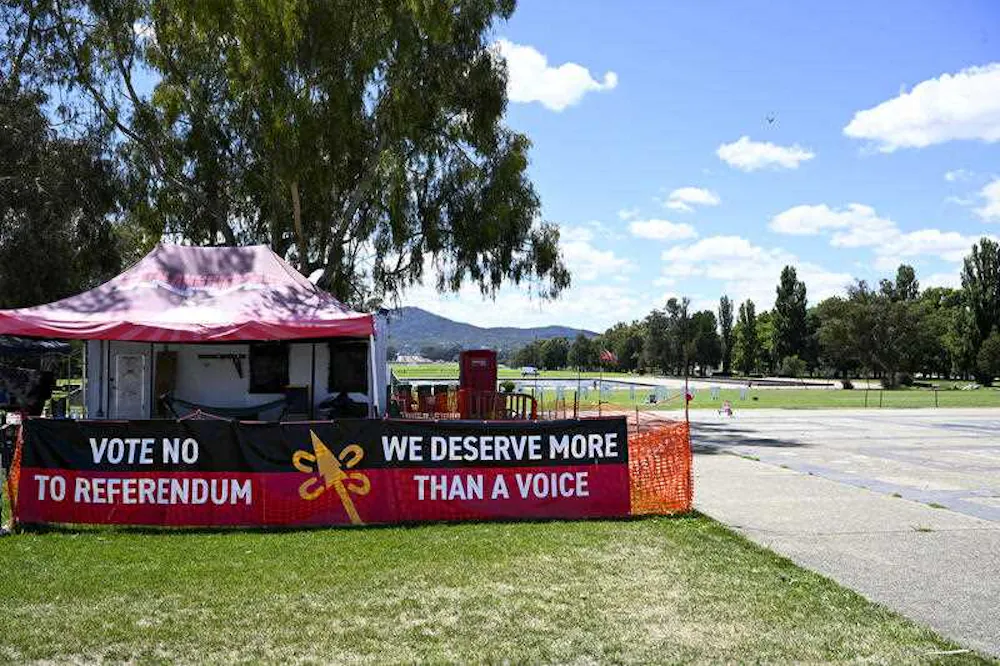
It’s not a simple debate
Presenting feelings towards the Voice to Parliament as an oversimplified, binary debate of “yes vs no” means Indigenous voices coming from somewhere in between continue to be silenced. Indigenous people’s concerns about maintaining self-determination are valid, and perspectives which need to be considered. This requires the non-Indigenous voices currently dominating the “no” debate to be silent and listen.
Some people are demanding more detail of the Voice proposal, suggesting voters shouldn’t consent to reforms that lack detail. But even with this, these finer details aren’t what will be represented in the Constitution. The Constitution is just the foundation stone upon which institutions, legislation, policy and process lay. So no matter what the design ends up being, it will be at the discretion of the government as to what is implemented, and how much power this Voice will have.
The Morrison government commissioned a Voice co-design report from a First Nations advisory group. This document is frequently referred to by politicians such as Prime Minister Albanese when asked what the design of the proposed Voice might look like. However expecting everyone to read a 250 page document hasn’t proven a practical approach.
We’ve been burned by past attempts to facilitate ‘Voice’
Many people have been led to believe implementing a Voice to Parliament is a once in a lifetime opportunity. But there have been past attempts and campaigns to have Indigenous people included in the Constitution.
One example is the Aboriginal and Torres Strait Islander Commission (ATSIC). ATSIC was significant because it was a Indigenous national advisory body in Australian government. However it had limited executive powers, and was abolished in 2004 by the Howard government.
At the time, the Aboriginal and Torres Strait Islander Social Justice Commissioner William Jonas condemned the abolition, stating the government:
seeks to ensure that the government will only have to deal with Indigenous peoples on its own terms and without any reference to the aspirations and goals of Indigenous peoples.
In 2012 the Gillard-led Labor government presented “You Me Unity”, a campaign designed to encourage conversation about updating the Constitution to recognise Indigenous peoples. This was quickly replaced by the “Recognise” campaign later that year. However, the Recognise campaign ultimately appeared to be more symbolic rather than expressing any real commitment to structural reform or legislation for constitutional change.
What we need to get Indigenous Peoples’ support of the Voice
We need better clarity on how a Voice can be representative of all Indigenous voices, and how it will affect the country’s journey towards a Treaty.
What we have seen happen to Djab Wurrung Gunnai Gunditjmara Senator Lidia Thorpe in speaking out about the Voice has made it difficult for mob to write and speak publicly on it if they oppose it. We risk being dismissed or attacked by both non-Indigenous and Indigenous peoples.
Indigenous people need safe spaces to lead discussions to address the diversity of First Nations perspectives in the Voice debate. These discussions could enable the creation of more accessible materials regarding the Voice design.
If the Australian media and governments cannot get a sense of the diversity of voices in Indigenous communities about what we want a Voice to be (or not be), how can they get a sense of our voices for the national Voice to parliament?
Authors: Kelly Menzel, Associate Dean Education, Gnibi College, Southern Cross University

















