

Lidia Thorpe’s Mardi Gras disruption is the latest in an ongoing debate about acceptable forms of protest at Pride
- Written by Justin Ellis, Lecturer in Criminology at the University of Newcastle, University of Newcastle
Independent senator for Victoria Lidia Thorpe’s temporary blocking of the Sydney Gay and Lesbian Mardi Gras Parade on Saturday night has again brought to the surface discussion on the role of protest and police discretion.
Amplification through media is one way of hopefully raising awareness of intractable social issues, such as Indigenous rates of incarceration and the role of police in that process. Peaceful protest, such as temporarily blocking the parade, might be a way to gain rare exposure in a cluttered 24-7 news cycle.
Highlighting of a range of messages through the media has been integral to the Sydney Gay and Lesbian Mardi Gras parade’s evolution. From a local protest in 1978 connected to the international gay and lesbian liberation movement, it’s become an international event in its own right.
The parade was central to raising awareness of the issues facing gay men and lesbians in the 1970s. Not least among these issues were the criminalisation of consensual same-sex conduct in New South Wales until 1984, and in Tasmania until 1997. The legacies of criminalisation have continued long after those reforms.
The Sydney Gay and Lesbian Mardi Gras parade since that time has raised awareness about the stigma facing people with HIV/AIDS, the fight for marriage equality, and the wider issues facing LGBTIQ+ peoples. Yet the parade as a vehicle for disruption to amplify awareness about intractable social issues can be at odds with the broader, ordered, public relations objective of the Mardi Gras. This is only amplified in the global context of Sydney hosting World Pride in 2023.
The evolving role of protest-turned-pride events
The role of the police at Mardi Gras is complex. The inaugural parade in 1978 ended with violence between the police and protesters, 53 arrests, and the beating of many of those people arrested while in police custody.
Exemplary of the relationship between mainstream news media and the police, The Sydney Morning Herald published the names, addresses and professions of those arrested. There have been apologies to the 78ers from politicians, police and media since then.
Investigations into possible bias motivated attacks have culminated in the current NSW Special Commission of Inquiry into LGBTIQ hate crimes. One aspect of that commission is to look at the ways the NSW police have approached issues relating to “bias crime” or “hate crime” from 1970 to the present.
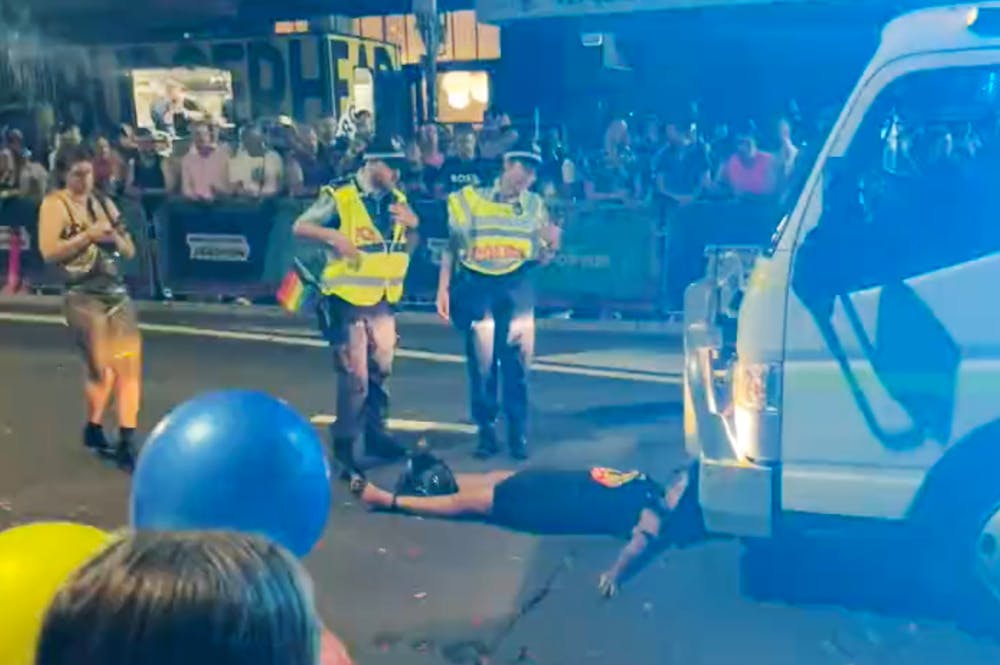
The policing of the 2013 Sydney Gay and Lesbian Mardi Gras gained global attention after a bystander video of police excessive force against a spectator went viral.
The policing of, and police participation in Mardi Gras events, remains contentious for these and other reasons, and formed part of the basis for Senator Thorpe’s temporary blocking of the parade. Senator Thorpe was marching with the No Pride in Genocide float, organised by Pride in Protest. Pride in Protest seeks to bring back the radical roots of the Sydney Gay and Lesbian Mardi Gras to bring about social justice change.
Taken from a tweet, Senator Thorpe’s narrower focus is to raise awareness of the role that Black and brown trans women have played in effecting change through protest against police violence.
One of the outcomes from the contentious policing of the 2013 Mardi Gras Festival was stronger inter-agency dialogue with police. That dialogue sought to emphasise the celebratory nature of Mardi Gras, and proportionate policing that reflected community values. Communities that have over been over-policed through being criminalised, and potentially underprotected because of stigma, are particularly sensitive to police interference. As such, police within those communities need to prioritise engagement through policing strategies that recognise the values of those communities. This requires reasonable justification of police practices from police, and community acknowledgement of the necessity of those practices.
Issues over the use and efficacy of drug detection dogs, the use of searches, and the scale of police presence at Mardi Gras events, remain contentious.
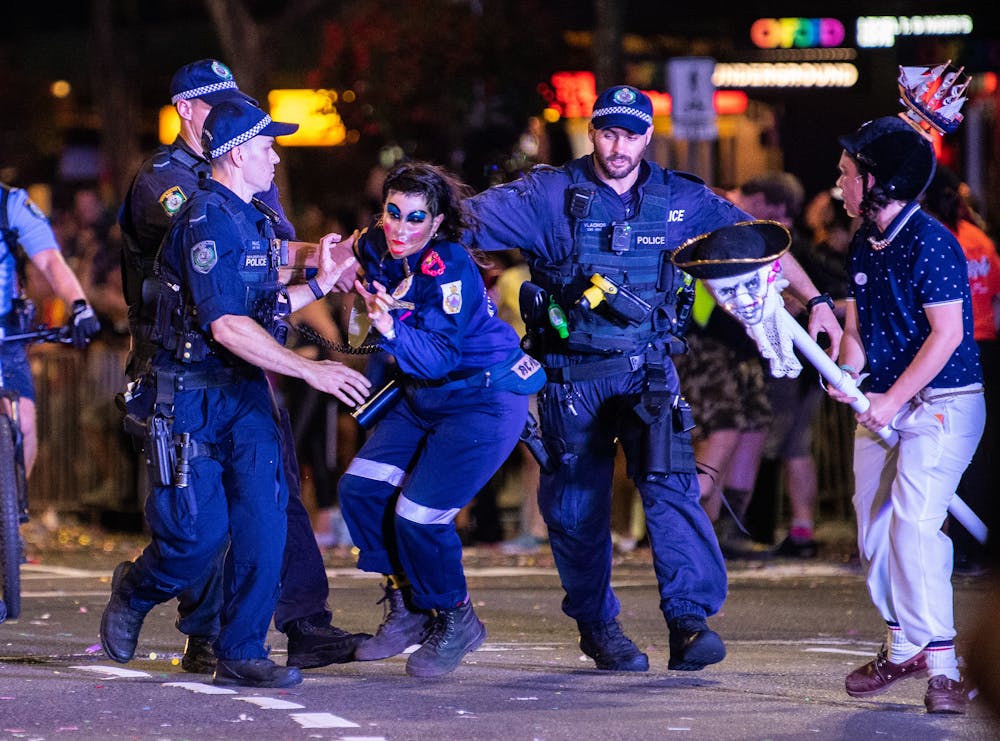 A protester being removed from the parade route by the police during in the 42nd annual Gay and Lesbian Mardi Gras parade in Sydney, Saturday, February 29, 2020.
James Gourley/ AAP
A protester being removed from the parade route by the police during in the 42nd annual Gay and Lesbian Mardi Gras parade in Sydney, Saturday, February 29, 2020.
James Gourley/ AAP
The medium is the message
Within this complex history, Thorpe’s temporary blocking of the parade forms part of an ongoing conversation between LGBTIQ+ communities, politicians and police about what are acceptable and unacceptable forms of protest.
The NSW Police Force has stated that it will not charge Thorpe. The broader reaction has been mixed – for some, her disruption of the protest is part of a continued fight for visibility of policing issues in Indigenous, queer and refugee communities. For others, Thorpe’s message was out of place at what has become a broader celebration of diversity and inclusion.
The longer-term question about the efficacy of this particular protest, and who benefits from it in the public relations space, remains to be seen. At the same time, the capacity of the Mardi Gras parade to balance activist perspectives with broader advocacy and allyship is very much grounded in what LGBTIQ+ peoples and their allies define as the driving issues of the day, the prioritisation of resources to that end, and what kind of exposure might best secure results.
Most recently, the more than a decade long campaign to secure marriage equality in Australia is a clear example of the organising capacity of LGBTIQ+ communities to effect law reform on important issues, and to maximise the use of social media networks and public relations to achieve those ends.
Read more: Can a polite sign lead to political change? What kinds of protest work?
The corporatisation of the Mardi Gras parade through major sponsorships, and major corporation participation in the parade, rankles with some because of the commodification of sexuality and gender identity that this represents. There is seemingly a distance between the visible grass roots activism of 1978, and the less visible, day-to-day, behind the scenes work that might go into securing a proportionate police presence at the Mardi Gras parade and related events.
Yet, these two approaches are not mutually exclusive. Pride parades across the globe are used as vehicles for awareness-raising and protest against a range of police conduct. But at the same time, the rise of anti-LGBTIQ+ extremism means that LGBTIQ+ events might need a security presence to keep participants and audiences safe.
The message of protest, its delivery, and harnessing of a broader call to action, are just as important as securing the media exposure in the first place to effect longer-term positive outcomes. Outcomes that in some instances may only really be measured at the ballot box, and through community prioritisation and resourcing of the issues most important to them.
Authors: Justin Ellis, Lecturer in Criminology at the University of Newcastle, University of Newcastle

















