

Extinct elephant birds were 3 metres tall and weighed 700kg. Now, DNA from fossil eggshells reveals how they lived
- Written by Alicia Grealy, Research Projects Officer, CSIRO
Madagascar’s extinct elephant birds – the largest birds ever to have lived – have captured public interest for hundreds of years. Little is known about them due to large gaps in the skeletal fossil record.
A new study published today in Nature Communications used ancient molecules extracted from fossil eggshells to reveal surprising new insights into the biology of these flightless giants. How many species were there? Where did they live? What did they eat?
Answers to these questions contribute to our understanding of the origin and loss of species, which is especially important today as global biodiversity continues to rapidly decline.
Staggeringly large birds
As a biodiversity hotspot, the island nation of Madagascar is a natural test tube for studying evolution and extinction. The numerous species of now-extinct megafauna that once roamed there play a key role in furthering our understanding of these processes.
One such group were the elephant birds, about which precious little has been gleaned since they were first described over 150 years ago.
Alongside Africa’s ostrich, Australia’s emu and cassowary, South America’s rhea, and New Zealand’s moa and kiwi, the elephant birds of Madagascar (or vorompatra in Malagasy language) were large, flightless ratites. They became extinct around 1,000 years ago, soon after humans first settled Madagascar.
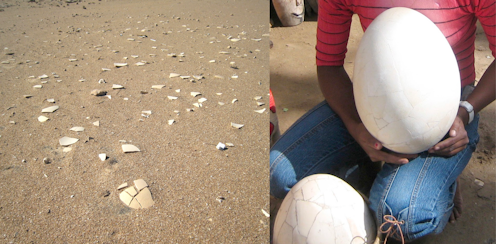
These were truly enormous birds, with some weighing over 700kg and standing up to 3m tall. Their eggs, weighing 10kg, were 150 times the size of a chicken’s egg.
Elephant birds (Aepyornithiformes) have been the stuff of legends for hundreds of years, with early sightings possibly being the origin of the mythical creature, roc (or rukh), and inspiring writers such as H. G. Wells. British naturalist David Attenborough also took a special interest in elephant birds, documenting his journey for answers about his own elephant bird egg in Attenborough and the Giant Egg.
In recent years, elephant birds were found to be most closely related to the chicken-sized kiwi bird – a result that changed our view of avian evolution.
A patchy record
Yet there is still debate about how many species of elephant bird there actually were. At one time, 16 species were named based on differences found between skeletal fossils. In the 1960s, this dropped to seven species, and the most recent revision classified elephant birds into four species. But why the controversy?
Although these birds became extinct relatively recently, the skeletal fossil record through time and space is patchy. Madagascar’s climate can be very hot and humid, which is not conducive to preserving biological material.
When bones are incomplete or fragmented, it can be hard to tell apart different species – and sometimes, bone doesn’t preserve at all, like in the far north of Madagascar where there have been reports of eggshells but no bones.
Modern DNA technology can help overcome this barrier. In a similar way that we can identify people, or tell how they are related to each other by comparing their DNA, ancient DNA from fossils can help identify unknown specimens or uncover relationships within and between species.
The more differences there are between two organisms’ DNA, the more distantly they are related. These differences can then be used estimate when species evolved, which provides clues about how and why. But, just like the elephant bird bones themselves, the DNA within them is not well preserved either.
Thick and abundant eggshell
This is where eggshell comes in. Compared to other birds, elephant bird eggshell is very thick, so the DNA trapped inside is better protected. Eggshells are also much more abundant than bones, with fragments densely scattered across beaches along Madagascar’s coastline, where these birds presumably once nested.
On top of preserving DNA and proteins, eggshell preserves “stable isotope” signatures which can be matched to those of plants and animals from the environment to get an idea of what the birds were eating and drinking.
Physical characteristics of eggshell (such as thickness and pore density) can also reveal information about egg size, bird size, the nesting environment, nesting behaviour, and can sometimes be used to distinguish between bird groups.
With the help and support of Malagasy locals, our team collected hundreds of 1,000-year-old fossil eggshell from across Madagascar. We looked at their thickness, their micro-structure (through micro-CT scanning), DNA and proteins, and their stable isotopes. We screened hundreds of eggshell fragments to find 21 with sufficient DNA to reconstruct a family tree using eggshell and bone specimens of known identity.
A mysterious lineage
We found there were not as many species of elephant bird as previously thought – there was very little genetic difference between specimens. We think some of the size and shape differences seen in the skeletal fossils are just differences between males and females, and not differences between species. It is common among ratites for females to be much larger than males – and to be mistaken for different species.
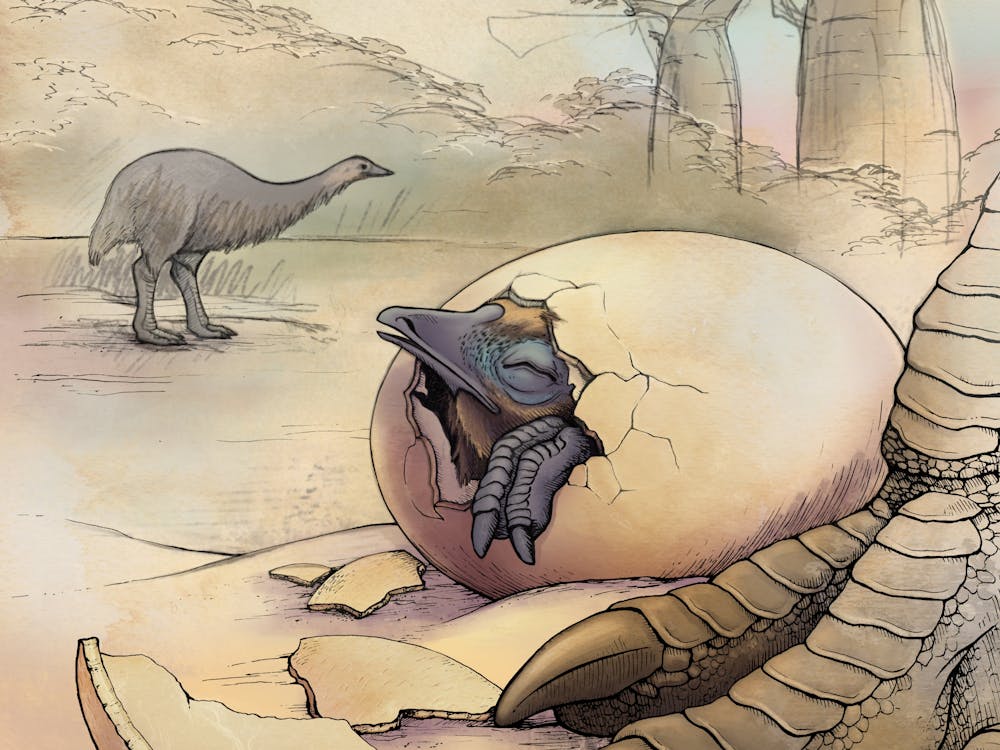
But more surprisingly, we identified a mystery eggshell from Madagascar’s far north as belonging to a novel lineage of large elephant birds that weighed 230kg and laid 3kg eggs. Although these birds were closely related to the elephant birds of central Madagascar, they were genetically distinct and had a different diet. They were also separated by about 1,000km in distance and 1.5km in elevation.
This proves that elephant birds were living in Madagascar’s far north where no skeletons have ever been found, a result that is reminiscent of the finding of a new hominid from DNA analysis of an unknown fossil.
These weren’t the only unexpected findings: we also identified potential drivers of speciation (formation of new species) and extreme gigantism in elephant birds. As Madagascar became drier and cooler during the last ice age, the vegetation changed, and elephant birds may have adapted to new niches. This led to the evolution of the largest species in a rapid and recent time frame – within the last 1.4 million years, a fraction of their evolutionary history.
These findings demonstrate how ancient DNA from eggshell is a promising avenue for studying the evolution of extinct birds. It contributes to our understanding of Madagascar’s past biodiversity – an important step towards understanding how to conserve its unique species into the future.
Authors: Alicia Grealy, Research Projects Officer, CSIRO

















