

Aussie native bees steal the show with unique social and foraging behaviours
- Written by James B. Dorey, Adjunct Associate Professor, Flinders University
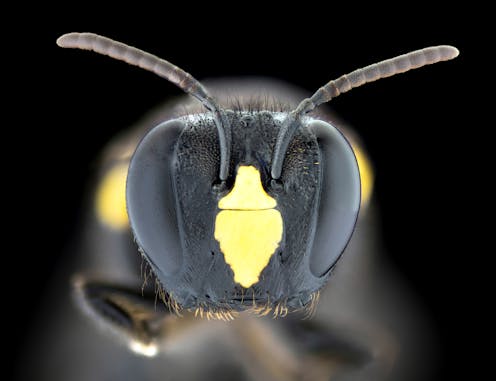
Australian native bees have evolved complex social structures and foraging behaviours that help biologists answer longstanding questions, such as the origins of social behaviour, and the drivers of increased biodiversity.
In European honeybees, the queen governs the hive with her sterile female workers. Meanwhile, the males are little more than freeloaders, or hangers-on (sorry boys).
But most Australian bees are different. Some are solitary. Others live in cooperative, egalitarian societies where individuals share and jointly defend a nest. There is no clear division into queen and worker castes.
Our new research, in the journals Biology Letters and Apidologie, reveals fresh insights into the evolution and ecology of Australian bees. These creatures deserve more attention and respect, not only for the ecosystem services they provide, but for the scientific lessons they can teach us.
Unusual bee-haviour
All bees face pressure from parasites and predators. But we discovered a unique strategy in one Australian species known as the capricious masked bee (Amphylaeus morosus).
Of the more than 2,000 species in the highly diverse Colletidae bee family, only the capricious masked bee is known to be social. Females that choose to cooperate can dramatically improve their defence against enemies such as parasitoid wasps and flies.
In these cooperative groups, one female protects the developing brood while the mother is away on foraging trips. (European honeybee queens rely on workers for such tasks, while they stay home.)
The guards do not produce their own offspring. However, guarded colonies do tend to produce more offspring - and the extras are always males.
However, having too many nest guards in the population can lead to an excess of males. When males greatly outnumber females, far fewer males (compared to females) will reproduce and pass on their genes. This reduces the genetic “value” of males and in turn cooperative behaviour.
Eventually, the relative benefit of cooperative nesting is diminished. We suggest this limits the frequency of the nest guard strategy, putting the brakes on further social evolution.
Read more: Phantom of the forest: after 100 years in hiding, I rediscovered the rare cloaked bee in Australia
The birds and the bees
When we took a closer look at the diet of other Australian colletid bees (also known as plasterer bees due to the way they smooth the walls of their nest cells with secretions that dry to a cellophane-like lining), we found it varied considerably.
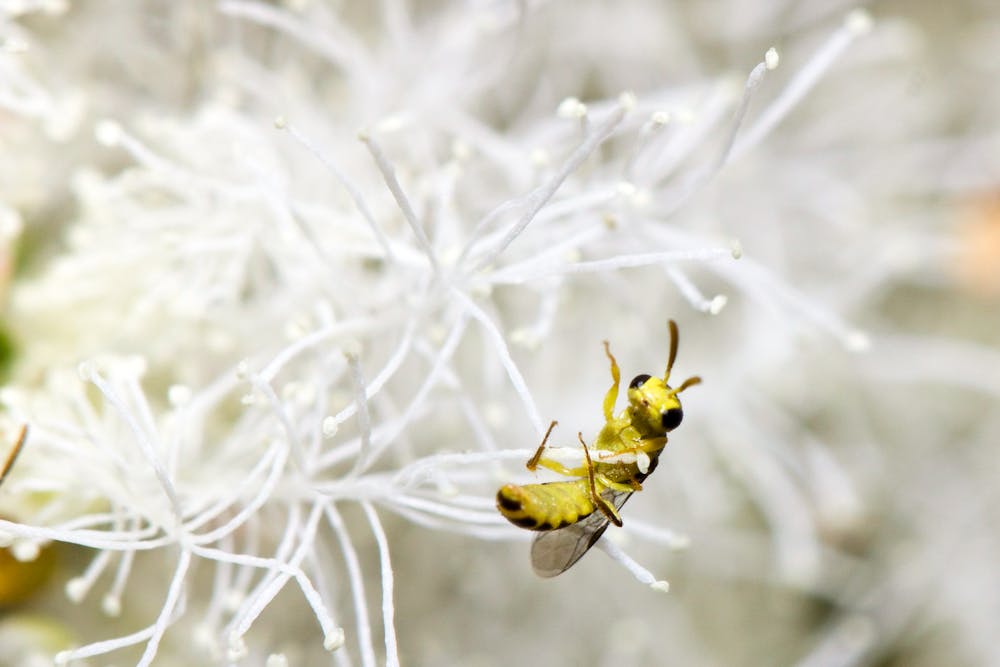
One group in particular only visited a very restricted range of plants. This group, the euryglossines, account for almost a quarter of all Australian bee species. So why are they so fussy?
The answer may lie in the nature of the food itself. Euryglossines clearly prefer plants in the family Myrtaceae. These include the gums, melaleucas, and tea trees that dominate Australian landscapes and provide massive amounts of pollen and nectar. Their shallow, brush-like flowers are also easy for small bees to access.
These same distinctive flowers are heavily used by parrots such as ringnecks, lorikeets and rosellas - who also love pollen and nectar. This floral system has likely been shaped by co-evolution of parrots and gum trees, and we suspect it was later exploited by euryglossine bees and helps account for their high species diversity. Clearly they are both onto a good thing.
 Parrots and gum trees are both iconic parts of the Australian landscape, and likely influenced the evolution of each other.
Michael Lee
Parrots and gum trees are both iconic parts of the Australian landscape, and likely influenced the evolution of each other.
Michael Lee
This research supports what many have suspected for years. Natives typically need other natives to flourish. Our native bees rely on our native plants, even if some have more flexible diets than others.
Spend some time looking at a flowering gum and you’re almost certain to see some of our tiniest but hardest-working pollinators - along with some of the brightest and loudest.
How to observe Australian bees
It is all very well for expert bee nerds, like us, to tell you about the value of native species. But to really appreciate our native bees, you should try observing them for yourself: they are all around us, but often smaller and less ostentatious than European honeybees.
Native bees are easy to spot, even in urban environments. Parklands, roadside verges, and even our gardens are full of them. Look for them at work pollinating flowers - they might look like little dark flies initially, but closer inspection will reveal their true bee shape.
They can be nesting in bare patches on the ground, the soft stems of tree ferns or grass trees, in the “bee hotels” made by people, or even pruned rose and hydrangea bushes. Just check for little perfectly round holes with insects buzzing around. With a bit of patience, a cold drink, and a comfy stool or cushion, one can watch these entrances and see critters hard at work.
Social Australian stem nesting bees are surprisingly complex, even though their colonies rarely contain more than four or five females. Watch for guard bees plugging the nest entrance with their red or black abdomens, while other females go to collect food. With extra patience it is possible to see ants or tiny wasps gather around the nest entrances, waiting for an unguarded moment to attack.
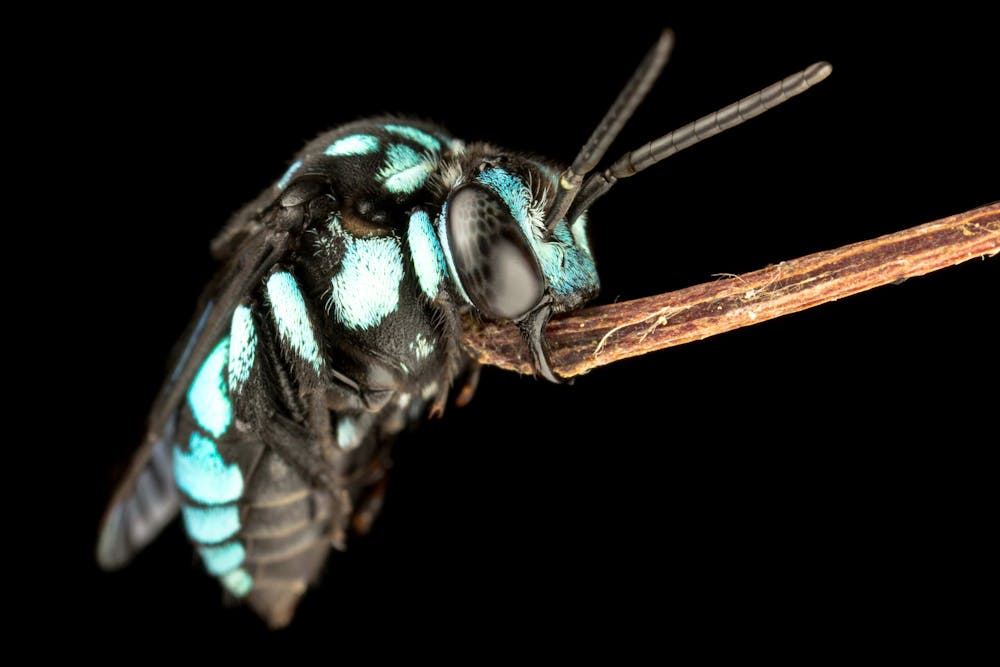 A female neon cuckoo bee, Thyreus nitidulus, roosting on a stick for the night. These cuckoo bees will follow blue-banded bees to their nests and replace their egg with one of their own. Hence the name, ‘cuckoo’.
James Dorey, Author provided
A female neon cuckoo bee, Thyreus nitidulus, roosting on a stick for the night. These cuckoo bees will follow blue-banded bees to their nests and replace their egg with one of their own. Hence the name, ‘cuckoo’.
James Dorey, Author provided
Australia has more than 1,650 native bee species. We encourage you to enjoy them on flowers, in the ground, in stems, or wherever you can find them. These little animals have a lot to offer us in terms of how we understand the world, in addition to being vital parts of the ecosystem. And importantly, they are our responsibility to understand and protect.
The authors would like to thank Michael Schwarz and Mark Stevens for their help in drafting this article.
Read more: A new $2 coin features the introduced honeybee. Is this really the species we should celebrate?
Authors: James B. Dorey, Adjunct Associate Professor, Flinders University

















