

Despite restrictions elsewhere, NZ still uses a wood preservative linked to arsenic pollution
- Written by Clemens Altaner, Associate Professor in Wood Science, University of Canterbury
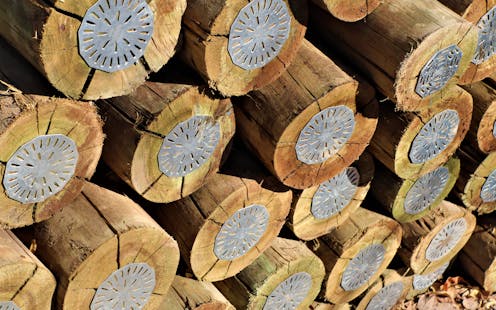
Timber with a green-grey hue – treated with copper chromium arsenic (CCA) – is a common sight in New Zealand. But how many people are aware that it pollutes the environment, is associated with health risks and is a toxic waste complicating the transition to a circular bioeconomy?
Other countries, including Australia, the US and the EU, have stopped or restricted the use of CCA, moved to safer alternatives and established viable end-of-life disposal options.
The ingredients of CCA are the heavy metals copper, chromium and arsenic. They don’t decompose and can’t be destroyed like organic compounds by incineration.
The heavy metals leach from the timber, polluting soil and water. When CCA-treated timber is burned, most arsenic becomes volatile and pollutes the air, while chromium and copper contaminate the ash.
The World Health Organization (WHO) lists arsenic among the top ten chemicals of major public health concern. It is a confirmed carcinogen. Chromium and copper are not without health risks either.
Banned or restricted elsewhere
In the early 2000s, the US Environmental Protection Agency and the timber industry agreed to restrict CCA-treated timber to industrial uses. This was driven by concerns about human exposure to arsenic from playground equipment, decks, picnic tables and other uses.
Most other developed countries followed with similar restrictions. CCA is no longer registered as a wood preservative in the EU.
But New Zealand’s treated-timber market is still dominated by CCA. It is used abundantly in playgrounds and residential buildings with a high risk of human exposure. This is despite Standards New Zealand having approved more benign alternatives.
New Zealand’s Environmental Protection Authority also recommends building playgrounds from alternative materials, providing consumer information at point of sale and greater dissemination of precautionary health advice. But these recommendations have been ignored in New Zealand for two decades.
Stakeholders have not adopted the standard developed jointly by Standards Australia and Standards New Zealand. The standard contains a consumer safety information sheet, which states CCA-treated timber cannot be used for products in direct contact with foodstuffs, garden furniture, exterior seating, children’s play equipment, patio and domestic decking and handrails.
It also details appropriate disposal and outlines precautions during handling:
avoid sawing
wear dust masks, gloves and eye protection
wash hands and face after working with CCA-treated timber.
Environmental and health risks
New Zealand excluded environmental risks from its CCA safety assessment. Yet environmental risks were leading reasons to phase out CCA overseas.
There are several domestic examples of environmental pollution by CCA.
Arsenic concentration in the air during winter exceeds New Zealand’s ambient air-quality guidelines. This is caused by inappropriate burning of CCA-treated timber in log fires and burn-offs by the agricultural sector.
Read more: 'Like having a truck idling in your living room': the toxic cost of wood-fired heaters
Arsenic concentration was predicted to exceed the drinking water standard in slow-flowing Marlborough aquifers.
While soil contamination is localised around CCA-treated timber, these hotspots can be frequent. Vineyards, for example, feature 500-600 posts per hectare. Land-use change for urban development will require significant remediation.
Improper disposal of ash from log burners in green bins causes arsenic contamination of compost. Deliberate composting of treated timber has also been uncovered.
In a study of 35 countries, New Zealand was the only one where arsenic contamination of residential indoor dust exceeded the non-carcinogenic hazard index for children.
No safe disposal
CCA is also an obstacle in the transition to a circular bioeconomy. Reuse of timber is a well established procedure. It prioritises reuse over thermal utilisation (using it as fuel to harness its energy).
However, there is no viable reuse for CCA-treated timber waste. The problem is even bigger. CCA-treated timber cannot be separated from untreated timber in demolition waste.
Read more: We create 20m tons of construction industry waste each year. Here's how to stop it going to landfill
In New Zealand, CCA-treated timber is to be disposed in secure landfills, forcing future generations to manage the toxic CCA leachate. Burning in appropriate facilities is the only viable disposal method for CCA-treated timber – it is the mandatory disposal option in Germany. However, no sizeable waste incineration plant has been commissioned in New Zealand.
A brief visit to any school, playground, picnic area, domestic garden or DIY shop demonstrates New Zealand’s comparatively relaxed attitude towards CCA. Government and industry state to never burn CCA-treated timber, but this is not communicated to the public effectively.
Recent advice at my local DIY stores included, “yes, it’s standard for playground equipment” and “it can be burned or recycled”. Preservative-treated wood is frequently sold as firewood. At my last check, three out of the top 50 firewood listings on the auction site TradeMe were CCA-treated timber waste.
New Zealand’s industry-led approach has failed. The first step to tackle the CCA liability is easy, as alternative preservatives are approved. Restricting the use of CCA-treated timber or introducing a product stewardship scheme will ensure nothing is added to New Zealand’s CCA legacy.
Ensuring our children do not have to inherit the existing CCA legacy is more difficult. We need to commission a suitable incineration facility.
CCA-treated timber is cheaper than safer alternatives but only if disposal costs are outsourced to future generations.
Authors: Clemens Altaner, Associate Professor in Wood Science, University of Canterbury

















