Humans are still hunting for aliens. Here's how astronomers are looking for life beyond Earth
- Written by Sara Webb, Postdoctoral Research Fellow, Centre for Astrophysics and Supercomputing, Swinburne University of Technology
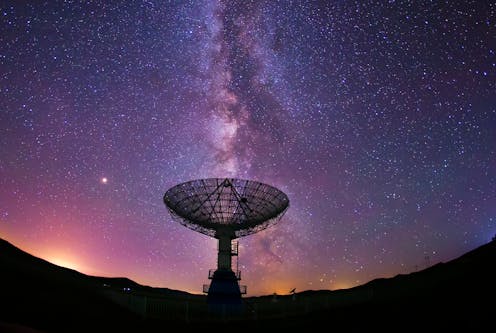
We have long been fascinated with the idea of alien life. The earliest written record presenting the idea of “aliens” is seen in the satiric work of Assyrian writer Lucian of Samosata dated to 200 AD.
In one novel, Lucian writes of a journey to the Moon and the bizarre life he imagines living there – everything from three-headed vultures to fleas the size of elephants.
Now, 2,000 years later, we still write stories of epic adventures beyond Earth to meet otherworldly beings (Hitchhiker’s Guide, anyone?). Stories like these entertain and inspire, and we are forever trying to find out if science fiction will become science fact.
Not all alien life is the same
When looking for life beyond Earth, we are faced with two possibilities. We might find basic microbial life hiding somewhere in our Solar System; or we will identify signals from intelligent life somewhere far away.
Unlike in Star Wars, we’re not talking far, far away in another galaxy, but rather around other nearby stars. It is this second possibility which really excites me, and should excite you too. A detection of intelligent life would fundamentally change how we see ourselves in the Universe.
In the last 80 years, programs dedicated to the search for extraterrestrial intelligence (SETI) have worked tirelessly searching for cosmic “hellos” in the form of radio signals.
The reason we think any intelligent life would communicate via radio waves is due to the waves’ ability to travel vast distances through space, rarely interacting with the dust and gas in between stars. If anything out there is trying to communicate, it’s a pretty fair bet they would do it through radio waves.
Listening to the stars
One of the most exciting searches to date is Breakthrough Listen, the largest scientific research program dedicated to looking for evidence of intelligent life beyond Earth.
This is one of many projects funded by Russian entrepreneurs Julia and Yuri Milner, with some serious dollars attached. Over a ten-year period a total amount of US$100 million will be invested in this effort, and they have a mighty big task at hand.
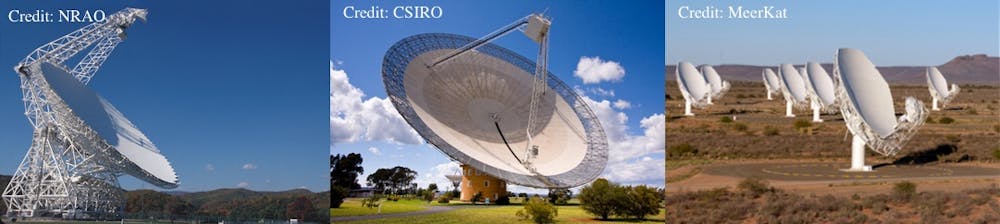
Breakthrough Listen is currently targeting the closest one million stars in the hope of identifying any unnatural, alien-made radio signals. Using telescopes around the globe, from the 64-metre Murriyang Dish (Parkes) here in Australia, to the 64-antenna MeerKAT array in South Africa, the search is one of epic proportions. But it isn’t the only one.
Hiding away in the Cascade Mountains north of San Francisco sits the Allen Telescope Array, the first radio telescope built from the ground up specifically for SETI use.
This unique facility is another exciting project, able to search for signals every day of the year. This project is currently upgrading the hardware and software on the original dish, including the ability to target several stars at once. This is a part of the non-profit research organisation, the SETI Institute.
Space lasers!
The SETI Institute is also looking for signals that would be best explained as “space lasers”.
Some astronomers hypothesise that intelligent beings might use massive lasers to communicate or even to propel spacecraft. This is because even here on Earth we’re investigating laser communication and laser-propelled light sails.
To search for these mysterious flashes in the night sky, we need speciality instruments in locations around the globe, which are currently being developed and deployed. This is a research area I’m excited to watch progress and eagerly await results.
As of writing this article, sadly no alien laser signals have been found yet.
Read more: Do aliens exist? We asked five experts
Out there, somewhere
It’s always interesting to ponder who or what might be living out in the Universe, but there is one problem we must overcome to meet or communicate with aliens. It’s the speed of light.
Everything we rely on to communicate via space requires light, and it can only travel so fast. This is where my optimism for finding intelligent life begins to fade. The Universe is big – really big.
To put it in perspective, humans started using radio waves to communicate across large distances in 1901. That first transatlantic signal has only travelled 122 light years, reaching just 0.0000015% of the stars in our Milky Way.
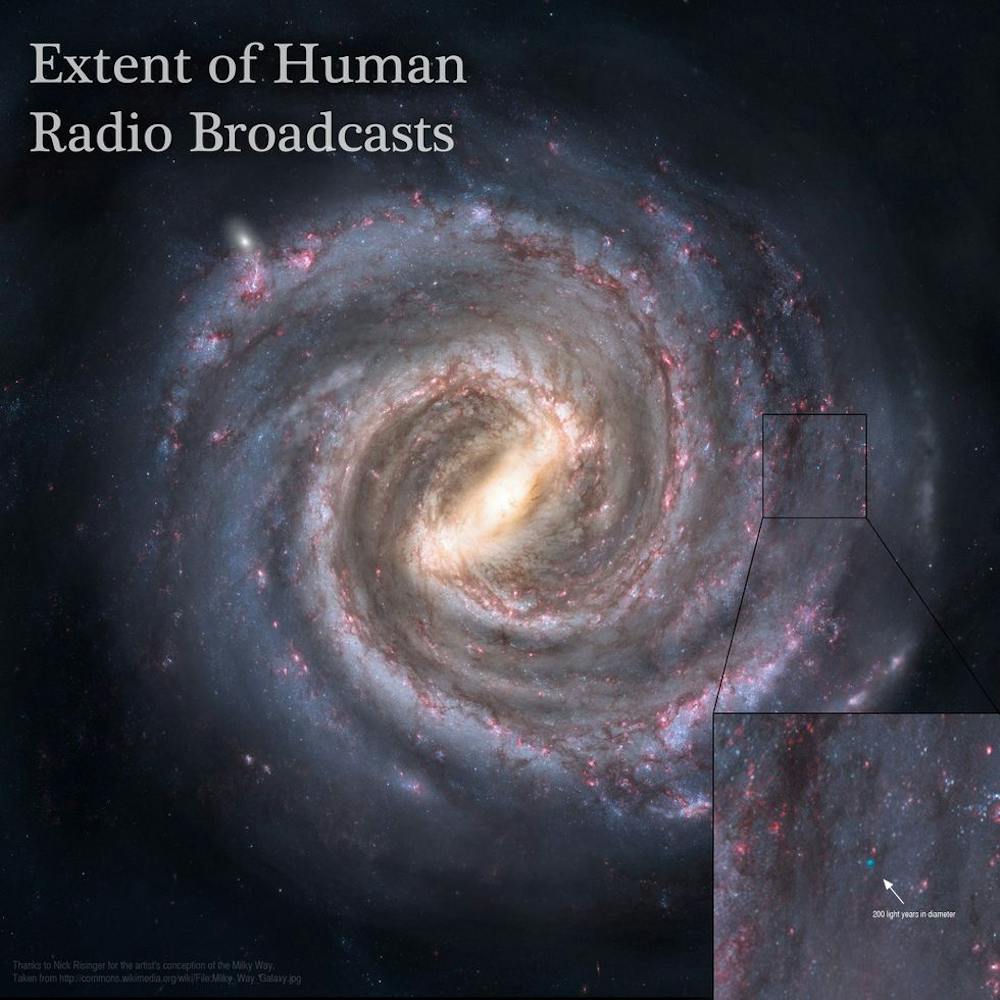 The little blue dot in the centre of the square is the current extent of human broadcasts just in our own galaxy.
Adam Grossman/Nick Risinger
The little blue dot in the centre of the square is the current extent of human broadcasts just in our own galaxy.
Adam Grossman/Nick Risinger
Did your optimism just fade too? That is okay, because here is the wonderful thing… we don’t have to find life to know it is out there, somewhere.
When we consider the trillions of galaxies, septillion of stars, and likely many more planets just in the observable Universe, it feels near impossible that we are alone.
We can’t fully constrain the parameters we need to estimate how many other lifeforms might be out there, as famously proposed by Frank Drake, but using our best estimates and simulations the current best answer to this is tens of thousands of possible civilisations out there.
Read more: Frank Drake has passed away but his equation for alien intelligence is more important than ever
The Universe might even be infinite, but that is too much for my brain to comprehend on a weekday.
Don’t forget the tiny aliens
So, despite keenly listening for signals, we might not find intelligent life in our lifetimes. But there is hope for aliens yet.
The ones hiding in plain sight, on the planetary bodies of our Solar System. In the coming decades we’ll explore the moons of Jupiter and Saturn like never before, with missions hunting to find traces of basic life.
Mars will continue to be explored – eventually by humans – which could allow us to uncover and retrieve samples from new and unexplored regions.
Even if our future aliens are only tiny microbes, it would still be nice to know we have company in this Universe.
Authors: Sara Webb, Postdoctoral Research Fellow, Centre for Astrophysics and Supercomputing, Swinburne University of Technology