Lie detection tests have worked the same way for 3,000 years – and they're still hopelessly inaccurate
- Written by Rebecca Wilcoxson, Lecturer in Forensic Psychology, CQUniversity Australia
Popular culture is fascinated with the ability to detect liars. Lie detector tests are a staple of police dramas, and TV shows such as Poker Face feature “human polygraphs” who detect deception by picking up tell-tale signs in people’s behaviour.
Records of attempts to detect lies, whether by technical means or by skilled observers, go back at least 3,000 years. Forensic science lie detection techniques have become increasingly popular since the invention of the polygraph early in the 20th century, with the latest methods involving advanced brain imaging.
Proponents of lie detection technology sometimes make grandiose claims, such as a recent paper that said “with the help of forensic science and its new techniques, crimes can be easily solved”.
Despite these claims, an infallible lie detection method has yet to be found. In fact, most lie detection methods don’t detect lies at all – instead, they register the physiological or behaviour signs of stress or fear.
From dry rice to red-hot irons
The earliest recorded lie detection method was used in China, around 1000 BC. It involved suspects placing rice in their mouths then spitting it out: wet rice indicated innocence, while dry rice meant guilty.
In India, around 900 BC, one method used to detect poisoners was observations of shaking. In ancient Greece a rapid pulse rate was taken to indicate deceit.
The Middle Ages saw barbaric forms of lie detection used in Europe, such as the red-hot iron method which involved suspected criminals placing their tongue, often multiple times, on a red-hot iron. Here, a burnt tongue indicated guilt.
What the polygraph measures
Historical lie detection methods were based in superstition or religion. However, in the early 20th century a purportedly scientific, objective, lie detection machine was invented: the polygraph.
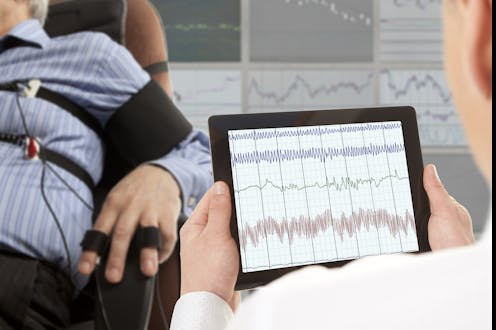
The polygraph measures a person’s respiration, heart rate, blood pressure, and skin conductance (sweating) during questioning.
Usually a “control question” about a crime is asked, such as “Did you do it?” The person’s response to the control question is then compared to responses to neutral or less provocative questions. Heightened reactions to direct crime questions are taken to indicate guilt on the test.
The overconfidence of law enforcers
Some law enforcement experts claim they don’t even need a polygraph. They can detect lies simply by observing the behaviour of a suspect during questioning.
Worldwide research shows that law enforcers are often confident they can detect lying. Many assume a suspect’s nonverbal behaviour reveals deceit.

A 2011 study with Queensland police revealed many officers were confident they could detect lying. Most favoured a focus on nonverbal behaviour even over available evidence.
However, research shows that law enforcers, despite their confidence, are often not very good at detecting lying.
Law enforcement officers are not alone in thinking they can spot a liar. Global studies have found that people around the world believe lying is accompanied by specific nonverbal behaviours such as gaze aversion and nervousness.
What’s really being tested
Many historical and current lie detection methods seem underpinned by the plausible idea that liars will be nervous and display observable physical reactions.
These might be shaking (such as in the ancient Indian test for poisoners, and the nonverbal behaviour method used by some investigators), a dry mouth (the rice-chewing test and the hot-iron method), increased pulse rate (the ancient Greek method and the modern polygraph), or overall heightened physiological reactions (the polygraph).
Read more: How's your poker face? Why it's so hard to sniff out a liar
However, there are two major problems with using behaviour based on fear or stress to detect lying.
The first problem: how does one distinguish fearful innocents from fearful guilty people? It is likely that an innocent person accused of a crime will be fearful or anxious, while a guilty suspect may not be.
This is borne out with the polygraph’s high false-positive rate, meaning innocent people are deemed guilty. Similarly, some police have assumed that innocent, nervous suspects were guilty based on inaccurate interpretations of behavioural observations.
The second major problem with lie detection methods based on nervous behaviour is there is no evidence that specific nonverbal behaviours reliably accompany deception.
Miscarriages of justice
Despite what we know about the inaccuracy of polygraph tests, they haven’t gone away.
In the US, they are still used in some police interrogations and high-security job interviews. In the UK, lie detector tests are used for some sex offenders on probation. And in China, the use of polygraphs in law enforcement may even be increasing.
Australia has been less enthusiastic in adopting lie-detection machines. In New South Wales, the use of lie-detector findings was barred from court in 1983, and an attempt to present polygraph evidence to a court in Western Australia in 2003 also failed.
Many historical and current lie detection methods emulate each other and are based on the same assumptions. Often the only difference is the which part of the body or physical reacion they focus on.
Using fallible lie detection methods contributes to wrongful convictions and miscarriages of justice.
Therefore, it is important that criminal-justice practitioners are educated about fallacious lie detection methods, and any new technique grounded in fear or stress-based reactions should be rejected.
Despite outward appearances of technological advancement, over many millennia little has changed. Fearful innocents remain vulnerable to wrongful assumptions of guilt, which is good news for the fearless guilty.
Authors: Rebecca Wilcoxson, Lecturer in Forensic Psychology, CQUniversity Australia