What are these 'cancer vaccines' I'm hearing about? And what similarities do they share with COVID vaccines?
- Written by Sathana Dushyanthen, Academic Specialist & Lecturer in Cancer Sciences & Digital Health| Superstar of STEM| Science Communicator, The University of Melbourne
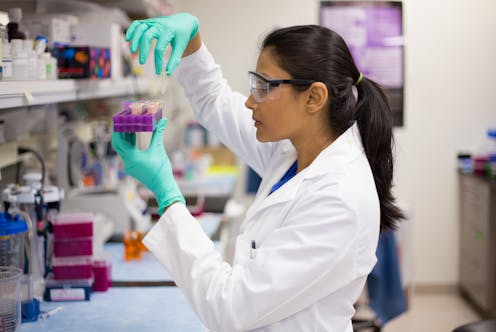
Barely a month goes by without headlines announcing yet another advancement in cancer vaccines.
Just last month, the United States Food and Drug Administration (FDA) granted breakthrough therapy designation to Moderna and Merck’s skin cancer vaccine. This allows expedited development and review of drugs intended to treat serious conditions.
We already have a vaccine to prevent human papillomavirus (HPV), which causes cervical and other cancers. We also have a vaccine to protect against the hepatitis B virus, which can cause liver cancer.
But you may have heard of new types of cancer vaccines being developed using technology similar to that used for COVID vaccines. Decades before COVID vaccines, scientists had been working on messenger ribonucleic acid (mRNA) vaccines targeting cancer.
Rather than preventing disease, these vaccines are a personalised treatment for cancer, to combat disease.
How do they work?
Science in Motion.Traditionally, vaccines inject part or all of a weakened virus (or other pathogen) into the body to provoke an immune response.
mRNA works by injecting only the genetic instructions and allowing the body’s cells to make part of the cancer protein (antigen) itself. This trains the immune system to develop antibodies against the protein.
When these same proteins are present on an invading tumour cell, the immune system stimulates an immune response against it.
While COVID mRNA vaccines respond to one antigen – the spike protein on the outside of coronavirus – cancer vaccines act on several antigens present on the tumour surface.
The mRNA cancer vaccines train the patient’s immune system to fight their own cancer. Most trials are manufacturing vaccines for individual patients based on the specific antigens present on their tumours.
It takes around two months to produce a vaccine.
How are they made?
To make these vaccines, a sample of the patient’s tumour and healthy tissue is taken. These samples are DNA-sequenced to compare differences between the DNA in the cancerous cells and the healthy cells.
Scientists identify problem mutations driving disease. These can then be used as antigen targets in the mRNA vaccine.
Bespoke approaches allow scientists to target a wider range of cancer antigens. Targeting multiple antigens decreases the odds that cancer cells will mutate and become resistant to vaccines, because the immune system attacks on multiple fronts.
Personalised medicines are extremely expensive because they are bespoke products. Manufacturing costs for bespoke treatments remain high. However, with rapidly falling costs of different aspects such as genome sequencing (some companies are now offering genome sequencing for just US$100), sequencing the entire genome is becoming more viable.
As large-scale manufacturing increases in future for off-the-shelf vaccines, there will be resource efficiencies that reduce cost.
What vaccines are in development?
In December 2022, Moderna and Merck (known outside the United States and Canada as MSD) published the results of its early phase (2b) clinical trial. The trial was investigating a combination therapy of an mRNA vaccine and immunotherapy (a drug that stimulates an immune response) in advanced stage melanoma patients.
After one year of treatment in 157 patients, they found the combination reduced the risk of cancer recurrence or death by 44%.
Now, Moderna and Merck plan to follow up their initial trial with a phase 3 trial for advanced melanoma in 2023. Phase 3 trials test for safety and efficacy in larger groups of patients.
BioNTech has several mRNA cancer candidates in the works, including for advanced melanoma, ovarian cancer and non-small cell lung cancer. It will release results from its own phase 2 melanoma trial (of 131 patients) using immunotherapy and an mRNA vaccine combination later this year. Its primary aim is to measure cancer progression and survival over 24 months in previously untreated patients.
A third company called CureVac is also developing mRNA vaccines targeting a range of cancers including ovarian, colorectal, head and neck, lung and pancreatic.
CureVac has a deal with Tesla, the electric car manufacturer, to develop small, portable mRNA bioprinters to automate the process of producing patient mRNA. These can be shipped to remote locations where they are able to churn out vaccine candidates based on the DNA template (recipe) fed into the machine.
A lot of these vaccines, including those targeting cancer, are in pre-clinical to phase 1 stages of development, to test the effects and side effects in the laboratory, animal models or small groups of patients.
When will they become available?
Overseas, Moderna and Merck’s mRNA cancer vaccine was fast-tracked for review by the US FDA in February 2023.
Australia’s Therapeutic Goods Administration has not approved the use of mRNAs for use either alone or with other cancer treatments yet.
In January 2023, the United Kingdom’s National Health Service partnered with BioNTech to fast-track the development of mRNA cancer vaccines over the next seven years. Eligible UK cancer patients will get early access to clinical trials from late 2023 onwards. By 2030, these mRNA vaccines will be made clinically available to around 10,000 cancer patients.
Read more: Cancer vaccine trials could start in the autumn – UK signs deal with BioNTech
In Australia, BioNTech is establishing its Asia-Pacific mRNA clinical research and development centre in Melbourne, in partnership with the Victorian government. This would develop mRNA vaccines for research and clinical trials, including personalised cancer treatments.
Meanwhile, Moderna will develop Australia’s first large-scale mRNA vaccine facility at Monash University by 2024, in partnership with the state and federal government. This will give Australians priority access to mRNA vaccines made locally.
What else could the technology be used for?
Aside from cancer, there is huge potential to use mRNA technologies across many gene therapies.
There are studies underway testing mRNA vaccines for various diseases such as evolving COVID strains, seasonal influenza, malaria, HIV, cystic fibrosis and even allergies, giving new hope for many previously incurable diseases.
Read more: 3 mRNA vaccines researchers are working on (that aren't COVID)
Authors: Sathana Dushyanthen, Academic Specialist & Lecturer in Cancer Sciences & Digital Health| Superstar of STEM| Science Communicator, The University of Melbourne