We used to think diamonds were everywhere. New research suggests they’ve always been rare
- Written by Carl Walsh, PhD Candidate, Queensland University of Technology
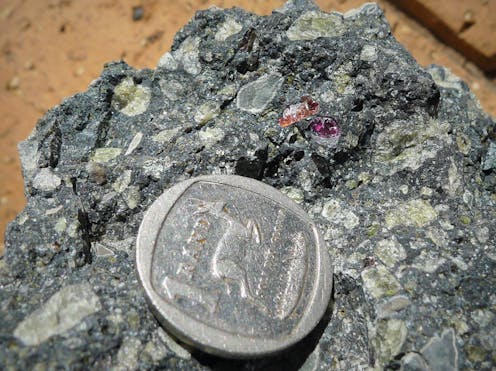
New research is shedding light on the tumultuous processes that give rise to diamonds, by homing in on a distinct purple companion found alongside them.
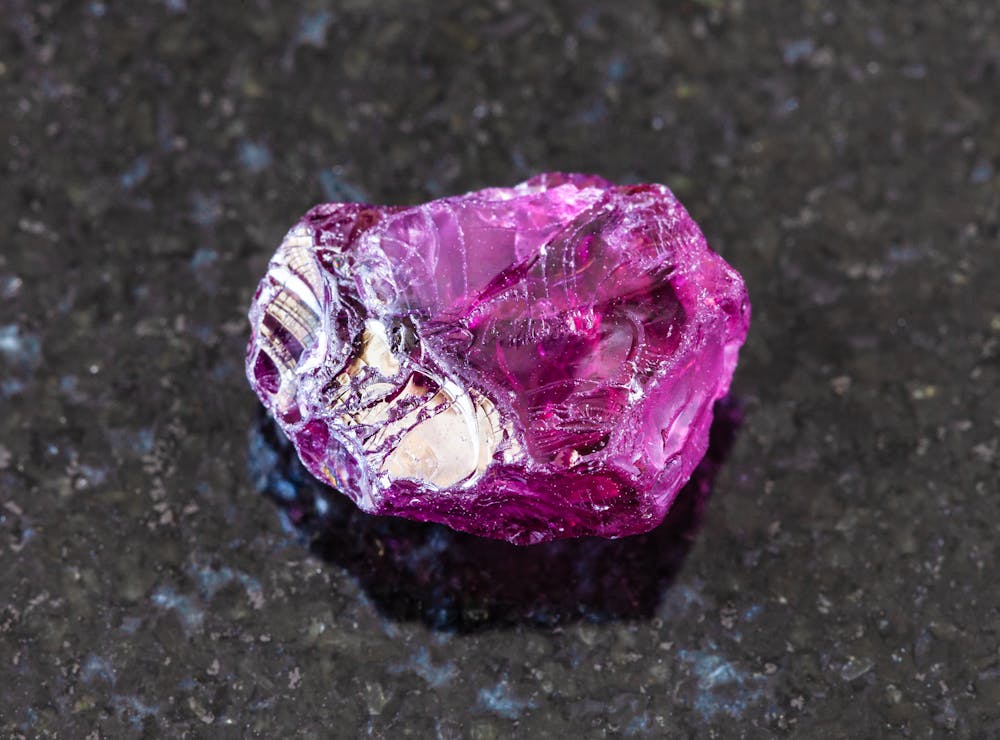
Diamonds are highly prized for their qualities but also for their rarity. One way to look for them is to search for associated minerals that occur more commonly, such as the chromium-rich pyrope garnet.
This vibrant purple garnet is easily found by diamond exploration companies, in sediment downstream from potentially diamond-bearing volcanic pipes, and within the pipes themselves. The presence of purple garnet is an indicator diamonds may also be present.
Moreover, this garnet isn’t just found near diamonds, but is also consistently found inside them. So by enhancing our understanding of pyrope garnet, and how it forms, we can also enhance our understanding of diamond formation.
It was previously thought this type of garnet could not form very deep in the Earth. The theory went that it originated from a different chromium-rich mineral, called spinel, which formed at a shallow depth in the mantle and was then pushed down where temperatures and pressures were higher – leading to the garnet’s formation.
Our latest research, published today in Nature, uses a new model to revisit an old theory that suggests these pyrope garnets are actually formed much deeper in the mantle, about 100km-250km below the present surface. It also suggests diamonds may be rarer than we think.
How diamonds and pyrope garnet form
Diamond is the crystalline form of elemental carbon, stable at very high pressures and relatively low temperatures – accidentally brought to the surface through powerful volcanic eruptions.
The necessary conditions to form diamond at great depth in the Earth’s mantle are only met in a few places. The geographic distribution of diamond is very uneven, with notable concentrations in southern Africa, the Congo, Tanzania, Canada, Siberia and Brazil. All of these places are characterised by ancient continental crust between 2.5 and 3.5 billion years old.
This crust is underlain by deep solid “roots” – like the keel of an iceberg – made of mantle which has become highly chemically depleted through intense melting over time.
It’s here in this depleted mantle, which extends as deep as 250km into the hotter, stirring mantle below it, that diamonds have the best opportunity to form. So what about their chromium-rich companions?
Using a thermodynamic computer model, we were able to demonstrate that pyrope garnets can form very deep in the Earth, at the same depths as diamonds. Specifically, these garnets would have formed during intense heating events with extreme pressures and temperatures in excess of 1,800℃.
Read more: More than just a sparkling gem: what you didn't know about diamonds
How the continents grew their roots
Although this is a very exciting finding in itself, what makes it more relevant is that it informs two other significant theories.
The first relates to why the continents formed the way they did – a point experts have long speculated about.
As mentioned above, pyrope garnets formed in extreme heat upwellings coming from great depths. Our findings suggest these upwellings then melted the upper mantle into place, forming the stable base of the continents.
In other words, the “roots” which help continents remain stable for billions of years are leftovers from the same mantle melting events that produced pyrope garnets.
Read more: Land ahoy: study shows the first continents bobbed to the surface more than 3 billion years ago
Diamond rarity
The second major inference relates to the rarity of diamonds.
Some researchers believe diamonds were not originally rare, but that many were destroyed as the mantle root was eroded and modified due to continental plates moving over the globe. Our model offers the alternative perspective that diamonds may have actually always been rare.
How can we evaluate whether the necessary cradles of diamond – bits of highly depleted mantle in the continental roots – were once common and became rare over time, or whether they have always been rare?
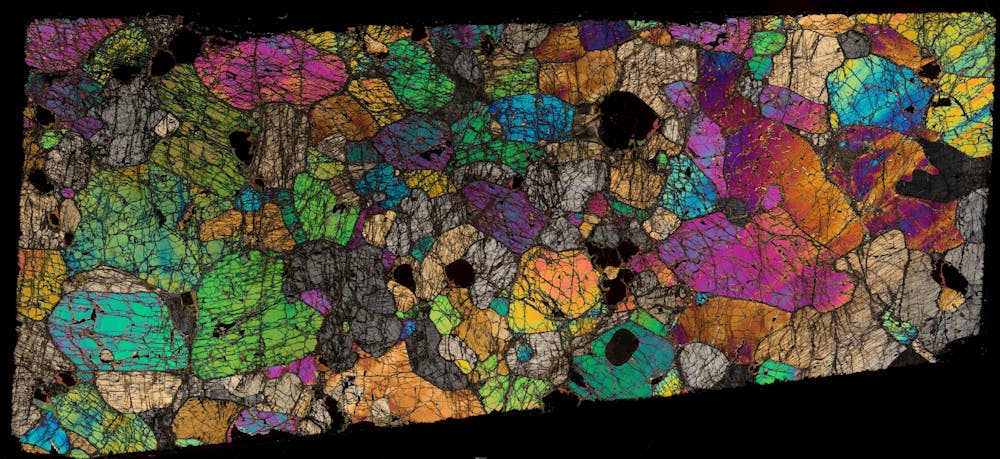 This kaleidoscopic image is a diamond cradle rock under a microscope. In this view, the garnet is the black mineral.
Author provided
This kaleidoscopic image is a diamond cradle rock under a microscope. In this view, the garnet is the black mineral.
Author provided
When intense melting events happened on the early Earth, the melts themselves erupted at the continental surface as very fluid lavas called “komatiites”. These lavas are preserved and are widely analysed. They have varying compositions, and our model predicts which of these could have formed alongside chromium-rich pyrope garnet.
We know from tens of thousands of chemical analyses of komatiite, that the particular composition associated with this pyrope garnet is very rare. That’s because in order for it to form, magma must interact with exceptionally depleted mantle that has gone through many melting events. Only between 8%-28% of komatiite fits this bill.
From this, we can infer that both the pyrope garnets, and the very depleted mantle domains they come from, have always been rare – even back on the early Earth. And because diamonds have an affinity for these particular rocks, they too must have always been rare – making them all the more remarkable.
Authors: Carl Walsh, PhD Candidate, Queensland University of Technology