the world must cut emissions and urgently adapt to the new climate realities
- Written by Bronwyn Hayward, Professor of Politics, University of Canterbury
This decade is the critical moment for making deep, rapid cuts to emissions, and acting to protect people from dangerous climate impacts we can no longer avoid, according to the latest report by the Intergovernmental Panel on Climate Change (IPCC).
The synthesis report is the culmination of seven years of global and in-depth assessments of various aspects of climate change.
It reiterates that the world is now about 1.1℃ warmer than during pre-industrial times. This already results in more frequent and more intense extreme weather, causing complex disruption and suffering for communities worldwide. Many are woefully unprepared.
The report stresses our current pace and scale of action are insufficient to reduce rising global temperatures and secure a liveable future for all. But it also highlights that we already have many feasible and effective options to cut emissions and better protect communities if we act now.
Many countries have already achieved and maintained significant emissions reductions for more than ten years. Overall, however, global emissions are up by 12% on 2010 and 54% higher than in 1990. The largest rise comes from carbon dioxide (from the burning of fossil fuels and industrial processes), followed by methane.
The world is expected to cross the 1.5℃ temperature threshold during the 2030s (at the current level of action). Already, the effects of climate change are not linear and every increment of warming will bring rapidly escalating hazards, exacerbating more intense heatwaves and floods, ocean warming and coastal inundation. These complex events are particularly severe for children, the elderly, Indigenous and local communities, and disabled people.
But in agreeing to this report, governments have now recognised that human rights and questions of equity, loss and damage are central to effective climate action.
This report also breaks emissions down to households – 10% of the highest-emitting households contribute 40-45% of global greenhouse gas emissions, while 50% of the lowest-emitting households (including small islands communities), contribute less than 15% of overall greenhouse gases.
Climate-resilient development
The report points to solutions for climate-resilient development, a process which integrates actions to reduce or avoid emissions with those to protect people to advance sustainability. Examples include health improvements that come from broadening access to clean energy and contribute to better air quality.
But the choices we make need to be locally relevant and socially acceptable. And they have to be made urgently, because our options for resilient action are progressively reduced with every increment of warming above 1.5℃.
This report is also significant for recognising the importance of Indigenous knowledge and local community insights to help advance ambitious climate planning and effective climate leadership.
Cities can make a big difference
Cities are key drivers of emissions. They generate around 70% of carbon dioxide emissions globally, and this is rising largely through transport systems relying on fossil fuels, building materials and household consumption.
But this also means urban spaces are where we can really exercise climate leadership. Decisions made at the level of local councils are going to be significant globally in terms of bringing national and global emissions down and protecting people.
Cities are sites for solutions where we can decarbonise transport and increase green spaces. While tackling climate risks can feel overwhelming, acting at the city level is a way communities can have more control over reducing emissions and where local action can really make a difference to our quality of life.
Read more: We’re building harder, hotter cities: it’s vital we protect and grow urban green spaces – new report
We know there is much more money flowing into mitigation than adaptation. But we have to do both now, and move beyond adaptation focused on physical protection (such as sea walls). We also need to be thinking really carefully about green infrastructure (trees and parks), low-carbon transport and social protection for communities, which includes income replacement, better healthcare, education and housing.
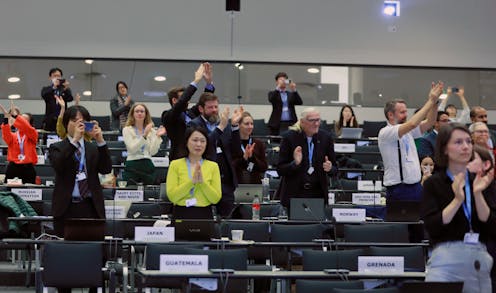
This report was particularly difficult to negotiate because we now live in a changed reality. More and more countries are experiencing very significant losses and damages. As countries face increasingly extreme weather events, the stakes are higher.
Governments everywhere, in my view as a political scientist, are now facing hard choices about how to protect their own national interests while also making significant efforts to tackle our global climate crisis. In negotiations, larger countries can dominate debate and it can take a long time to get to agreement. This puts enormous pressure on smaller nations, including Pacific delegations with fewer people and diplomatic resources. This is yet another reason to ensure action is inclusive, fair and equitable.
For authors of the IPCC core writing team, the past 18 months have been intense. We all felt significant responsibility to accurately summarise years of work, completed by hundreds of our global scientific colleagues, who contributed to six reports in this assessment cycle: on physical science, adaptation and vulnerability, mitigation, and special reports on land, global warming of 1.5℃, and ocean and cryosphere.
These reports show the choices we make in this decade will impact current and future generations, and the planet, now and for thousands of years.
Fear & Wonder is a new climate podcast, brought to you by The Conversation. It will take you inside the IPCC’s era-defining climate report via the hearts and minds of the scientists who wrote it. The first episode drops on March 23. Learn more here, or subscribe on your favourite podcast app via the icons above.
Authors: Bronwyn Hayward, Professor of Politics, University of Canterbury