

Modern Australian
The Times

How can Australia pay $368 billion for new submarines? Some of the money will be created from thin air

  • Written by Peter Martin, Visiting Fellow, Crawford School of Public Policy, Australian National University
How can Australia pay $368 billion for new submarines? Some of the money will be created from thin air

Australia’s decision to buy three nuclear-powered submarines and build another eight is so expensive that, for the A$268 billion to $368 billion price tag, we could give a million dollars to every resident of Geelong, or Hobart, or Wollongong.

Those are the sort of examples used by former NSW treasury secretary Percy Allan on the Pearls and Irritations blog, “in case you can’t get your head around a billion dollars”.

Such multi-billion megaprojects almost always go over budget.

For instance, when Prime Minister Malcolm Turnbull announced the Snowy Hydro 2.0 pumped hydroelectricity project in 2017, it was supposed to take four years and cost $2 billion. The latest guess is it’ll actually take 10 years and cost $10 billion.

So to pay for those two megaprojects alone, there’s an awful lot of money we will need to find from somewhere. Or will we?

‘No simple budget constraint’

In the first year of the pandemic, Australians were given a glimpse of a truth so unnerving that economists and politicians normally keep to themselves.

It’s that, for a country like Australia, there is “no simple budget constraint” – meaning no hard limit on what we can spend.

“No simple budget constraint” is the phrase used by Financial Times’ chief economics commentator Martin Wolf, but he doesn’t want it said loudly.

The problem is, he says, “it will prove impossible to manage an economy sensibly once politicians believe there is no budget constraint”.

A quick look at history shows he is correct about there being no simple budget constraint, despite all the talk about the need to pay for spending.

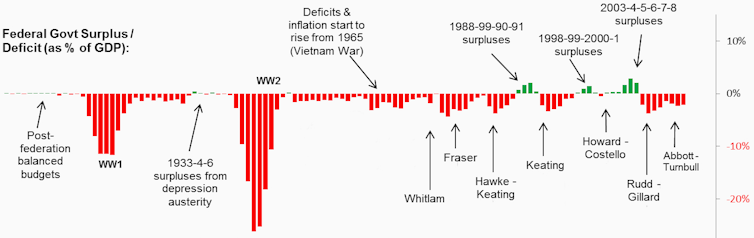
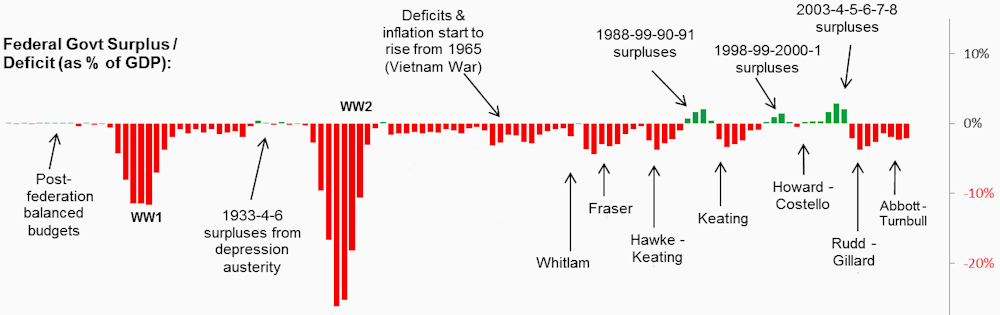
As you can see below, Australia’s Commonwealth government has been in deficit (spent more than it earned) in all but 17 of the past 50 years. The US government has been in deficit for all but four of the past 50.

Commonwealth government surpluses and deficits since 1901
Ashley Owen, Stanford Brown There is no hard limit on how the Commonwealth can spend over and above what it earns, just as there’s no hard limit on how much you and I can spend. But whereas you or I have to eventually pay back what we have borrowed, governments face no such constraint. Because the Commonwealth lives forever, it can keep borrowing forever, even borrowing to pay interest on borrowing. And unlike private corporations, it can borrow from itself – borrowing money it has itself created. Governments create money That’s what the Morrison government did in 2020 and 2021, in the early days of COVID. To raise the money it needed for programs such as JobKeeper, the government sold bonds (which are promises to repay and pay interest) to traders, which its wholly-owned Reserve Bank then bought, using money it had created. The government could have just as easily cut out the traders and borrowed directly from its wholly-owned Reserve Bank, using money the bank had created – effectively borrowing from itself. But the Reserve Bank preferred the appearance of arms-length transactions. And there’s no doubt the Reserve Bank created the money it spent, out of thin air. Asked in 2021 whether it was right to say he was printing money, Governor Philip Lowe said it was, although the money was “created”, rather than printed. People think of it as printing money, because once upon a time if the central bank bought an asset, it might pay for that asset by giving you notes, you know, bank notes. I’d have to run my printing presses to do it. We don’t operate that way anymore. These days the Reserve Bank creates money electronically. It credits the accounts of the banks that bank with it. One way to think about it (the way so-called modern monetary theorists think about it) is that none of the money the government spends comes from tax. The government creates money every time it gets the Reserve Bank to credit the account of a private bank (perhaps in order to pay a pension), and destroys money every time someone pays tax and the Reserve Bank debits the account. If it creates more money than it destroys, it’s called a budget deficit. If it destroys more than it creates, it’s called a budget surplus. Too much spending creates problems Can the government create more money than it destroys without limit? No, but where it should stop is a matter for judgement. If it spends too much money on things for which there is plenty of demand and a limited supply, it’ll push up prices, creating inflation. Where to stop will depend on how much others are spending. If there’s little demand (say for builders, as there was during the global financial crisis) the government can safely spend without much pushing up prices (as it did on builders during the global financial crisis). If it wants to spend really big (say on building submarines), it might have to restrain the spending of others, which it can do by raising taxes. What matters is what others are spending But it’s not a mechanical relationship. The main function of tax is not to pay for government spending, but to keep other spenders out of the way. If the economy is weak in the decades when the subs are being built, the burst of government spending will be welcome, and needed to create jobs. There will be no economic need to offset it by raising tax. Read more: Explainer: what is modern monetary theory? But if the economy is strong, so strong the government would have to bid up prices to get the subs built, it might have to push up tax to wind other spending back. This truth means there’s no simple answer to the question “how they are going to pay for subs?” – just as there was no simple answer to questions about how to pay for a much-needed increase in the JobSeeker, or anything else. The deeply unsatisfying answer is that, from an economic perspective, it depends on who else is spending what at the time. Authors: Peter Martin, Visiting Fellow, Crawford School of Public Policy, Australian National University

Read more https://theconversation.com/how-can-australia-pay-368-billion-for-new-submarines-some-of-the-money-will-be-created-from-thin-air-202150

7 Signs It's Time to Upgrade Your Piston Air Compressor

If you run a workshop, panel shop, or fabrication business anywhere around Perth, you already know what heat and dust do to equipment over a few sum...

How Long Do Bathroom Renovations Melbourne Take? Step-by-Step Process Explained

Planning a bathroom renovation is exciting, but one of the biggest questions homeowners ask is, "How long will it take?" While every project is uniq...

Why Your Skin Breaks Out: The Science of Acne Explained

Acne is the most common skin condition in the world. An estimated 85% of people experience it at some point between the ages of 12 and 24, and a gro...

10 Swimwear Trends Australian Women Are Wearing This Summer

Every Australian summer brings a fresh wave of swimwear trends, but some styles have much greater staying power than others. While fashion constantly ...

Why Regular Skills Updates Are Essential for Licensed Security Officers

A guard at a Brisbane shopping centre gets a call about a shoplifter who's turned aggressive.  They’ve done the job for six years. But their de-...

10 Benefits of Choosing Professional Tutoring Penrith Services

Every student has unique learning strengths, challenges, and academic goals. While classroom teaching provides essential knowledge and structure, so...

Sunshine Coast Baby Classes Prove Big Hit Among First-Time Mums

There's a movement gaining traction on the Sunshine Coast, providing a village of support, socialisation and relief for first-time mothers and babie...

Father's Day Gift Ideas for Men Who Are Hard to Buy For

Some dads are easy to buy for. Others do not want anything, already have everything, or give you the classic "don't worry about me" answer every yea...

Top 5 Mistakes That Wear Out Your Brakes Faster

Brakes don't need frequent replacements like oil changes do.   But a lot of the wear happens quietly, over months, because of habits most drivers...

Plantation Shutters vs Curtains: Which Is Better for Your New Home?

Moving into a new home is an exciting opportunity to personalise your space and make it your own. While many homeowners focus on furniture, flooring...

Celebration of Life vs Traditional Funeral: What's the Difference?

When saying goodbye to someone you love, there is no single way to honour their life. Every family has different traditions, beliefs, and preference...

Building Approval for Roofing Projects: What Homeowners Need to Know

Roofing projects are an important part of maintaining and protecting your home. Whether you're repairing storm damage, replacing an ageing roof, or ...

Chatswood Tutoring And Its Role In Academic Achievement

Academic success often requires more than classroom attendance alone. Students face increasing expectations as they progress through school, particu...

Why Laser Hair Removal Treatments Continue Growing In Popularity

Managing unwanted hair can become time-consuming and frustrating for many people, especially when shaving, waxing, and other temporary methods requi...

Choosing the Right Devices for a Flexible Workplace

For IT leaders managing large fleets, the device layer is where workforce productivity and security policy meet. The shift towards flexible and hybrid...

How Business Advisory Services Help Companies Achieve Sustainable Growth

Every business owner aims to build a profitable and sustainable organisation. While dedication, innovation, and hard work are important, achieving l...

Why Body Contouring Has Become A Popular Cosmetic Treatment

Many people maintain healthy lifestyles through regular exercise and balanced eating habits but still struggle with stubborn areas of fat that are d...

How to Choose the Right POS Hardware for Your Business in Australia

A lot of Australian business owners spend weeks researching POS software but buy hardware almost as an afterthought. That's a mistake. The wrong har...

















