New research reveals how forests reduce their own bushfire risk, if they're left alone
- Written by Philip Zylstra, Adjunct Associate Professor at Curtin University, Research Associate at University of New South Wales, Curtin University
Fire management in Australia is approaching crisis point. Seasons such as the Black Summer three years ago showed how our best efforts in fire-fighting and prescribed burning are insignificant in the face of a changing climate.
But what if forests have their own tools to manage bushfire risk, and we could tap into them?
We know long-unburnt mountain forests in south-east Australia are far less fire-prone than more recently burnt areas. And forests in south-west Australia have the lowest fire risk when they’ve not been subjected to prescribed burning.
Our study just published set out to understand why this occurs, by modelling fire behaviour in iconic red tingle forests of south-west Australia. Our findings offer a clear set of tools for living with fire, even in a warming climate.
The ‘fuel load’ dilemma
Most bushfires in the south-west forests of Western Australia occur in areas burned specifically to reduce fuel loads.
Current fire management by government agencies focuses on broadscale burning to reduce fuel load. The practice is also known as prescribed, planned, controlled or hazard-reduction burning. It aims to reduce the intensity of future fires at a location by burning leaf litter and other fine surface matter.
Fuel-load reduction is premised on the idea that the amount of fuel in a forest determines how flammable it is. The idea comes from early attempts at fire behaviour modelling imported from the United States in the 1960s.
But more recent work has shown prescribed burning can lead to catastrophic outcomes. This includes the near-destruction of critically endangered wildlife populations and the destruction of homes when prescribed burns escape.
So what can be done? Our study on the iconic red tingle (Eucalyptus jacksonii) deals with this dilemma.
Read more: Bad fire science can kill our threatened species. It's time to cooperate with nature
Getting to know the red tingle
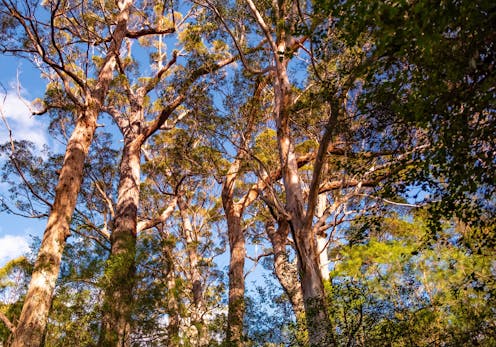
Red tingles are among the tallest eucalypts, growing up to 70 metres. They grow only in a 6,000-hectare stretch along the high-rainfall south coast of Western Australia.
Red tingles can live for more than 400 years. They regenerate well after fire – even an intense fire – and form naturally mixed aged forests dominated by large old trees.
But red tingles are sensitive to frequent fires, no matter how mild. Flames can enter the tree and hollow it out, eventually causing its collapse.
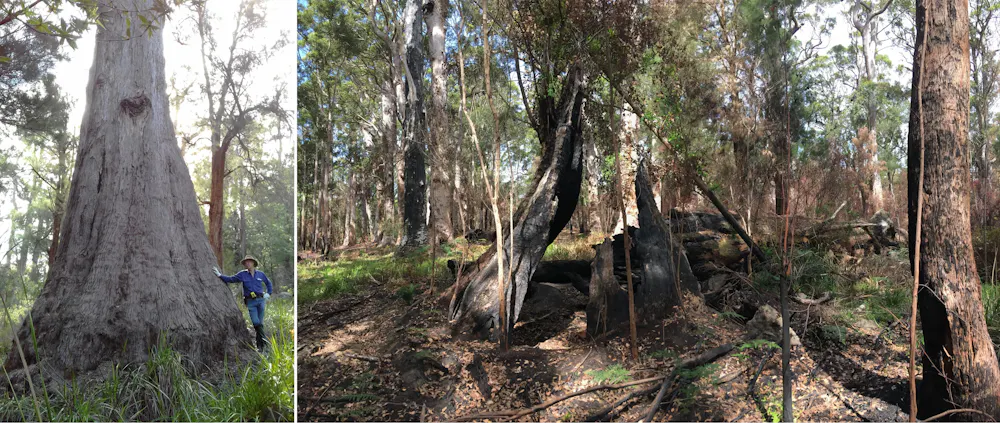
The understorey of red tingle forest consists of tall, long-lived shrubs that germinate prolifically after fire. These understoreys thin and open as they age.
The goal of our research was to understand how these changes in red tingle forests affect fire behaviour. To do this, we used an advanced fire modelling tool developed by the lead author of this article, Phillip Zylstra, and his colleagues.
The tool doesn’t use a simple number to characterise a forest’s fuel load. Instead, it uses hundreds of thousands of calculations to determine which plants will ignite – and importantly, which plants won’t ignite but will instead calm the flames.
So what did we find? As the understorey of red tingle forest ages and thins, the lower branches of taller plants “self-prune” – in other words, they shed dead leaves and twigs.
When this litter is on the ground, it begins to decay and poses a lower fire risk than if it were still suspended.
The lower branches of taller plants, once self-pruned, are then less likely to ignite as fuel. Instead, they act as “overstorey shelter” that reduces wind speed and fire severity. In this way, mature forests control fire rather than drive it.
Our study showed that, due to this calming effect, fires in mature red tingle forests could be extinguished by firefighters most of the time.
By contrast, our study showed that prescribed burning in red tingle forests creates dense regrowth, which burns severely during bushfires. In such cases, our study showed firefighters are often unable to extinguish the flames and must resort to backburning - a risky fire suppression technique.
Read more: New modelling on bushfires shows how they really burn through an area
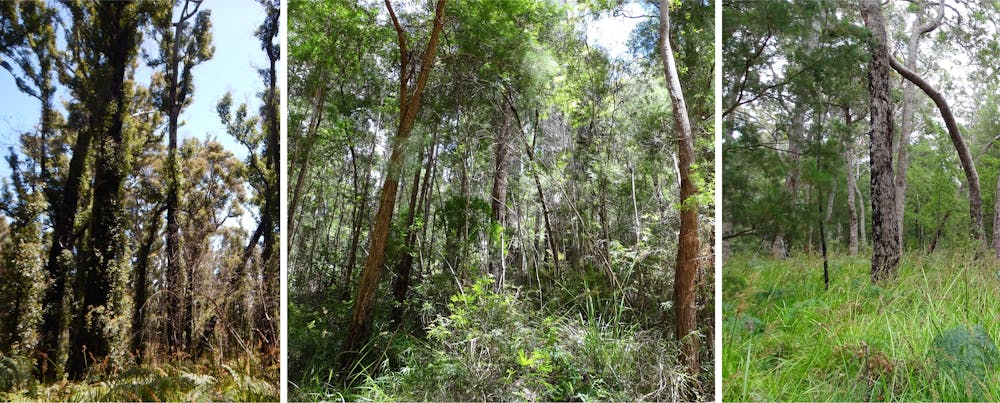 Left to right, a red tingle forest after a prescribed burn, the resulting regrowth, and mature forest.
M Howe; P Zylstra
Left to right, a red tingle forest after a prescribed burn, the resulting regrowth, and mature forest.
M Howe; P Zylstra
Making peace with the bush
Contemporary fire management approaches, and their dependence upon broadscale prescribed burns, contrast starkly with the approach of Australia’s First Nations people.
Menang and Goreng Traditional Owners of red tingle and surrounding forests say fire should be used in specific locations, burning only what is needed in small, strategically placed patches. Wadandi Pibulmun Yunungjarlu Elder Wayne Webb advised our team that Traditional Owners deliberately excluded fire from tall red tingle forests.
In our contemporary context, we can co-operate with the landscape - balancing the effects of climate change by using specialist fire-fighting skills and technological advances to reinforce safe forest havens.
The fire risk in WA’s south-western forests, and many other eucalypt forests, is so much lower if they’re left unburnt and allowed to mature. Our analysis of red tingle forests helps explain why.
One thing is clear: if we still want forests in our flammable country, we must stop burning their defences away.
Read more: Contrary to common belief, some forests get more fire-resistant with age
Authors: Philip Zylstra, Adjunct Associate Professor at Curtin University, Research Associate at University of New South Wales, Curtin University