Modern Australian
The Times

life seeking ice-free refuges imitates art in Ice Age, the movie

  • Written by Mark Stevens, Adjunct Associate Professor, University of Adelaide
life seeking ice-free refuges imitates art in Ice Age, the movie

Antarctica is an icy place today, but the ice extended even further during past ice ages. The question of how and where life survived on land in the icy continent, through the ages, has long puzzled biologists.

Ever since the first expeditions to Antarctica, the persistence of life in this inhospitable environment has remained a mystery. Until now.

We assembled data to test our theory of how life survived previous ice ages. We argue that life forms including invertebrates, vertebrates and plants persisted by retreating to numerous ice-free areas, called nunataks, that were not buried by advancing glaciers.

Then when Antarctica gradually warmed up again, life expanded from these nunatak refuges to repopulate larger ice-free areas. Our approach explains the uneven distribution of Antarctic terrestrial life, and identifies new research priorities to test our theory further.

The coming age of ice

Ice Age the movie (clips): With the impending ice age almost upon them, a mismatched trio of prehistoric critters – Manny the woolly mammoth, Diego the sabre-toothed tiger and Sid the giant sloth – find an orphaned human infant and decide to return it.

For many, the term “Ice Age” conjures up memories of the animated adventures of Manny, Sid and Diego (and don’t forget that squirrel-rat, Scrat!) trying to escape the advancing ice.

There may be some truth to this story. The idea of a mammoth, sloth, sabretooth tiger (and pesky humans) migrating south for warmer climes is becoming well known in the Northern Hemisphere. And research published this month suggests early humans sat out the last ice age in the ice-free refuges of southern Europe.

But in Antarctica, land-loving life forms had nowhere to go. Or so it seemed, until now.

As scientists began to learn more about life in Antarctica, they began to consider the possibility of survival in ice-free refuges. But there was a problem. Any ice-free land in coastal regions, where life exists today, would have surely been consumed by the expanding ice. So how did life survive?

Unusual ice-free refuges

Using evidence from the biology and geology of Antarctica, we describe how ice-free refuges (nunataks) could have provided respite for coastal species.
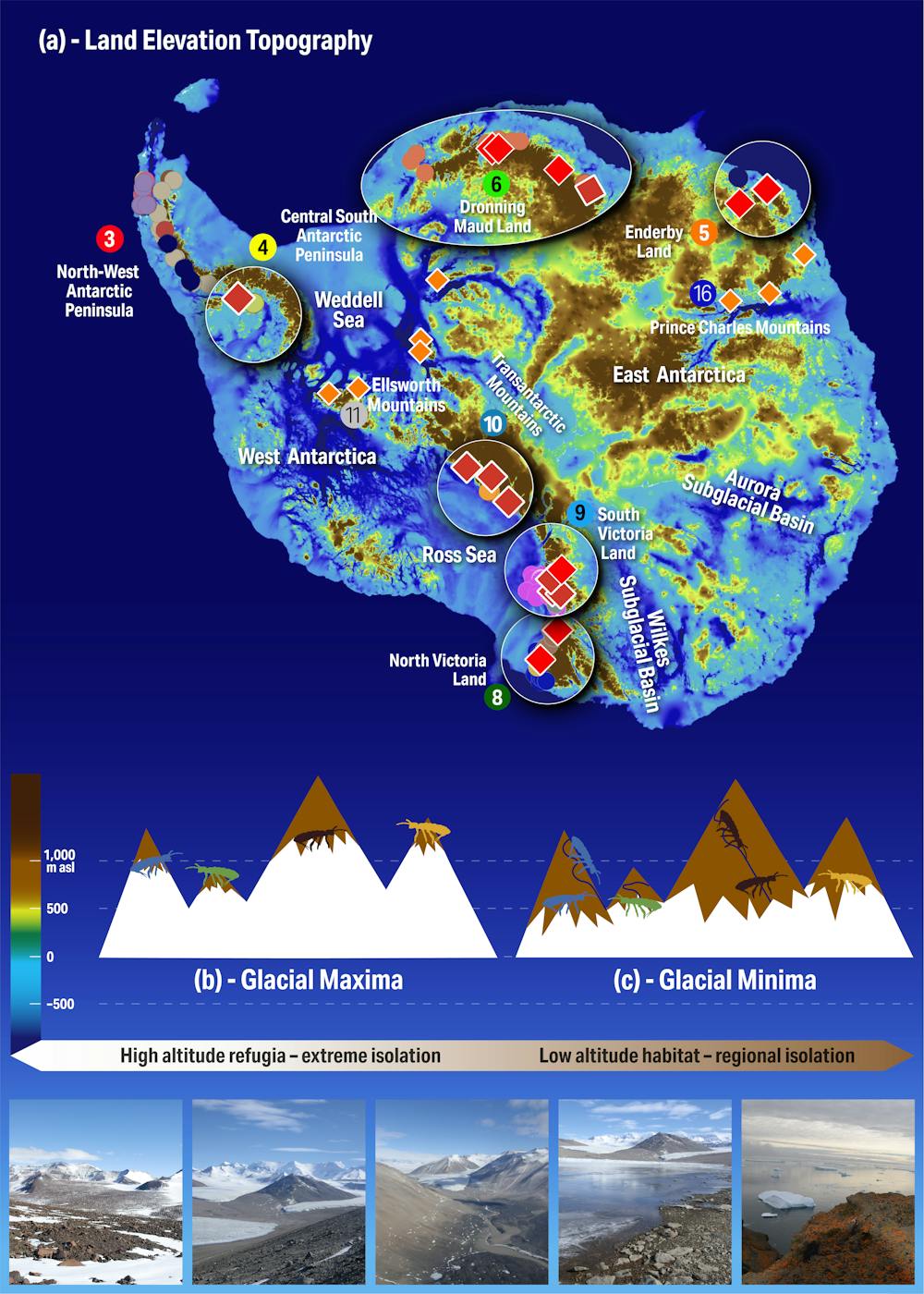
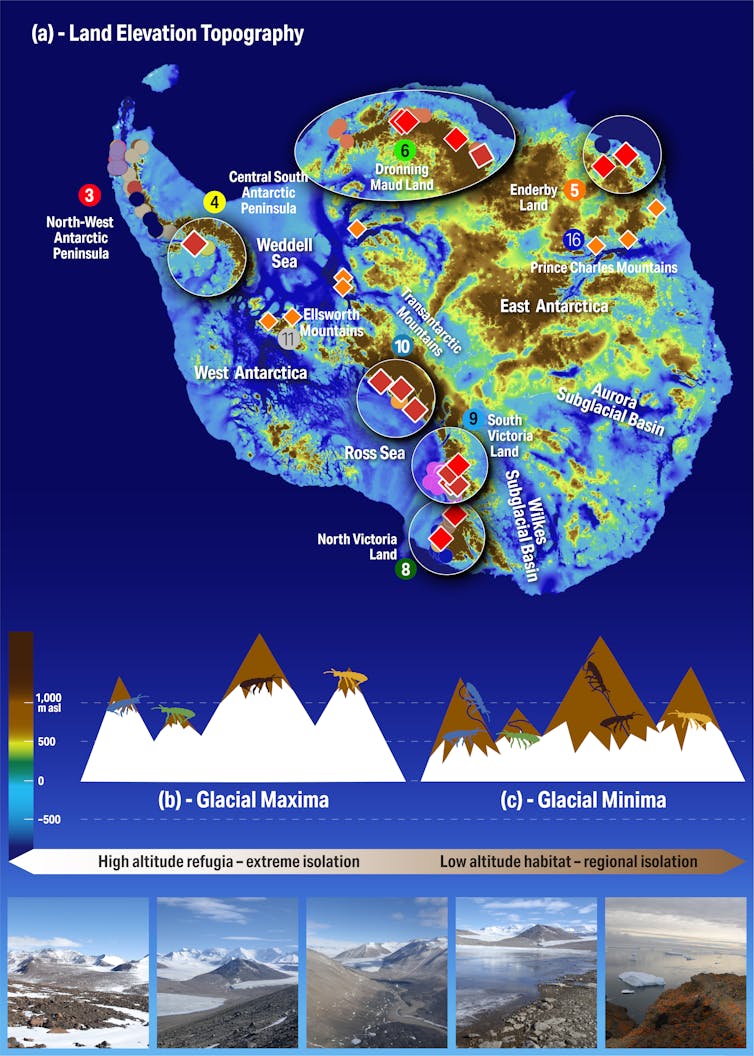
Image of Antarctica from above showing land elevation topography and locations where springtails were sampled, also schematic of mountains comparing glacial maxima (ice age) and minima (before/after ice age).
The nunatak refuge hypothesis is that life retreated during ice ages to ice-free refuges on mountain tops (nunataks) and moraines, across the continent. Evidence for this theory comes from springtail specimens and geological records. This map of an ice-free Antarctica (a) reveals land above sea-level (green/yellow/brown). Every known springtail sampled is shown (coloured circles within the ellipses). Ice-free refuges indicated by cosmogenic dating (red/orange diamonds). Survival of springtails (colours represent isolated species) in ice-free terrain shown in (b and c) shift with glacial margins as ice expands and retreats. Biology Letters, CC BY

We discounted previous research suggesting geothermal sites provided sufficient ice-free refuges on the coast. That’s because these would have been short-lived - compared to an ice age lasting around 100,000 years - and too few in number to explain the survival of life on the continent today.

We provide the first testable evidence-based hypothesis for the existence of life on continental Antarctica for millions of years. And we achieved this using the most well-known of all Antarctic invertebrates, a small creature that inhabits ice-free land year-round: springtails.

Springtails are an important contributor to soil health globally. They were among the first animals collected during early expeditions to the Antarctic Peninsula and the northern coast of Victoria Land from 1897-1900.

We collated a database of distribution records for Antarctic springtails from these first discoveries more than a century ago to the present.

Read more: 200 years of exploring Antarctica – the world's coldest, most forbidding and most peaceful continent

The springtail Cryptopygus sverdrupi is one of many species found in Antarctic ice-free locations. This species is from Dronning Maud Land, and survives on the numerous nunataks that stick out of the ice cap that covers the Antarctic continent. Cyrille D'Haese

We also delved into an existing resource that has not been previously used to explore these questions of survival. By exploring the Informal Cosmogenic-nuclide Exposure-age Database (ICE-D) for Antarctica, we were able to demonstrate that ice-free conditions persisted across the last (and previous) ice ages at a large number of locations.

Cosmogenic-nuclide dating is normally used to improve the understanding of ice sheets’ response to climate change, by revealing when a rock was last covered by ice. But it had not been used to identify ice-free glacial refuges, until now.

Jamey Stutz samples two ice-transported cobbles (rocks) at Hughes Bluff in Victoria Land, Antarctica.
Dating rocks in Antarctica has provided a unique way to identify where life could have survived repeated ice ages. Jamey Stutz samples two ice-transported cobbles (rocks) at Hughes Bluff in Victoria Land, Antarctica. The cobbles were deposited thousands of years ago, when the ice was thicker than today. Andrew Mackintosh, Author provided

We show that some of these ice-free refuges persisted above the expanding ice during past ice ages. Some contained all species found in a region.

But how did life move from these refuges, to repopulate habitats such as coastal areas? Clues to this remarkable survival story comes from well-known alpine and polar studies, showing life present in ice-free ecosystems near glacial margins shifts as the ice expands or contracts.

Mount Suess, nestled within the Mackay Glacier in Victoria Land, provides one of the best examples of survival of life on nunataks across the last ice age. Dating rocks in the area reveals it remained ice-free. Kevin Norton and Richard Jones

Learning life lessons

Antarctic life faces an uncertain future as the climate changes. The region is experiencing more extreme events such as the catastrophic breakup of ice shelves, the highest observed Antarctic air temperature, and the least extensive sea ice ever recorded. It seems we are now living in the sequel “Ice Age: The Meltdown”. Let’s hope we fare as well as Manny and his friends.

Read more: The Antarctic ice sheet is melting. And this is bad news for humanity

Antarctica will change forever, and limiting that change will take a “mammoth” collective effort at a global scale to rapidly reduce greenhouse gas emissions. This is a daunting and unprecedented challenge, but one which is required to secure Antarctica’s future. Life endured past ice ages, but can it survive us?

The Antarctic Dry Valleys region is one of the driest places on earth. Today, it has the greatest amount of ice-free areas in Antarctica. These, and other regions around Antarctica, are expected to be dramatically affected by climate changes leading to large volumes of fresh water from the melting glaciers. Mark Stevens

Read more: Troubling new research shows warm waters rushing towards the world's biggest ice sheet in Antarctica

Authors: Mark Stevens, Adjunct Associate Professor, University of Adelaide

Read more https://theconversation.com/antarctic-ice-age-survival-story-life-seeking-ice-free-refuges-imitates-art-in-ice-age-the-movie-201231

How Long Do Bathroom Renovations Melbourne Take? Step-by-Step Process Explained

Planning a bathroom renovation is exciting, but one of the biggest questions homeowners ask is, "How long will it take?" While every project is uniq...

Why Your Skin Breaks Out: The Science of Acne Explained

Acne is the most common skin condition in the world. An estimated 85% of people experience it at some point between the ages of 12 and 24, and a gro...

10 Swimwear Trends Australian Women Are Wearing This Summer

Every Australian summer brings a fresh wave of swimwear trends, but some styles have much greater staying power than others. While fashion constantly ...

Why Regular Skills Updates Are Essential for Licensed Security Officers

A guard at a Brisbane shopping centre gets a call about a shoplifter who's turned aggressive.  They’ve done the job for six years. But their de-...

10 Benefits of Choosing Professional Tutoring Penrith Services

Every student has unique learning strengths, challenges, and academic goals. While classroom teaching provides essential knowledge and structure, so...

Sunshine Coast Baby Classes Prove Big Hit Among First-Time Mums

There's a movement gaining traction on the Sunshine Coast, providing a village of support, socialisation and relief for first-time mothers and babie...

Father's Day Gift Ideas for Men Who Are Hard to Buy For

Some dads are easy to buy for. Others do not want anything, already have everything, or give you the classic "don't worry about me" answer every yea...

Top 5 Mistakes That Wear Out Your Brakes Faster

Brakes don't need frequent replacements like oil changes do.   But a lot of the wear happens quietly, over months, because of habits most drivers...

Plantation Shutters vs Curtains: Which Is Better for Your New Home?

Moving into a new home is an exciting opportunity to personalise your space and make it your own. While many homeowners focus on furniture, flooring...

Celebration of Life vs Traditional Funeral: What's the Difference?

When saying goodbye to someone you love, there is no single way to honour their life. Every family has different traditions, beliefs, and preference...

Building Approval for Roofing Projects: What Homeowners Need to Know

Roofing projects are an important part of maintaining and protecting your home. Whether you're repairing storm damage, replacing an ageing roof, or ...

Chatswood Tutoring And Its Role In Academic Achievement

Academic success often requires more than classroom attendance alone. Students face increasing expectations as they progress through school, particu...

Why Laser Hair Removal Treatments Continue Growing In Popularity

Managing unwanted hair can become time-consuming and frustrating for many people, especially when shaving, waxing, and other temporary methods requi...

Choosing the Right Devices for a Flexible Workplace

For IT leaders managing large fleets, the device layer is where workforce productivity and security policy meet. The shift towards flexible and hybrid...

How Business Advisory Services Help Companies Achieve Sustainable Growth

Every business owner aims to build a profitable and sustainable organisation. While dedication, innovation, and hard work are important, achieving l...

Why Body Contouring Has Become A Popular Cosmetic Treatment

Many people maintain healthy lifestyles through regular exercise and balanced eating habits but still struggle with stubborn areas of fat that are d...

How to Choose the Right POS Hardware for Your Business in Australia

A lot of Australian business owners spend weeks researching POS software but buy hardware almost as an afterthought. That's a mistake. The wrong har...

Why Material Handling Hose Is Critical for Industrial Efficiency

A high-performance material handling hose is an essential component in industries that transport abrasive, dry, or bulk materials on a daily basis...