

Australia is now almost entirely held by Labor
- Written by Frank Bongiorno, Professor of History, ANU College of Arts and Social Sciences, Australian National University
When Dominic Perrottet gave a gracious concession speech after his defeat in the New South Wales election on Saturday night, it was hard to avoid favourable comparison with the United States. There was no sign of rancour or hyper-partisanship. He praised Labor’s Chris Minns for a clean campaign. He predicted Minns would be a “fine” premier, urging people to “get behind him”.
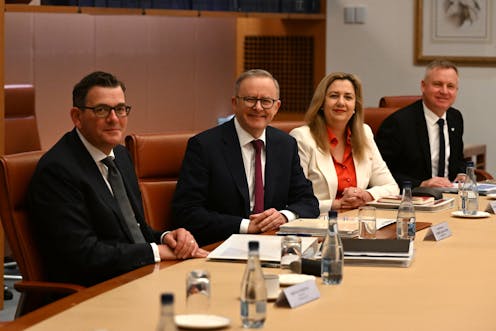
But in one respect, our politics do look more American: Australia now has “red” and “blue” states, although we reverse their political colour scheme. The maps have already begun to appear on social media. The Australian mainland, with its five states and two territories, is now “red”. Only little Tasmania remains “blue”, looking like an antipodean Taiwan, with the sole surviving Liberal government in the country.
These look like good times for Labor. It is not quite there yet, but the last time – indeed, the only time – it has been in office in all nine of Australia’s jurisdictions was for a few months between late November 2007 and early September 2008, between Kevin Rudd’s federal victory and Alan Carpenter’s loss to Colin Barnett in Western Australia a little over nine months later.
The parties of the right have also only once, since 1910, held office everywhere: for just over a year, in 1969-70, between a win in Tasmania and a loss in South Australia. In those days, the bar was a little lower than today, for neither the Northern Territory nor Australian Capital Territory had gained self-government yet. Australia had six sub-national jurisdictions, not the eight of today.
Read more: Labor is odds-on for a narrow victory in NSW election, but it is far from a sure bet
An obvious question to ask of these circumstances is whether they matter for the governments involved. Is it, for example, easier for a federal government if the states and territories are ruled by the same party? Is it better for a state or territory government if the government on the federal scene has the same complexion?
Like so many historical questions, the answer isn’t simple.
If government by one party is rare in Australia, a situation where one party has become preponderant nationally is not. The 1980s, for instance, was a Labor decade in ways that extended well beyond the ascendancy of the Hawke government. Labor was also in power in New South Wales, Victoria, South Australia and Western Australia for much of the decade.
In the 1990s, there was something of a reversal. Beginning in New South Wales in 1988, all four of those states became Coalition or Liberal by 1993. To balance things a little, Labor won power in Tasmania (in an Accord with Greens Independents) and Queensland in 1989. But when the John Howard government came to office in March 1996, there was just one Labor government left in Australia, that of Bob Carr in New South Wales, which had returned to office the previous year.
These configurations very likely reverberated in federal electoral politics. In 1990, as Labor’s tide went out in Victoria, it was coming in for the party in Queensland. The early unpopularity of some hardline policies of the Kennett government in Victoria possibly helped Paul Keating in the 1993 election.
There was some irony here, since Keating’s relations with Kennett were healthy in a way they had not been with John Cain, Victorian Labor premier through much of the 1980s. Cain, who tried to steer his government on a Keynesian path in an era of economic rationalism, blamed Hawke government economic policy for many of the difficulties his state had faced during the decade.
Here is a reminder there is no guarantee of sweetness and light simply because the same party holds office in a state and in Canberra. The history of strong disagreement between federal and state governments of the same complexion is almost as long as the history of the two-party system itself.
When the Fisher Labor government sought additional powers via a constitutional referendum in 1911, it was stymied by opposition from the New South Wales Labor government, and especially the attorney-general, William Holman, who saw in the proposals a dangerous trend towards centralisation of power.
The most spectacular clashes between federal and state government have arguably occurred when they have represented different sides of politics. Those over censorship and conscription during the first world war in 1917 between T.J. Ryan, the Queensland Labor premier, and Billy Hughes, who had split the Labor Party and formed the Nationalists, were legendary.
Gough Whitlam’s exasperation with Joh Bjelke-Petersen led him to call the Queensland premier a “bible-bashing bastard”. The latter’s actions in filling a casual vacancy with a Senator hostile to the Whitlam government, and a similar action by a Liberal premier of New South Wales, damaged Whitlam. But it should be recalled that there were also strains, over money, between Whitlam’s government and that of his Labor counterpart in South Australia, Don Dunstan.
Conversely, there is little evidence until quite late in the day that the Howard Coalition government was greatly hampered by having to face a wall of Labor governments in the early 2000s.
There was a rather pointed walk-out from a Premiers’ Conference over health policy in 2003; one of the premiers involved was still chuckling about it years later when recounting the stunt to me. And the premiers, especially Victoria’s Steve Bracks, made difficulty over the Murray-Darling basin policy late in the life of Howard’s government.
Nonetheless, state and territory governments, whatever their stripe, have a strong incentive to cooperate, even if few are as simpatico as Labor prime minister Ben Chifley, and South Australian Liberal and Country League premier Tom Playford in the years following World War Two. Meanwhile, Scott Morrison’s relations with both Gladys Berejiklian and Dominic Perrottet disclose how unhappy political families can become.
Anthony Albanese will be taking nothing for granted in his relations with Labor state and territory governments. And the premiers and chief ministers will know better than to expect too many free kicks.
Authors: Frank Bongiorno, Professor of History, ANU College of Arts and Social Sciences, Australian National University

















