Gabriele Amorth conducted over 60,000 exorcisms and believed Hitler was possessed. Meet the man who inspired The Pope’s Exorcist
- Written by Brendan C. Walsh, Sessional Academic, The University of Queensland
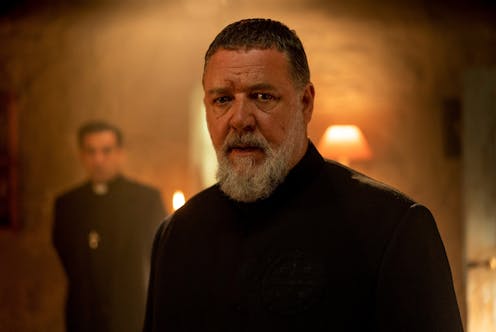
Father Gabriele Amorth (1925-2016) was undoubtedly the most famous Catholic exorcist of the modern era. By his account, Amorth performed at least 60,000 exorcisms during the course of his ministry, sparking a renewed interest for exorcism within Catholicism.
Amorth was also known for his controversial statements.
He claimed Hitler and Stalin were possessed by the Devil. In 2012 he made headlines for asserting paedophilic cults operated within the Vatican.
Modern popular culture was also an affront to Amorth. He railed against ouija boards, yoga and Harry Potter, believing them to be a gateway to the demonic.
Now, Russell Crowe’s new supernatural horror film The Pope’s Exorcist fictionalises Amorth’s exorcism ministry, adding in a centuries-old Vatican cover up for good measure.
Exorcism and the church
Exorcism has been a prominent rite of the Christian faith since its inception.
During the first few centuries exorcism could be performed by all believers and it played an important role in attracting outsiders to the burgeoning faith.
As Christianity took hold across the Roman Empire, exorcism shifted from a form of charismatic lay-healing into a miracle carried out by figures of exceptional spiritual authority. From the 4th century, the liturgy of exorcism was refined as the early church assumed full authority over the ritual.

The use of exorcism has waxed and waned over the centuries. During the mid-20th century, many clergy thought exorcism had no place in modern Catholic theology.
Vatican II, an international conference of Catholic bishops held between 1962 and 1965, signalled a move away from exorcism as the church attempted to modernise.
The 1960s and early 1970s represented a historical low point in the practice of this ritual.
The period following witnessed a backlash of conservative charismatic Catholicism with exorcism at the forefront. The work of Catholic exorcists such as Amorth played a significant role in legitimising the modern practice of this ritual.
This growing popularity provoked the Vatican to publish a new set of exorcistic guidelines in 1998 and increase the number of priests trained to address demonic possession.
While many clergy remain sceptical, support for exorcism is present at all levels of the Catholic Church. And in the last decade, the practice has experienced a worldwide surge in demand.
Read more: The Catholic Church's views on exorcism have changed – a religious studies scholar explains why
What’s in an exorcism?
The Catholic Church divides exorcism into “minor” and “major”.
A minor exorcism consists of sacraments and blessings used to treat demonic influence. The priest will usually deliver a prayer, invocation or litany upon the afflicted. Lay people may also pray on the afflicted’s behalf.
Typically, a minor exorcism is applied to all individuals being baptised into the Catholic Church.
A Major Rite of Exorcism is only carried out when there is a perceived case of demonic occupation.
These rituals encompass readings of the Psalms and Gospel, reciting of specific “exorcistic prayers”, holy water, a crucifix and the performing of the sign of the cross.
The exorcist might also use “the imposition of hands, as well as the breathing on the person’s face (exsufflation)”.
In this instance Hollywood’s sensationalist depiction of exorcism does at least get the basics right.
The church requires a thorough medical and psychiatric examination before a major exorcism can be implemented. Canon Law, the code of laws governing the church, dictates exorcisms can only be performed with “express permission” from the local ordinary, a church officer who can execute these laws.
Amorth, however, believed the need for exorcising demons was so great he advocated all Catholic clergy should be permitted to perform major exorcisms without acquiring permission.
Amorth seems to have had carte blanche in fulfilling his exorcism ministry.
Read more: Exorcism – how does it work and why is it on the rise?
Amorth’s exorcisms
Amorth led a colourful life. As a teenager, he was part of the Italian resistance against the Nazis and their fascist collaborators. After the war, he studied law and was briefly deputy to the future Italian prime minister Giulio Andreotti.
In 1946 he entered the Society of St Paul and worked as a journalist for Catholic media.
Amorth’s exorcism ministry didn’t formally begin until he was 61 and was unexpectedly appointed exorcist of the Diocese of Rome in 1986. He enthusiastically took to this new vocation, serving as an assistant to notable exorcist Father Candido Amantini.
In the early 1990s, Amorth established the International Association of Exorcists, becoming its longtime president. The association received Vatican approval in 2014 and now holds a biannual exorcism conference.
Amorth’s claim of performing over 60,000 exorcisms requires further investigation. In his biography An Exorcist Tells His Story Amorth clarified an exorcism was an individual prayer or ritual ranging anywhere from “a few minutes” to “many hours” in length. He could thereby perform dozens of exorcisms per day, usually on troubled souls appearing on his doorstep.
By Amorth’s own admission, only 100 of the exorcisms he performed were for outright demonic occupation.
Amorth demonstrated a rather cavalier attitude towards exorcism. In his biography he wrote “an unnecessary exorcism never harmed anyone”.
He also outlined the ritual itself was diagnostic. “Only through the exorcism itself can we determine with certainty whether there is a satanic influence,” he said.
This rationale explains Amorth’s impressive exorcism record.
An enduring archetype
Amorth is the ideal figure for dramatisation. He neatly embodies the archetype of the Catholic exorcist: the courageous man of faith who rescues afflicted souls from the Devil’s clutches.
This archetype continues to be enduring. It represents a traditional form of spiritual authority seldom seen in our modern society. If an individual has the power to exorcise demons this can be seen as a validation of their faith, the Devil and God.
As long as films like The Pope’s Exorcist continue to perpetuate the Catholic Church’s effectiveness against demonic incursion, exorcism will remain as a viable spiritual practice for the foreseeable future
Read more: Dealing with devil has long been a part of medicine
Authors: Brendan C. Walsh, Sessional Academic, The University of Queensland