

I’ve created a monstera! How to care for the ‘Swiss cheese plant’ in your life
- Written by Gregory Moore, Senior Research Associate, School of Ecosystem and Forest Sciences, The University of Melbourne
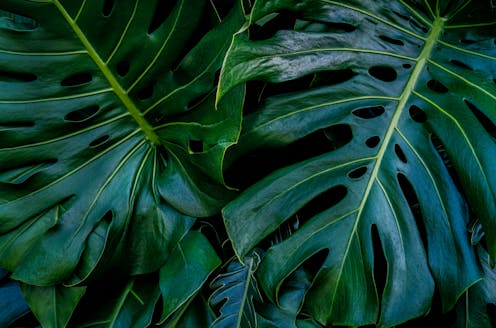
When I was growing up monsteras (sometimes known as monsteria) were not all that common, but neither were indoor plants. In fact, monsteras were out of fashion back then – but now monsteras are back and, appropriately, in a big way.
The plants that we know as monsteras, fruit salad plant or Swiss cheese plants (due to their holey leaves) are a rainforest plant called Monstera deliciosa.
They’re originally from Central America, around Mexico, but their iconic large leaves can now be found everywhere in popular culture – from fabric prints and earrings to tattoos and mugs.
So, what’s special about this large and lovely plant? And what’s the secret to keeping one happy and healthy?
Read more: Multi-coloured plants are suddenly a home decor 'must-have'. Here's how to keep them alive
Rainforest climbers
In their natural habitat, monstera are climbers that can scramble through rainforest trees to heights of 25 metres or more.
Their large perforated leaves can be over a metre long, with regular nodes along the stem and roots often growing from these nodes. The roots help them hook onto other plants as they climb to access light.
There are about 50 species in the Monstera genus and some – such as Monstera adansonii (Adanson’s monstera or five holes plant) and Monstera siltepecana (silver monstera) – are popular indoor plants.
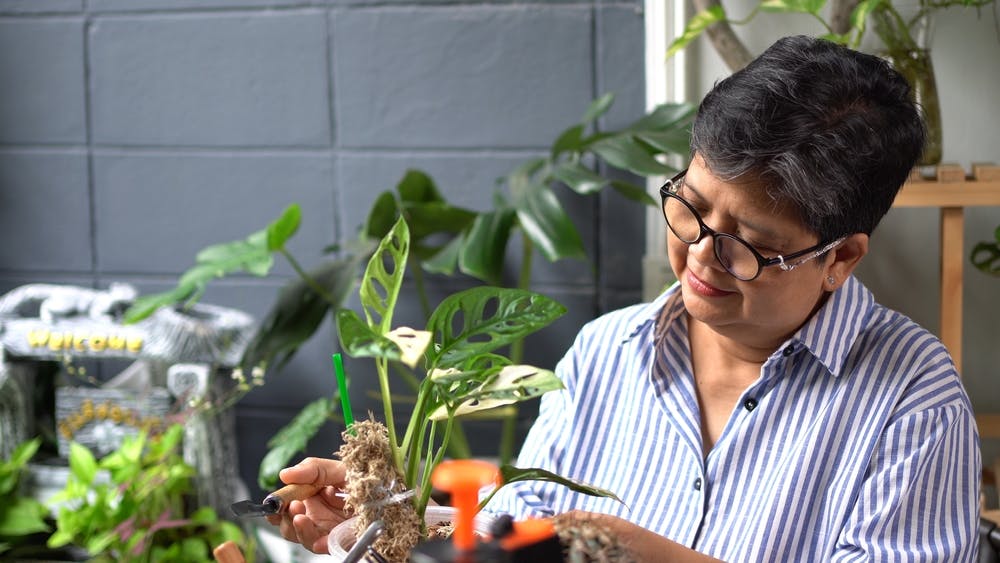
The name Monstera dates back to the 1700s, but these days most people associate this part of the name with its massive leaves. They are, after all, real monsters.
These huge leaves develop wherever there is a patch of light and allow the plant to grow quickly and shade out nearby competition.
The species name, deliciosa, refers to its fruit, which tastes a little like a cross between banana and pineapple.
Monsteras are related to the arum lilies and produce white flowers on a fleshy stem (known as a “spadix”) that is surrounded by a cream or white leaf-like structure or bract (known as a “spathe”).
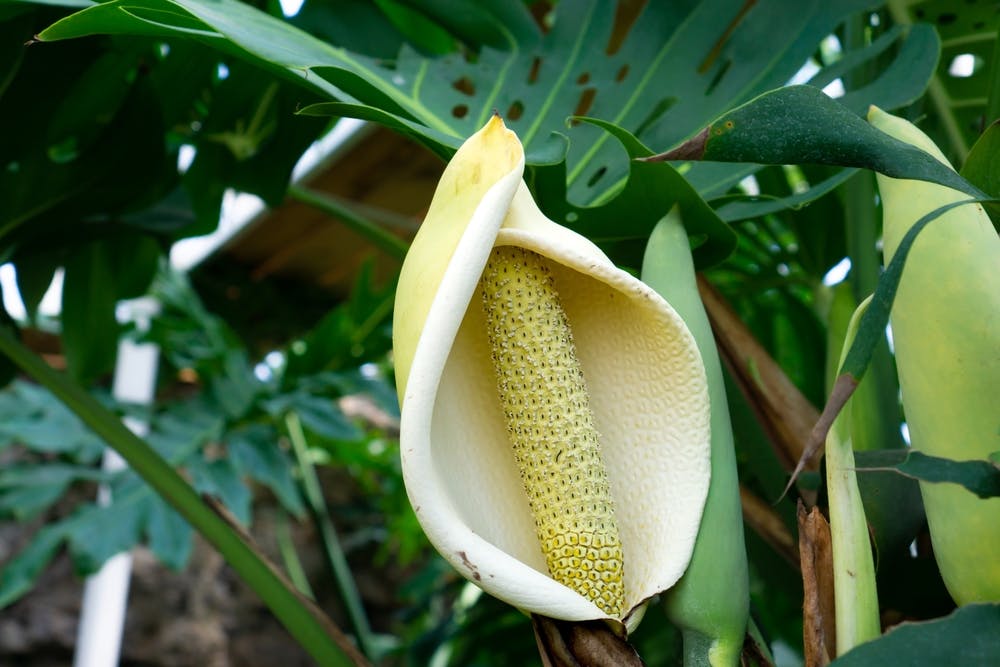 The fruit can be eaten.
Shutterstock
The fruit can be eaten.
Shutterstock
Our first and only monstera began its life with us as a rather small indoor plant given as a gift in 1980. It remained indoors for a year or two, growing well, but then proved too great a temptation for a curious young son.
It was moved in its container (which was, by then, larger than its original pot) into a protected corner of an outside patio.
It had done well indoors, growing in a good quality potting medium, getting plenty of sunlight and regular water. Its leaves had gone from small philodendron-like features into the large and perforated foliage of the Swiss cheese plant.
The move outdoors did it no harm. Good light, regular water, fresh air and protection from winds and frosts saw it flourish into a plant with many large leaves and measuring nearly two metres in height. It filled a corner beautifully.
A forgiving plant
Monsteras are quite forgiving indoor plants. They are quite hardy (like many climbers) but as a tropical plant they like warm, humid conditions and moist, well-drained soils.
They also tolerate shade and so it’s not surprising they do well indoors.
If you have a humus-rich potting medium and provide a climbing frame for them, they can thrive and survive for many years inside. However, you may need to give them a liquid fertiliser every year or two and re-pot them into a larger container.
While they are hardy and relatively easy to cultivate, Monsteras can decline if they become waterlogged.
This can easily happen if you over-water plants and have the container on a dish that gathers water.
Direct sunlight near a window can burn their leaves or lead to scorched patches. Leaves can also be damaged by warm dry air if plants are placed too close to heaters or heating ducts.
Their large leaves may also need dusting as the surfaces can become quite dirty, especially in bathrooms. The occasional prune will prevent the plant becoming too big indoors and removes yellow, burnt and older leaves.
Like many indoor plants, monsteras can benefit from a bit of R-and-R outdoors in a warm, sheltered spot for a few days.
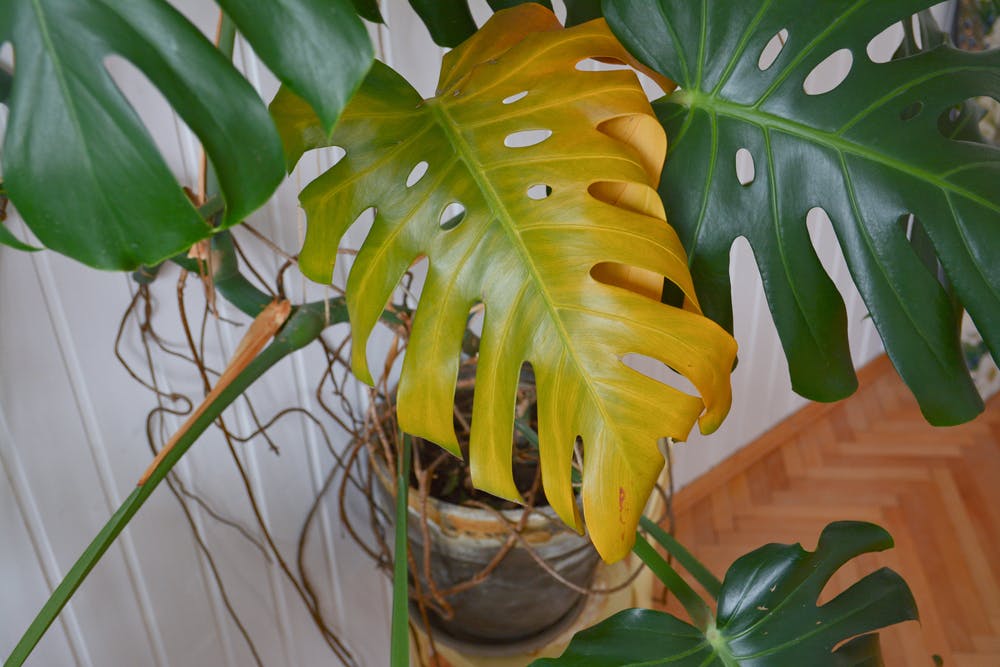 Yellow leaves are a sign you’re likely doing something wrong.
Shutterstock
Yellow leaves are a sign you’re likely doing something wrong.
Shutterstock
Easily propagated
As a fashionable plant, large monsteras can be quite pricey and variegated forms which grow more slowly are even more expensive.
However, Monstera deliciosa can be readily propagated from cuttings.
The easiest and quickest way of getting a new plant is to take a section of stem with a leaf or two attached and, if possible, with a few developing roots. Place it in a good quality potting mix in a large container.
You can also aerial layer monsteras, which is where you wrap potting mix or sphagnum moss around a node, preferably with some roots, in plastic or cling wrap. Make a couple of slash-like cuts in the stem and when roots develop, take your cutting from the stem.
They grow and establish quickly. So quickly, in fact, they’re considered a weed along some New South Wales rivers.
After being on the patio for several years, the patio was to be demolished for an extension and our monstera either had to go or be planted in the garden.
We chose the latter and planted it in what we thought was an appropriate spot.
The monster responded as only a successful rainforest climber could. It spread, it climbed, it fruited and wherever there was a patch of light, it oriented a giant Swiss cheese leaf to gain maximum benefit for photosynthesis.
It is now over 40 years old, many metres long as it meanders its way through the garden and has been the source of several successful cuttings for family and friends.
Read more: Trees can be weeds too – here's why that's a problem
Authors: Gregory Moore, Senior Research Associate, School of Ecosystem and Forest Sciences, The University of Melbourne

















