A decade after the Rana Plaza garment factory disaster, New Zealanders still rely on fast fashion
- Written by Mike Lee, Associate Professor of Marketing, University of Auckland
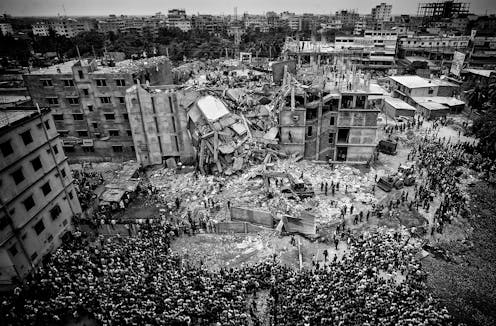
Ten years to the day after the collapse of the Rana Plaza garment factory in Bangladesh, a disaster that killed more than 1,100 workers and injured another 2,500, the global addiction to cheap clothing remains strong.
In New Zealand, fast fashion has gone from strength to strength, fuelled by the ongoing cost of living crisis, low wages and accessible cheap clothing.
And it is understandable.
When you’re struggling to pay rent or put food on the table, it’s a lot harder to think about the needs of others – particularly those overseas and essentially invisible in your daily life.
Our research has shown that a person’s subjective wellbeing – how they evaluate their life circumstances, experiences and feelings in relation to the people around them – needs to be good before they have room for moral and ethical consumer dilemmas such as sustainability, the environment and fair wages.
The cracks that killed
There were a number of factors that led to the Rana Plaza disaster. The eight-storey building had visible – and growing – cracks in a wall that were worsened by the vibrations of a two-tonne generator on the roof.
Garment workers, working in conditions akin to modern slavery, raised their concerns with managers but were told they would lose their jobs if they didn’t continue to work in the building.
Read more: Fast Fashion: Why garment workers' lives are still in danger 10 years after Rana Plaza — Podcast
A power cut on the morning of April 24, 2013, led to the use of the generator, causing the building to collapse. Garment labels for a number of global brands were found in the rubble. Rana Plaza is considered one of the worst industrial disasters ever, second only to the 1984 Union Carbide accident that killed 3,787 people in Bhopal, India.
In the Rana Plaza aftermath, the building’s owner, factory bosses and the Bangladesh government were blamed. But the spotlight was also shone on the fast fashion phenomenon. The workers and factory owners were under intense pressure to meet relentless production deadlines for clothing brands around the world, and do so at minimum cost.
Low cost, high price
Fast fashion refers to the rapid and cheap design, manufacturer and marketing of high volumes of clothing. The garment production often uses low-quality materials (like synthetic fabrics) and low-cost labour in countries like Bangladesh and China.
It is fairly well agreed that fast fashion exploits people and the environment. So, why don’t we stop? The answer may lie in why we shop.
Read more: Fast fashion: why your online returns may end up in landfill – and what can be done about it
Consumers buy things for three main reasons: function (because we need it to do something), symbolic reasons (to associate with others or develop a unique identity) or experience (to feel something special).
When it comes to fashion there’s a tension between functionality – the bang for buck that fast fashion gives you – versus the symbolism that is associated with sustainable clothing.
But when money gets tight, symbolism and experience lag far behind functionality.
The luxury of ethical shopping
Previous consumer research looked at whether certain behaviours – like ethical shopping and minimalism – lead to an improved outlook in how people viewed their wellbeing in comparison to others.
We flipped that idea and asked whether people need to first feel good about themselves and their place in the world before they can engage in good consumer behaviour.
Read more: 'I can only do so much': we asked fast-fashion shoppers how ethical concerns shape their choices
What we found is that people with higher levels of subjective wellbeing had increased capacity to practice anti-consumption and pro-environmental behaviour. People with less subjective wellbeing, however, found it harder to go against brands they otherwise might have wanted to reject.
And that is a problem during a cost-of-living crisis.
New Zealand is a relatively low-wage economy, meaning price is a significant motivation when we shop. At the same time, goods tend to be more expensive due to our small scale and high shipping costs. Rising inflation has put further pressure on households.
People who are stressed about their finances, paying the rent, dealing with rising interest rates and the rising price of food will not care about where or how a pair of socks is made.
Read more: Sustainable fashion expert: why I'm cutting my wardrobe down to ten items this month
Consumers can’t do everything
With rising prices and a low-wage economy, it is probably too much to ask for New Zealand consumers to lead the charge against fast fashion. While shoppers can buy less, most will still be looking for the cheapest deals on items they need.
There is an argument for greater regulation and government intervention at the point of production. But these manufacturing nations depend on the wealth produced by their garment workers. Pushing up prices to improve regulations could cause brands to go elsewhere.
Businesses could reduce profit margins in favour of decent pay and working conditions. However, the current business model that puts shareholders first means it’s unlikely most corporations (particularly those that compete on low cost) will place people over profits.
Currently there is no perfect solution, but leaving consumers to resolve the fast fashion dilemma on their own might be the least promising approach.
Multilateral government oversight of working conditions (at the point of production) combined with further regulations encouraging ethical supply chains (at the point of import), may be a more effective way to reduce the chances of another Rana Plaza.
Authors: Mike Lee, Associate Professor of Marketing, University of Auckland