Dozens of woodland bird species are threatened, and we still don't know what works best to bring them back
- Written by Jessica Walsh, Lecturer in Conservation Science, Monash University
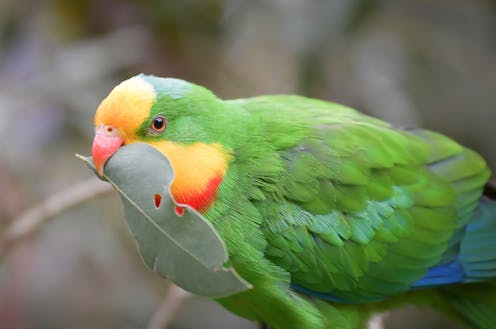
Australia’s woodland birds include colourful parrots, flitting honeyeaters, bright blue fairywrens and the unassuming “little brown birds”. Some, such as willie wagtails, laughing kookaburras and rosellas are found in urban gardens. Others, such as swift parrots and regent honeyeaters, are exceptional rarities for which bird enthusiasts spend days or weeks searching.

There are other woodland birds you might never have noticed, such as pardalotes, thornbills, treecreepers, gerygones and nightjars. Forty woodland bird species are listed as threatened and several others are declining.
And just this month another six woodland birds were added to the national threatened list.
Efforts to help these species recover are being made. Common actions include replanting trees and installing nest boxes. But it is important we know which efforts are making the biggest difference. We can then ensure we are doing enough to recover these birds and directing resources to actions that work best.
Our systematic review collated all the published research we could find that tested the effectiveness of 26 conservation actions for woodland bird communities. And yet we found little evidence about exactly how effective most of these actions are.
Read more: We rely on expert predictions to guide conservation. But even experts have biases and blind spots
Why don’t we know more about what works?
Australian woodland birds are a well-studied group of species. However, the research on management effectiveness for this ecological community is sparse. This limits our ability to develop general, evidence-based recommendations.
Some actions are certainly beneficial. For example, we know replanting trees and shrubs helps recover woodland birds. Leaving large pieces of dead wood on the ground helps too – birds like robins and treecreepers appreciate it.
However, many of the studies we reviewed didn’t compare sites where a conservation action was done with “control” sites – otherwise similar areas where that action hadn’t occurred. That made it difficult to compare the effectiveness of different actions. Because of this, we simply can’t be sure which actions work best in different contexts, and how large their effect is.
We found surprisingly few actions had been the subject of studies that used control sites, where birds were studied in similar sites where no action had been taken. This was true even for common actions, like control of weeds, feral herbivores (goats, pigs, deer) and predators (cats and foxes), or nest box installation.
All these actions probably have at least some benefits. Without more studies and appropriate controls, though, we can’t say how large the benefits are, or which action makes the biggest difference.
Where the evidence exists, results are mixed
Interestingly, four actions for which we could collate some clear evidence had mixed results. These actions were grazing management, prescribed burning, noisy miner control and habitat protection. The evidence shows their effects on birds depend on the site and management context.
Reducing livestock grazing had mixed results for woodland birds. Sometimes the effects were positive, sometimes negative, and sometimes it had no effect.
Prescribed burning was unlikely to boost woodland bird numbers, with some studies showing no effect, and others negative effects.
These contradictory results could be due to differences in the bird communities, the severity of threats, or differences in the habitat or climatic conditions of the site, as well as in the landscapes surrounding the study sites.
They could also be explained by differences in how the management actions were implemented (such as intensity, frequency, method) and monitored (for example, time since the action took place). But because there was only a handful of studies, we couldn’t tease apart these reasons.
Despite declines of Australian woodland birds and ongoing investment in their conservation, we were unable to make generalised conclusions about the overall effectiveness of 26 conservation actions for these species. We still don’t know which management actions are most effective for this well-loved bird community. This knowledge gap is likely to be worse for less-studied taxonomic groups.
So what can we do to fill in the gaps?
To give us concrete answers, there are two key messages for conservation practitioners and researchers.
First, we need to do more research designed to test the effectiveness of management actions, and understand the context in which different results occur. These studies need rigorous study designs, appropriate controls and careful statistical reporting.
Second, we encourage practitioners to tap into the online database of existing studies that we did collate and the accompanying annotated bibliography. These provide a wealth of detailed practical information about each management action. These resources are a comprehensive collation of the best available evidence to help support management decisions for woodland birds.
We also encourage collaborations among practitioners and researchers to build the evidence base by evaluating management actions that are being implemented or soon to be trialled.
Unfortunately, these conclusions of “we need more research” and “it depends on the context” are not novel. However, we now have a clear understanding of the knowledge gaps.
In the meantime, avoiding damage and loss of habitat in the first place is the most important thing we can do.
Authors: Jessica Walsh, Lecturer in Conservation Science, Monash University