Hit your head while playing sport? Here's what just happened to your brain
- Written by Sarah Hellewell, Research Fellow, Faculty of Health Sciences, Curtin University, and The Perron Institute for Neurological and Translational Science, Curtin University
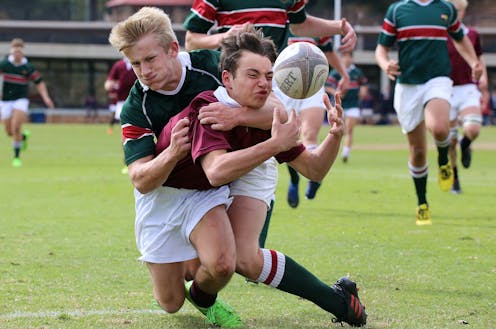
It’s Friday night, your team is playing, and scores are nail-bitingly close. A player intercepts the ball, and bam! A player tackles his opponent to the ground. Trainers and doctors gather nervously while the commentators wait for confirmation: a concussion, mild traumatic brain injury, head knock, strike, tap, bump, blow … there are many terms for it.
How to prevent and treat such injuries is the subject to a Senate inquiry, with public hearings this week.
But what exactly are these injuries? What’s going on in the brain?
What is concussion?
Concussion is a form of traumatic brain injury (TBI). Concussion typically falls at the milder end of the spectrum, and so is often called mild TBI.
Concussions happen most often when the head directly hits against something. But it can also happen without head impact, when a blow to the body causes the head to move quickly.
The brain is a soft organ in a hard case, floating in a thin layer of cerebrospinal fluid. The brain can be damaged away from the site of impact for this reason, as it bounces with force within the skull.
Concussions that happen during sport can be complex because the head often rotates as the person falls. This “rotational acceleration” can cause more damage to the brain. This is especially the case for cells in the long tracts of white matter responsible for relaying signals around the brain.
As well as causing initial damage to brain cells at the time of injury, concussion sets off a cascade of chemical and biological changes. These occur within minutes and may last for days or even weeks after concussion.
Cell membranes become permeable (more leaky), causing an imbalance of brain chemicals inside and outside cells. Cellular functions shift into overdrive to try to restore balance, using more fuel in the form of glucose. At the same time, blood flow to the brain is often reduced, resulting in a mismatch between energy supply and demand.
The structural scaffolding of cells in the white matter may begin to weaken or break, preventing or reducing the ability of cells to communicate.
Sensing danger, cells from the immune system begin to migrate to the brain in an attempt to stem the damage, spouting chemical signals to recruit other inflammatory cells to the sites of injury.
These initial responses to concussion typically resolve over time, but the recovery period may be different for each person, and may persist even after symptoms go away.
What are the symptoms?
Concussion symptoms can differ depending on the person and the circumstances of injury.
Some people have more obvious symptoms like loss of consciousness, vomiting and confusion; others may have headaches, problems with their vision, or thinking and concentration. Some people may have one symptom while others have many. Some people’s symptoms may be severe, and others may have only mild symptoms.
So diagnosing and managing concussion can be difficult. Most people who have a concussion will find their symptoms subside within days or weeks. But around 20% of people will have persistent symptoms beyond three months after their concussion.
Ongoing symptoms can make it harder to perform at work or school, to socialise with friends and to maintain relationships. Scientists don’t know why recoveries are different for different people. We have no way to predict who will recover from concussion and who won’t.
Read more: Having a brain injury does not mean you'll get dementia
How about repeat blows to the head?
People who play contact sports are more likely to have multiple concussions over a playing career. Higher numbers of concussions tend to mean worse symptoms and slower recovery for subsequent concussions.
This indicates the brain doesn’t get used to concussions, and each concussion is likely to impart additional damage.
Emerging evidence suggests repeated concussions may lead to ongoing changes in people’s brain cell structure and function.
Inflammation may persist inside and outside the brain. Inflammation may also cause or contribute to someone developing symptoms, and long-term brain functional and structural changes.
Prolonged symptoms and long-term brain changes may be worse in the long run for people who experience their concussions as young adults compared to people who have concussions as older adults.
Scientists are also starting to find differences in symptoms and brain alterations in males and females. These could be related to newfound sex differences in the scaffolding proteins of male and female brains, making female brains more susceptible.
We’ve known about this for a long time
The long-term brain and behaviour changes resulting from repeated sports concussions have been reported since at least the 1920s. Back then, it was seen in boxers and termed dementia pugilistica, or punch-drunk syndrome.
We now call this condition chronic traumatic encephalopathy (CTE). People found to have CTE don’t always experience severe symptoms. Instead, symptoms tend to emerge or worsen later in life, even decades after injury or at the end of a playing career.
People also have varied symptoms that can sometimes be hard to measure, like confusion, impaired judgement and aggression. This has made diagnosis difficult while people are alive. We can only confirm CTE after someone dies, by detecting altered structural proteins of the brain in specific brain areas.
There is still a lot to learn about CTE, including the exact processes that cause it, and why some people will develop it and others won’t.
Read more: Here's what we know about CTE, the brain condition that affected Danny Frawley
Concussion is common
Concussion is a common injury almost 30% of us will experience in our lifetime.
Although we have a lot still to learn, the current advice for people who experience concussion is to seek medical advice to help with initial management of symptoms and guide decisions on returning back to playing sports.
For coaches, trainers, parents and others interested in learning more about how to manage concussion, resources are available from Connectivity Traumatic Brain Injury Australia. These include its free concussion short courses to help you understand, recognise and manage a concussion injury when it occurs.
Authors: Sarah Hellewell, Research Fellow, Faculty of Health Sciences, Curtin University, and The Perron Institute for Neurological and Translational Science, Curtin University