Isotope analysis helps tell the stories of Aboriginal people living under early colonial expansion
- Written by Shaun Adams, Archaeologist, Griffith University
Acknowledgement: we would like to extend our thanks to the Gkuthaarn and Kukatj People who invited us to work on this sensitive project through the lens of truth-telling – particularly Phillip George, Richie Bee and Francine George – whose insights have formed a key pillar of the work.
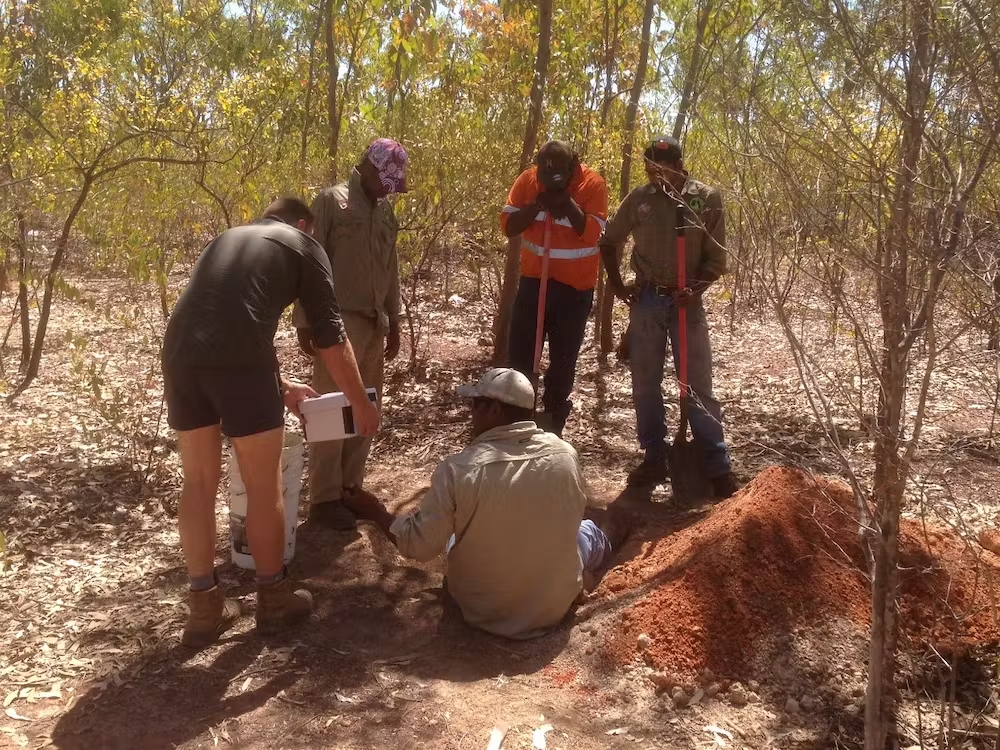
In 2015, Gkuthaarn and Kukatj community members of Queensland’s Gulf Country invited us to excavate, analyse, and rebury the skeletal remains of eight young Indigenous people who died near the town of Normanton in the late 1800s.
The remains were acquired by Walter Roth (1861-1933). Roth was a medical doctor, anthropologist, and the first Northern Protector of Aboriginal people. He eventually sold the remains to the Australian Museum in Sydney, which held them for almost a century before repatriating them to the Traditional Owners in the 1990s.
The remains were reburied, but later exposed by erosion – which prompted Gkuthaarn and Kukatj community members to invite us to collaborate with them.
In research published in Archaeologies, we show how bioarchaeological techniques have helped shed light on the experiences of these young Indigenous people who were displaced by European colonisation.
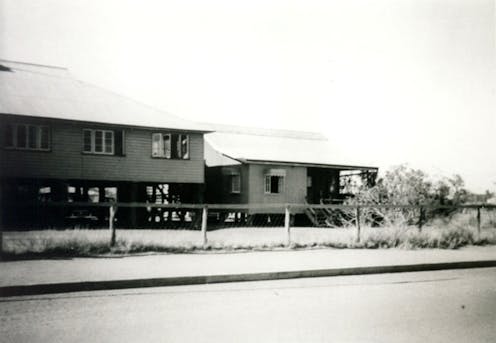
Unfortunately, we only know the name of one of the eight individuals – a young woman named Dolly. Roth’s records indicate Dolly was a member of the Gkuthaarn and Kukatj People, and was working at the police barracks (shown in the banner image) in the town of Cloncurry, about 382km south of Normanton, when she died.
Driven from their lands
In 2018, we published a study that showed these individuals had experienced nutritional stress and, in some cases, syphilis. These findings are consistent with other evidence relating to the experience of Aboriginal people living on the Gulf Country during colonial expansion.
Archaeological data and historical documents indicate Aboriginal people on the Gulf Country lived as foragers until the mid-1800s, when their lands were occupied by Europeans and stocked with cattle. The cattle depleted resources that were critical for a foraging lifestyle, and conflict ensued.
As a result of the violence and loss of resources, many Aboriginal people on the Gulf Country became refugees in their own land. They had little choice but to move into camps on the fringes of towns such as Normanton. These camps were overcrowded and unhygienic, and many occupants died from infectious diseases as a result.
We spoke to several Gkuthaarn and Kukatj people during the course of our research. One senior person expressed feeling relief when the remains were safely retrieved and reburied:
[Researchers] put a tarp over and dug it [the remains] up real steady. [They were] fragile from the sun […] We felt like we was just welcome [by the spirits of the people connected with these remains], like they wanted to get reburied. [We] just had that feeling they wanted to get reburied; was a couple of times they had been exposed.
Insight into displacement, disease and diet
In our recent study, we analysed strontium, carbon, and oxygen isotopes from the teeth of six of the eight individuals.
Measuring isotope ratios in human bones and teeth can reveal information about an individual’s diet and geographical movements prior to their death. When we compare strontium isotope values from tooth enamel to an isotope map (called an “isoscape”) constructed for this project, we can see where the six individuals grew up.
Dolly’s strontium value suggests she grew up near the Gulf of Carpentaria. This is consistent with Roth’s suggestion that Dolly was a member of the Gkuthaarn and Kukatj People, as their traditional territory extends to the coast. The strontium results for the other individuals suggest they grew up some distance to the east or northeast of Normanton.
Carbon isotope results indicate that in their early years, all six individuals had diets dominated by tropical plants and/or marine foods. However, Dolly’s carbon value suggests her diet was especially high in such foods. This is again consistent with her having lived near the Gulf of Carpentaria when she was young.
The oxygen isotope results we obtained are also high when compared to international samples. We suspect these elevated values can be explained by a combination of the environmental conditions in the Gulf Country, and the effects of infectious diseases that spread into the region with European settlers.
Based on the formation times of Dolly’s tooth samples, and her strontium and oxygen values, we estimate she moved from the Gulf of Carpentaria to the Cloncurry area sometime between the age of 2.5 and 10. Our analyses also suggest she was a young adult when she died.
These assessments are in line with Roth’s reports from the Gulf Country, which state that Indigenous girls were often taken from their families and made to work for Europeans, and that it was common for such individuals to succumb to diseases early in life.
Speaking on the findings, one Gkuthaarn and Kukatj person told us:
I am sad to learn of our people getting horrible diseases and, with the study completed, these were young people who left behind such a sad story that needs to be told so non-Indigenous people, not just throughout Australia but particularly in our region, know and understand that these traumas still impact on our people 120 years later.
The Voice
Combined with historical documents and information from contemporary Gkuthaarn and Kukatj People, our results provide new individual-level insight into the devastating impact of European colonisation on Aboriginal people of the Gulf Country.
Australians are currently debating a constitutional amendment to create an Aboriginal and Torres Strait Islander Voice to Parliament. The proposed amendment is a key recommendation of the Uluru Statement from the Heart. Another key recommendation is that of “truth-telling” about the experiences of Aboriginal people during European colonial expansion.
Science can’t tell us whether the Voice is the correct course of action. Yet our findings about these individuals – whose remains we have been honoured to analyse – reveal that scientific work conducted with and by First Nations people has an invaluable role in the process of truth-telling.
We hope such work will help reveal more truth of the experiences of those rendered voiceless by the violence of colonisation. As one Gkuthaarn and Kukatj person explained:
My old grandmother was one of those people who said they was horrible and didn’t want to repeat it [i.e. they did not want to tell accounts of colonial violence to subsequent generations], but I believe it should be repeated [to] help us understand more about what really happened.
People [are] just listening to one side of it. You’ve got people who say Aboriginals just live off the welfare, but there was a reason why that happened. Aboriginal people fought for this country. You’ve got people who say you’ve gotta get over that [colonial violence], but what I say is: lest we forget.
We would like to thank our co-author Susan Phillips for her involvement in this research.
Authors: Shaun Adams, Archaeologist, Griffith University