Here's why your freezer smells so bad – and what you can do about it
- Written by Enzo Palombo, Professor of Microbiology, Swinburne University of Technology
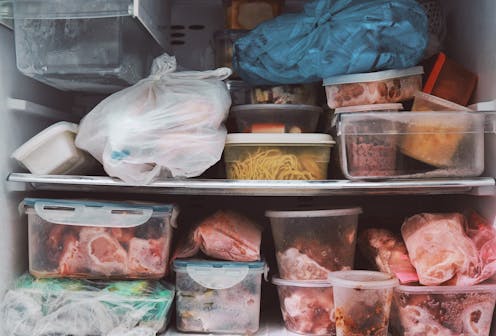
Most people would expect a freezer can keep perishable food fresh and safe from spoilage for many months. Unfortunately, this is not always the case.
Have you ever noticed a funky smell in your freezer? Where does it come from and what can be done to fix the problem?
Hardy microbes and pungent chemicals
There are several causes for bad smells coming from your freezer. Typically, the culprits are microbes – bacteria, yeasts and moulds.
Although a freezer dramatically slows down the growth of most common spoilage microbes, some can still thrive if the temperature rises above -18℃ (the recommended freezer temperature). This can happen if there is a power outage for more than a few hours, or if you put something hot straight in the freezer.
Food spills and open containers provide an opportunity for microbes to get to work. It’s also worth noting that many microbes will survive freezing and start growing again once conditions are favourable – for example, if you remove the food, partially thaw it, and return it to the freezer.
Two things happen when food breaks down. First, as microbes start to grow, several pungent chemicals are produced. Second, the fats and flavours that are part of the food itself can and will be released.
These are generally referred to as volatile organic compounds (VOCs). They are the pleasant aromas that we sense when we eat, but VOCs can also be produced by bacteria.
For example, many of us would be familiar with the smells that come from fermentation – a microbial process. When fermenting a food, we intentionally contaminate it with microbes of known characteristics, or provide conditions that favour the growth of desirable microbes and subsequent production of aromatic compounds.
By contrast, uncontrolled food spoilage is problematic, especially when the contaminating microbes can cause disease.

Freezing changes the food
It is not only microbial growth that can lead to undesirable odours. There’s a suite of chemical processes happening in the freezer, too.
Freezing causes physical changes to foods, often enhancing their breakdown. Many of us would be familiar with “freezer burn” on meats and other foods, as well as ice crystals on frozen food.
This phenomenon is called “salt rejection”. Depending on how rapidly something is frozen, salts can sometimes be concentrated, as pure water freezes at a higher temperature than water with things dissolved in it – like sugars and salts. On a large scale, this happens to icebergs in the ocean. As the sea water freezes, salt is removed. Thus, the iceberg is composed of fresh water, and the surrounding sea water becomes a saltier and denser brine.
In a similar way, as water in food freezes, organic molecules are concentrated and expelled. If these are volatile, they move about the freezer and stick to other things. Where they end up depends on what else is around.
Some of the volatiles like water. We call them “hydrophilic” or water loving; those are the ones that will make your food taste bad. Other are more water-hating or “hydrophobic” and they stick to things like silicone ice cube trays, making them go smelly.
Domestic freezers are commonly attached to a refrigerator, and this provides another opportunity for smells to move through the systems. The two units share a single cooling source and airflow channel. If your fridge has foul odours from the food inside (natural or after microbial spoilage), it is very likely they will migrate to your freezer.
Read more: How colour-coding your fridge can stop your greens going to waste
Help, my freezer smells!
There are some simple steps you can take to stop your freezer from smelling.
First, try to prevent odours from developing in the first place by covering the food. If you place food in an airtight container (glass is best), it will dramatically slow the release of any aromatic compounds produced by bacteria or the food itself. Covered food is also less likely to absorb smells and flavours from other foods around it.
If the smells have already developed, you can eliminate them by following a few simple steps, including a thorough clean.
Remove all items from the freezer and inspect the foods for any spoilage, freezer burn or unpleasant odours.
Discard anything that has developed ice crystals and store the rest in a cooler box while attending to the freezer itself. You should also inspect the fridge and discard any bad-smelling foods.
Once you have removed all items, take out the shelves and clean up spills or crumbs.
Wipe down all surfaces using warm soapy water or a mix of two tablespoons of baking soda with warm water.
Wash all the shelves and ice compartments and let them dry completely.
If the smells are not removed with these simple cleaning steps, the freezer may require a deep clean, which involves turning off the unit and letting it “breathe” for a few days.
Placing some baking soda inside the freezer before adding food can help to absorb any residual odours. For serious smells where crevices or insulation are contaminated, you may need a service technician.
In short, even though we think freezers keep things “fresh”, microbes can still proliferate in there. Make sure to clean your freezer now and then to keep your food safe and healthy.
Authors: Enzo Palombo, Professor of Microbiology, Swinburne University of Technology
Read more https://theconversation.com/heres-why-your-freezer-smells-so-bad-and-what-you-can-do-about-it-203058