What do white staff do in remote Indigenous art centres?
- Written by Una Rey, Senior Industry Affiliate, RMIT University
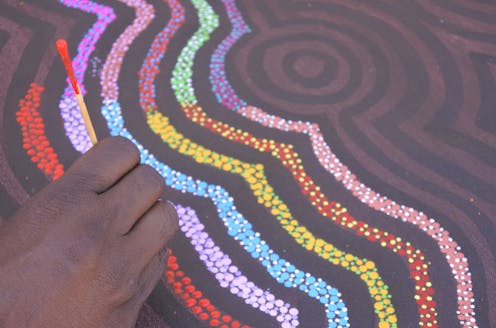
In April, The Australian published the results of a four-month investigation into white staff “interference” at Tjala Arts, a member of the APY Arts Centre Collective of Indigenous art centres across South Australia.
It included a video of an art centre manager painting on Yaritji Young’s canvas, to “juice it up” a bit.
The ongoing media commentary has been divisive and confusing. One question it raises is what do art managers and studio assistants actually do in remote Indigenous community art centres?
50 years of arts centres
Remote art centres are central to today’s internationally successful Indigenous contemporary art industry. They typically have a white art centre manager and other staff overseen by an Indigenous board.
Papunya Tula Artists in Central Australia, incorporated in 1972, is the common ancestor of the publicly funded art centre model.
Papunya Tula marked the transition from the paternalism of the mission era to Indigenous self-determination, supported by the establishment of the Aboriginal Arts Board.
On May 3 1973, a press release from Prime Minister Gough Whitlam’s office announced:
Aboriginals have been given full responsibility for developing their own programs in the arts under a new Government policy to revitalise cultural activities through the Australian Council for the Arts.
What followed was a revolution, led by and for Aboriginal artists, with non-Indigenous staff employed to mediate with the art world.
Today, this workforce are mostly young women with degrees in visual art or arts management. They operate in around 90 Aboriginal-owned collectives across remote Australia. Staff turnover is high, and recruitment is a perennial task.
Read more: 40 years on: how Gough Whitlam gave Indigenous art a boost
A cross-cultural thing
The troubling fact is not that “Aboriginal art is a white thing”, as Aboriginal artist and activist Richard Bell famously declared in 2002. Rather, Aboriginal art is “a cross-cultural thing”, bringing Indigenous and non-Indigenous creative workers together.
Despite the shared goal and triumphs of the cultural industries in celebrating Indigenous art, the shadow of Australia’s colonisation is never far away.
The conditions in remote art centres have evolved since the 1970s, but the practicalities are essentially the same. Art centre staff support the artists socially, culturally and logistically to ensure artists are happy to create their work in a culturally safe space.
Staff also manage the external demands of the market, exhibition schedules, bureaucratic accountability (to funding bodies and institutions, for example) and advocacy.
Studio assistance involves purchasing art materials, stretching and priming canvas, harvesting raw material such as ochre, bark or timber, as well as packing, freighting and distributing the work and travelling with artists to exhibitions.
The level of support depends on an individual artist’s needs. Art centres often include the elderly and artists with a disability. Some artists have a strong creative drive; some work slowly or inconsistently.
Whatever the art form, good work takes considerable time. Art production is frequently interrupted “mid-canvas” to attend to other business such as cultural events, funerals or medical treatment.
Read more: Aboriginal art: is it a white thing?
A collaborative space?
The APY Art Centre Collective management strongly denied allegations of any interference with the paintings or “the Tjukurrpa” (the Aṉangu term for their comprehensive spiritual belief system). Their website currently states hands-on assistance, such as “underpainting”, is common practice.
Selecting colours and mixing paint, priming and delegating canvases, washing brushes and general maintenance, as well as regular discussion and responsiveness to the art are all part of the studio assistant’s role.
Some aesthetic influence on the final product is only natural, but painting directly on the canvas is never part of the job description. Undeclared, many would consider it fraudulent.
In 1997, when I first went to work in a Western Desert art centre, the message from the artists was simple: sell our paintings, and be straight with us.
It was also clear the paintings offered for sale – to public institutions, knowledgeable collectors and souvenir buyers – would be of a certain standard.
“Quality control” is an ambivalent term, but it is implied and expected in the job.
In 1996 Kathleen Petyarre won the lucrative Telstra Art Award for her painting Storm in Atnangkere Country II. It was later revealed she was “assisted” by her white partner.
Following an inquiry, Petyarre retained her rightful authorship of the work, but this prompted art centres to recognise “creative labour”, when delegated by the artist and particularly among family, as culturally accepted practice — which should be attributed accordingly.
The right to determine who gets to collaborate on artwork, and how, applies to artists worldwide. The studios of Jeff Koons and Damien Hirst are extreme examples of art making being undertaken by studio assistants. So too, Aboriginal artists enjoy workshops with specialists in fields as varied as printmaking, bronze casting, animation or glassmaking.
It’s up to the artists first, and the institutions, curators, the market and art critics next, to evaluate such collaborations and exchanges case by case.
Cultural narratives and daily realities
A key role in art centres is “taking the story”. This is where art centre staff document the artist’s painting with a photo and the related Tjukurrpa or Country.
These “certificates of authenticity” documenting culturally important stories guarantee the works as genuine Aboriginal or Torres Strait Islander works. They also underpin the marketing, promotion and interpretation of many contemporary art exhibitions from remote communities.
It’s the disconnect between these purist cultural narratives and the realities of the busy cross-cultural studios that puts the artists, their staff and the entire industry in such a paradoxical position.
Trust and ethics lie at the heart of these working relationships. It’s impractical to create more rules and impossible to enforce the ways artists and staff interact in art centre settings, but it’s time to acknowledge these exchanges with a new story.
Authors: Una Rey, Senior Industry Affiliate, RMIT University
Read more https://theconversation.com/what-do-white-staff-do-in-remote-indigenous-art-centres-204746