Bus rapid transit can avoid traffic chaos for the AFL's new stadium and transform Hobart – and other cities too
- Written by Jason Byrne, Professor of Human Geography and Planning, University of Tasmania
Following a decision to fund an AFL stadium on Hobart’s waterfront, the Tasmanian premier announced plans for a new bus rapid transit (BRT) system and ferry services to avoid traffic congestion. These plans are linked to Hobart’s City Deal and promise to reinvigorate the city’s ailing public transport system.
Hobart once led transport innovation. It was the first city in the southern hemisphere with an electric tram system. At its peak, these trams handled 40% of journeys in the city.
Since the 1970s, though, following the closure of Hobart’s last passenger rail service, the city’s public transport network has suffered from dwindling investment and patronage (now under 5% of journeys). Could bus rapid transit help combat the city’s notorious car dependence?
Read more: Growth pains and gridlock come to Hobart, and building more roads is not the best way out
What is bus rapid transit?
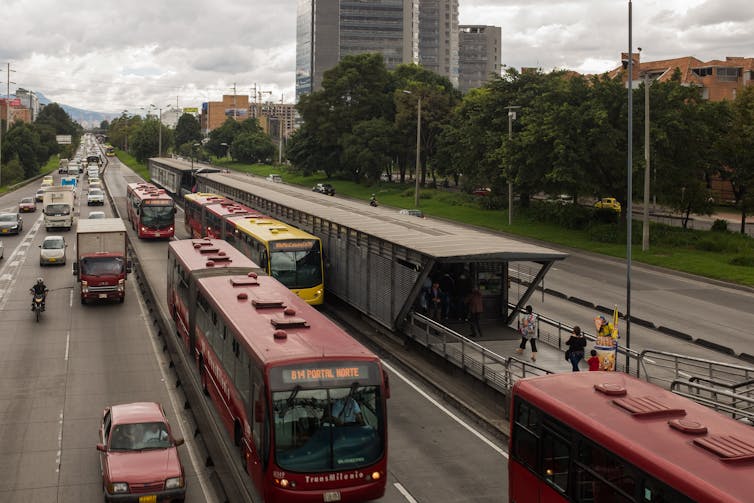
Bus rapid transit systems typically run buses along dedicated corridors, taking the bus out of traffic. They can be highly effective people-movers. Many such systems have achieved passenger capacities comparable to light rail.
For example, bus rapid transit systems move more than 40,000 passengers per hour in Bogota, Colombia, and around 20,000 in Brisbane. The vehicles are no ordinary bus – they can carry nearly 200 passengers in comfort.
Modern articulated electric BRT vehicles provide a similar ride experience to light rail. And bus rapid transit stations have the look and feel of rail stations.
Is this system a better choice than light rail?
A key question some Hobart residents are asking is why the Tasmanian government has chosen bus over light rail. A major reason is the cost-effectiveness of this sort of bus system. A state government-funded report estimated the construction cost of Hobart’s rapid bus transit system at A$445 million, versus $596 million for light rail.
Recognising that these are pre-COVID numbers, costs will now be much higher. For example, while Canberra’s light rail cost $675 million, the cost of stage 3 of the Gold Coast light rail has blown out from around $600 million to $1.2 billion.
Bus rapid transit vehicles also cost less, but their passenger capacities are comparable to light rail vehicles. The Canberra light rail vehicle can carry 207 passengers. Brisbane’s Metro rapid transit bus will have a capacity of 150-180 people.
Read more: Why cities planning to spend billions on light rail should look again at what buses can do
The benefits of bus rapid transit for fighting congestion.How do we ensure it works in Hobart?
Research has identified several important principles that need to be met if the new Hobart bus system is to be effective. These include reliable, high-frequency services, effective station design, quality station amenities, ride quality and passenger experience.
Investing in quality infrastructure will be essential. As Brisbane’s busway has shown, it is vital that buses coming into a station don’t clog up the corridor when passengers alight. Station designs must allow room for multiple vehicles, with by-pass lanes around stations to allow express services to continue unimpeded.
The vehicles must have multiple doors so passengers can get on and off quickly.
As research on Melbourne’s tram system shows, if public transport gets stuck in traffic, patronage will suffer. That’s because the system is then slower (average 15 kilometres per hour) than taking a car and much more unreliable.
For this reason, the new bus rapid transit system must have its own dedicated corridor and not share intersections with other traffic – or else traffic lights must give priority to the buses. Research shows this will enable the vehicle to increase its average speed to more than 50km/h (maximum 80km/h). Because the Gold Coast light rail does not have a dedicated corridor for parts of its route, its average operating speed is only 27km/h.
The passenger experience will also be crucial for the system’s success. Research shows passengers have a low tolerance for waiting around and having to transfer between routes and to other transit modes (such as ferries).
Experience elsewhere also shows it is important that passengers get tickets at the station, not on the bus. A ticketing system that allows seamless transfer between bus rapid transit, regular buses and ferries will be vital to maximise efficient travel. It’s also important to design stations and vehicles to provide universal access, so everyone can use the new system.
Rapid bus transit has broader impacts too
The impacts of bus rapid transit on a city are broader than transport. It has important land-use planning benefits. A well-designed system can increase housing densities and thus improve housing options, including affordable housing, along the corridor.
A bus rapid transit network can also connect people with jobs, education, healthcare, childcare and recreation opportunities. Councils along the new transit corridor in Hobart will need to protect adjoining land from speculative investment to manage gentrification. They will also have to develop sound design guidelines to steer desirable types of development, such as medium-density neighbourhoods – the “missing middle”.
Read more: People want and need more housing choice. It's about time governments stood up to deliver it
Bus rapid transit is emerging as a very viable way to deliver quality transport solutions for cities. It’s especially suitable for those with limited resources, such as smaller cities and those in the developing world. While Hobart’s bus rapid transit is explicitly linked to the new stadium, cities like Barcelona have shown such urban revitalisation investment can have transformative benefits for cities.
Authors: Jason Byrne, Professor of Human Geography and Planning, University of Tasmania