Tail first and making an early splash, some whales just can't wait to be born
- Written by Vanessa Pirotta, Postdoctoral Researcher and Wildlife Scientist, Macquarie University
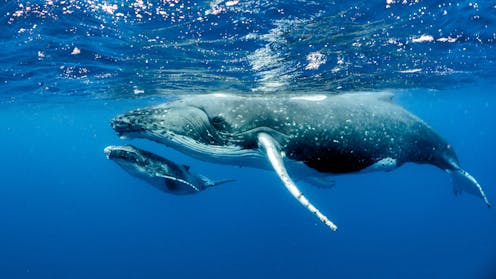
Did you know whales are born tail first? They enter their water world being able to swim from day dot. From the moment they’re born, their first instinct is to swim to the surface for air.
While most enjoy the comforts of hanging out in mum’s tummy until she reaches warm northern Australian waters, some just can’t wait to enter the big blue.
May marks the official start to the whale watching season and we’ve already had an exciting teaser with the recent sighting of a pygmy blue whale mother and calf in Western Australian waters.
While this sighting is rare, it’s not likely to be the last mother and calf whale sighting we’ll see this year. We’ll soon start seeing various whale species moving along the west and east coasts of Australia.
Dr Vanessa Pirotta explains whale migration in Australian waters.Read more: Thar she blows! An expert's guide to whale watching 101
Why are whales coming here?
Generally speaking, whales migrate to Australian waters in the winter to breed.
Depending on where you are on the Australian coast, you’ll probably see at least the main migratory baleen (toothless) whale species.
These include the iconic humpback whale, the southern right whale, dwarf minke whale (east coast mainly) and possibly the pygmy blue whale (west coast).
The first three species typically migrate north to warmer waters to breed and calve. They’ve spent the summer feeding in Antarctic/Southern Ocean waters, putting on a lot of weight. Now, they’re ready to spend their energy going north to reproduce.
In contrast, pygmy blue whales typically stay in Australian waters over summer. They then travel along the west coast of Australia, past Perth into international waters such as the Banda Sea where they are thought to breed during the winter.
The making of a whale calf
Baleen whales are mammals just like you and me. A humpback whale is pregnant for 11-12 months. So female humpback whales that fell pregnant in Australian waters during the last breeding season are likely to give birth this year.
A female humpback whale may mate with multiple males. Males may sing and/or fight to mate with females. Males provide no parental care for their young.
A humpback whale mother may produce a calf every two to three years. This is a relatively quick turnaround and is likely one reason why Australian humpback whale numbers have been recovering well post-whaling.
The ultimate water birth
Antarctic waters are too cold for a newborn calf. This is one reason why humpback whales travel to warmer water to breed.
Whales rely on a lot of blubber to keep them warm. Newborn calves are born with very little body insulation, so warm Australian waters are an ideal environment to be born into.
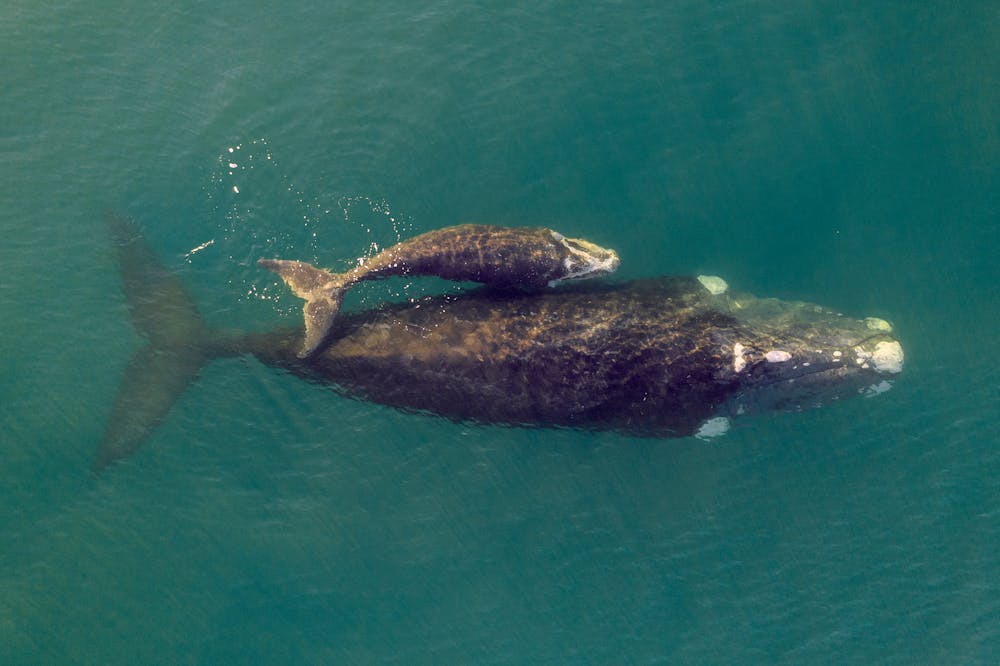
Traditionally, northern breeding grounds for humpback whales in Australian waters occur in the Kimberley region on the west coast and in the Great Barrier Reef on the east.
Globally, humpback whale breeding waters are ideal at temperatures between 21℃ and 28℃. With climate change and an expansion of warming waters, this area is increasing.
Why do we sometimes see mothers with calves travelling north?
Sometimes we see mothers with newborn calves well south of traditional breeding grounds. This is most likely the case with the recent pygmy blue whale sighting.
On the east coast of Australia, both humpback and dwarf minke whale mothers have been observed travelling north with bubs in recent years. Perhaps this is a result of the waters being ideal and warm, or maybe some calves just can’t wait to enter the world. Maybe this happens more than we think, with efforts to document this still ongoing.
 There’s growing evidence that humpback whales are observed with young before they reach the warm waters of their traditional breeding grounds. Here a humpback whale mother and young calf pass Sydney. The calf is just visible as it comes up for air.
Vanessa Pirotta, Author provided
There’s growing evidence that humpback whales are observed with young before they reach the warm waters of their traditional breeding grounds. Here a humpback whale mother and young calf pass Sydney. The calf is just visible as it comes up for air.
Vanessa Pirotta, Author provided
On the swim for multitasking mothers
Once a calf is born, mothers continue to swim with the calf alongside her. This is the most efficient position where the calf is able to swim in her slipstream.
During this time, they may stop and rest. The calf is able to suckle milk from mum’s mammary glands. This fatty milk is perfect for putting on blubber. And don’t worry whale mums, humpback whale calves don’t have any teeth. In fact, all baleen whales, like humpback whales are toothless. Instead of teeth, they have baleen, which are long hair like structures they use to filter feed when they are older.
Read more: Curious kids: why don’t whales have teeth like we do?
Breastfeeding duties also come at the time when the mother is migrating, when she must also keep an eye out for predators such as orcas, human hazards (such as ships, fishing gear/nets) and trying to avoid males who may wish to mate with her.
Impressively, she is also likely to be fasting at the same time, relying on energy stores obtained in Antarctic waters.
If conditions are favourable, she may also take the chance to feed in Australian waters. Talk about the ultimate underwater mother!
How can you see a mother with calf?
You just never know what you might see when whale watching. Although your chances of spotting a mother and calf pair is highest in those northern breeding areas, you could also spot them as they migrate northward, or on their return journey south to Antarctic waters. The good news is, whale watching can be done from both land and on the water, depending on where you are in Australia.
Fortunately, all whales in Australian waters are protected. Mothers with calves afford special protection. If on the water or flying a drone, please keep them safe and keep your distance.
Whale mothers truly are tremendous multi-taskers who never cease to amaze me.
Authors: Vanessa Pirotta, Postdoctoral Researcher and Wildlife Scientist, Macquarie University