How do we remake ourselves after unravelling? Plunge into life and pay attention, suggests Deborah Levy's mesmerising new work
- Written by Jane Gleeson-White, Adjunct Lecturer, English and Creative Writing, UNSW Canberra, UNSW Sydney

The opening sentence of Deborah Levy’s new novel August Blue contains the germ of the whole: “I first saw her in a flea market in Athens buying two mechanical dancing horses.” Its simplicity and specificity are classic Levy – and yet it’s loaded with mystery. Who is this woman? Why mechanical animals? Why horses? Why two? Why dancing?
In this book, as compact and artfully worked as a sonnet, all these questions are answered. Or, more accurately – because Levy prefers questions to answers – they are played with, teased out, turned over.
Review: August Blue – Deborah Levy (Hamish Hamilton)
Reality remade

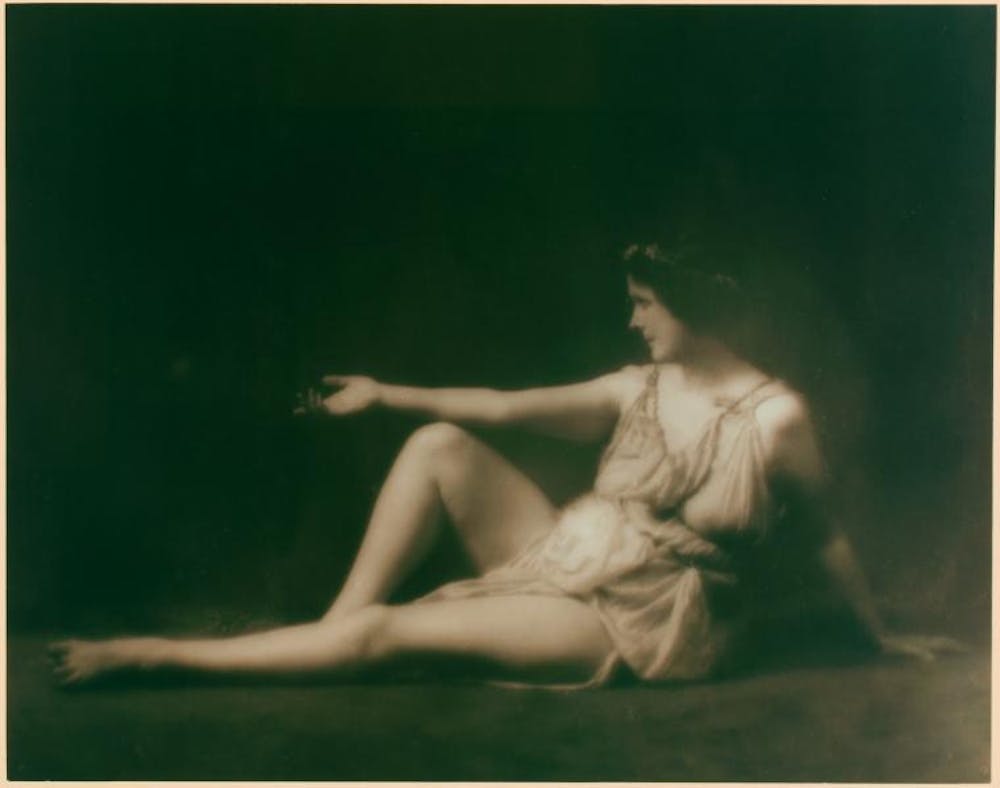 Elsa is reading the autobiography of Isadora Duncan, the mother of modern dance, who used her body as ‘a form and language’ to express thought.
Wikimedia Commons
The phrase “upwards and outwards” recurs. It articulates Elsa’s emergence from the ruins of her old life, as well as a mode of living in the wake of a global trauma. It suggests a practice of passionate engagement with the stuff of the world, its sensory richness, as a way to live through a time when “at any moment, reality could flip”.
August Blue is as condensed and multifaceted as a diamond – and like a diamond, it’s the embodiment of metamorphosis. This is the unfolding of Elsa to become herself and an other, through the appearance of a doppelganger. The woman with the horses is part of Elsa’s transmutation. She simultaneously leads her outwards into the world and inwards, back to her childhood and its mysterious absences, to which this woman seems to hold a key.
A high horse of her own
August Blue is Levy’s fourth novel since her breakthrough novel Swimming Home (2011) and follows Real Estate (2021), the third of her “living autobiographies”. All her writing is concerned with centring women’s lives and so, necessarily, with mothers and creation. In Real Estate, Levy’s narrator-self wonders why she is
still searching for a missing female character. If I could not find her in real life, why not invent her on the page? There she is, steering her high horse with flair, making sure she does not run over girls and women struggling to find a horse of their own.
In Real Estate she also recounts the startling moment when, aged 60, she first saw her mother in her own face, staring back at her in the bathroom mirror. She is there in Levy’s Paris apartment from beyond the grave. Finding her mother present in her adult self interested Levy in doppelgangers and the idea of seeing yourself in a new way in the face of someone else. Her mother is there when Levy looks at a photograph by Edmund Engelman of Freud’s street in Vienna. It’s been raining and there’s a man in the street wearing a trilby.
Elsa is reading the autobiography of Isadora Duncan, the mother of modern dance, who used her body as ‘a form and language’ to express thought.
Wikimedia Commons
The phrase “upwards and outwards” recurs. It articulates Elsa’s emergence from the ruins of her old life, as well as a mode of living in the wake of a global trauma. It suggests a practice of passionate engagement with the stuff of the world, its sensory richness, as a way to live through a time when “at any moment, reality could flip”.
August Blue is as condensed and multifaceted as a diamond – and like a diamond, it’s the embodiment of metamorphosis. This is the unfolding of Elsa to become herself and an other, through the appearance of a doppelganger. The woman with the horses is part of Elsa’s transmutation. She simultaneously leads her outwards into the world and inwards, back to her childhood and its mysterious absences, to which this woman seems to hold a key.
A high horse of her own
August Blue is Levy’s fourth novel since her breakthrough novel Swimming Home (2011) and follows Real Estate (2021), the third of her “living autobiographies”. All her writing is concerned with centring women’s lives and so, necessarily, with mothers and creation. In Real Estate, Levy’s narrator-self wonders why she is
still searching for a missing female character. If I could not find her in real life, why not invent her on the page? There she is, steering her high horse with flair, making sure she does not run over girls and women struggling to find a horse of their own.
In Real Estate she also recounts the startling moment when, aged 60, she first saw her mother in her own face, staring back at her in the bathroom mirror. She is there in Levy’s Paris apartment from beyond the grave. Finding her mother present in her adult self interested Levy in doppelgangers and the idea of seeing yourself in a new way in the face of someone else. Her mother is there when Levy looks at a photograph by Edmund Engelman of Freud’s street in Vienna. It’s been raining and there’s a man in the street wearing a trilby.
 Deborah Levy’s work is concerned with centring women’s lives – and so, with mothers and creation.
Sheila Burnett
All these fragments, including the resonance between doubling and mothers, magically inform August Blue. In this novel, Levy has refashioned details from her living autobiography to compose another thrilling “answer” to the question that preoccupies her:
Who is she? That is the question I was starting to ask in all my books. Not who am I, though that comes into it. How does she get along in the world that voided her?
Read more:
How autofiction turns the personal into the political
This is a question that also preoccupies novelist and memoirist Rachel Cusk. Reading August Blue, I felt like Levy’s novel was conversing with Cusk’s “Faye trilogy” (Outline, Transit and Kudos), which is also concerned with women’s lives and features a narrator who is recomposing herself through her encounters with others.
The books share a similar movement through Europe and various houses following a rupture; and narrate times of liminality and dissolution. And they contain common elements: the teaching of students in Europe, formative scenes at a hairdresser, necessary immersions in water. Are these daily practices key aesthetic modes by which a woman recreates her self and her life?
How you might recreate yourself in the wake of a shocking rupture is now a pressing, global question. August Blue suggests you plunge yourself into life and listen: you pay attention to what life is telling you, to what it is asking from you. And life plays by the highest stakes, insists upon the greatest gamble: love.
Love was the adrenalin, the addiction, it was like a slot machine, you put the coins in and a poet of twentieth-century music was the jackpot.
August Blue is mesmerising. I read it like a thriller, often feeling the urge to weigh its slender size against the great magnitude of its reach. It’s Levy at her best.
Authors: Jane Gleeson-White, Adjunct Lecturer, English and Creative Writing, UNSW Canberra, UNSW Sydney
Deborah Levy’s work is concerned with centring women’s lives – and so, with mothers and creation.
Sheila Burnett
All these fragments, including the resonance between doubling and mothers, magically inform August Blue. In this novel, Levy has refashioned details from her living autobiography to compose another thrilling “answer” to the question that preoccupies her:
Who is she? That is the question I was starting to ask in all my books. Not who am I, though that comes into it. How does she get along in the world that voided her?
Read more:
How autofiction turns the personal into the political
This is a question that also preoccupies novelist and memoirist Rachel Cusk. Reading August Blue, I felt like Levy’s novel was conversing with Cusk’s “Faye trilogy” (Outline, Transit and Kudos), which is also concerned with women’s lives and features a narrator who is recomposing herself through her encounters with others.
The books share a similar movement through Europe and various houses following a rupture; and narrate times of liminality and dissolution. And they contain common elements: the teaching of students in Europe, formative scenes at a hairdresser, necessary immersions in water. Are these daily practices key aesthetic modes by which a woman recreates her self and her life?
How you might recreate yourself in the wake of a shocking rupture is now a pressing, global question. August Blue suggests you plunge yourself into life and listen: you pay attention to what life is telling you, to what it is asking from you. And life plays by the highest stakes, insists upon the greatest gamble: love.
Love was the adrenalin, the addiction, it was like a slot machine, you put the coins in and a poet of twentieth-century music was the jackpot.
August Blue is mesmerising. I read it like a thriller, often feeling the urge to weigh its slender size against the great magnitude of its reach. It’s Levy at her best.
Authors: Jane Gleeson-White, Adjunct Lecturer, English and Creative Writing, UNSW Canberra, UNSW Sydney