These giant 'drop bears' with opposable thumbs once scaled trees in Australia. But how did they grow so huge?
- Written by Anusuya Chinsamy-Turan, Professor, Biological Sciences Department, University of Cape Town
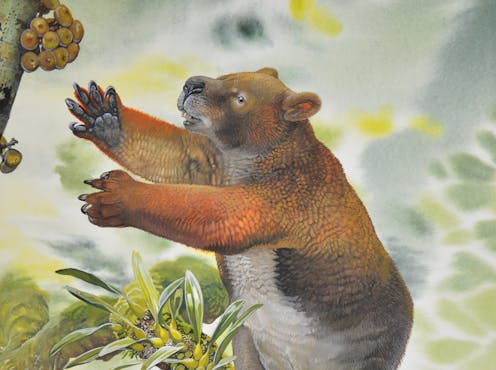
Although long dead, fossil skeletons provide an incredible window into the lifestyle and environment of an extinct animal.
By analysing the various features of fossil bones we can reveal not only the overall size and shape of the animal, but also what kind of movement the animal was capable of, its lifestyle, and the environment in which it lived.
But what if we looked inside fossil bones? What secrets would it reveal about the growth and development of an extinct animal? In a newly published paper in the Journal of Paleontology, we have done just that, using 15 million-year-old skeletons of a giant bear-like marsupial from the world-famous Riversleigh World Heritage Area (Boodjamulla) in Waanyi country of northwest Queensland.
Read more: Fossils reveal Australia's tree-top heavyweight herbivore
Tree-dwelling wombat relatives
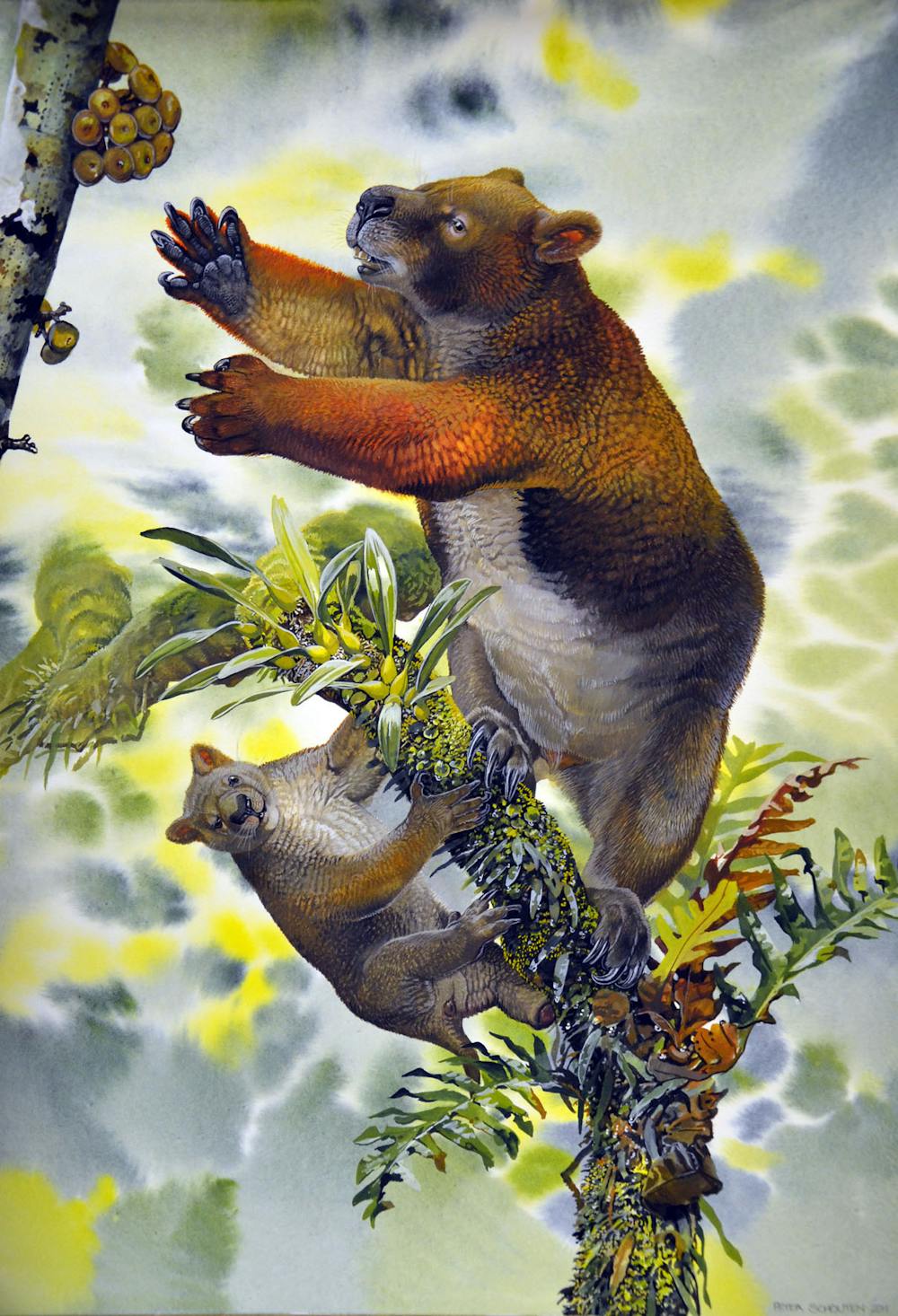
The huge tree-dwelling herbivorous marsupials, known as Nimbadon, weighed about 70kg, making them the largest arboreal (tree dwelling) mammals known from Australia.
Nimbadon belongs to a diverse group of long extinct, large-bodied marsupials known as diprotodontoids, the likes of which include the largest marsupial to have ever lived, the 2.5 tonne megafaunal Diprotodon, and bizarre trunked marsupials reminiscent of modern-day tapirs.
Among living animals, Nimbadon is most closely related to wombats. Yet surprisingly, in terms of body size and lifestyle, they are more comparable to sun bears, which today can be found scaling the rainforest canopies of Southeast Asia.
When we first uncovered jawbones of Nimbadon at Riversleigh in 1993, we thought we were looking at very large leaf-eating marsupials who foraged for food on the forest floor.
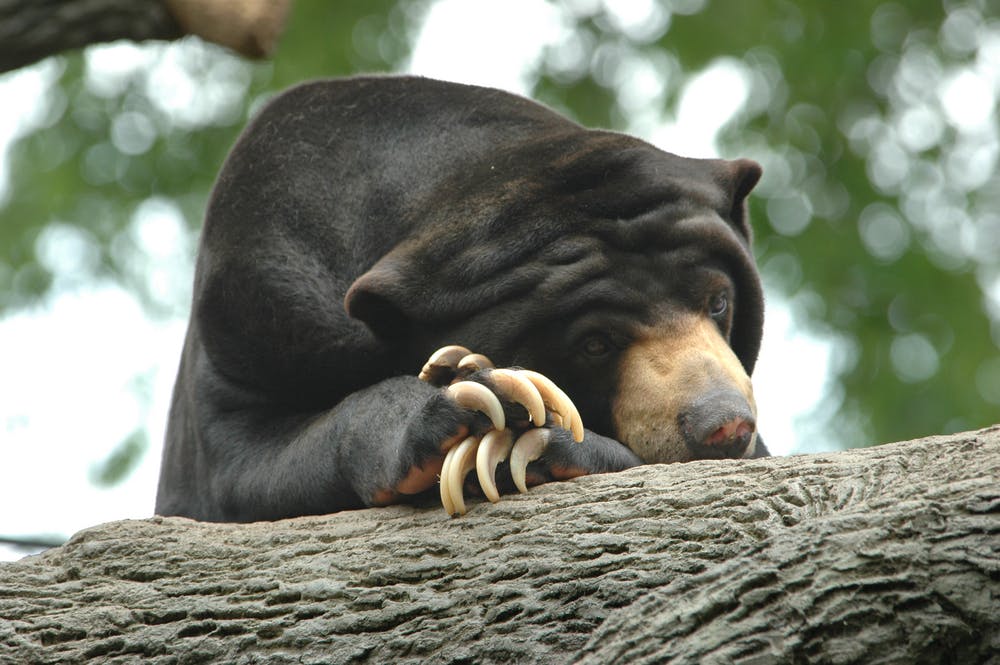 Modern-day sun bears climb trees and lounge there much like sloths do.
Shutterstock
Modern-day sun bears climb trees and lounge there much like sloths do.
Shutterstock
But like many of the species we’ve unearthed from Riversleigh, the closer we look at these animals, the more bizarre and fascinating they become.
Nimbadon is now known from its complete skeleton, including material representing developmental ages ranging from tiny pouch-young to mature adults. It had strong arms with very mobile shoulder and elbow joints. Its hands and feet had specially adapted opposable thumbs with huge curved claws for climbing, penetrating bark and grasping branches.
These animals were highly specialised climbers and lived vastly different lifestyles compared to their closest living relatives – the land-dwelling, burrowing wombats.
Our initial research showed that Nimbadon was not only a “tree-hugger”, but also a “tree-hanger”, spending some of its time suspended from tree branches like a sloth.
 Fossil skeleton of a mature adult Nimbadon.
Karen Black, Author provided
Fossil skeleton of a mature adult Nimbadon.
Karen Black, Author provided
Nimbadon lived 15 million years ago in the canopy of lowland Australian rainforests. These biodiverse, lush forests were home to some equally strange animals: flesh-eating kangaroos, tree-climbing crocodiles, ancestral thylacines, cat- to leopard-sized marsupial lions, huge anaconda-like snakes, giant toothed platypuses and mysterious marsupials so strange they have been called “Thingodonta”. It was a very different Australia than the one we see today.
Read more: Meet the giant wombat relative that scratched out a living in Australia 25 million years ago
Sectioning the bones
Despite the wealth of information we have gleaned from Nimbadon skeletons, until now we hadn’t fully understood the growth patterns of these ancient marsupials.
Were they affected by seasonality? How long did they take to grow to adult body size in the canopies of the ancient forest? Clues to these questions lay in the bones’ microscopic structure.
To look inside the fossil bones, we needed to select the right material. Long bones, such as the bones of the leg, are known to preserve a good record of growth, so we analysed ten long bones of several different-sized individuals.
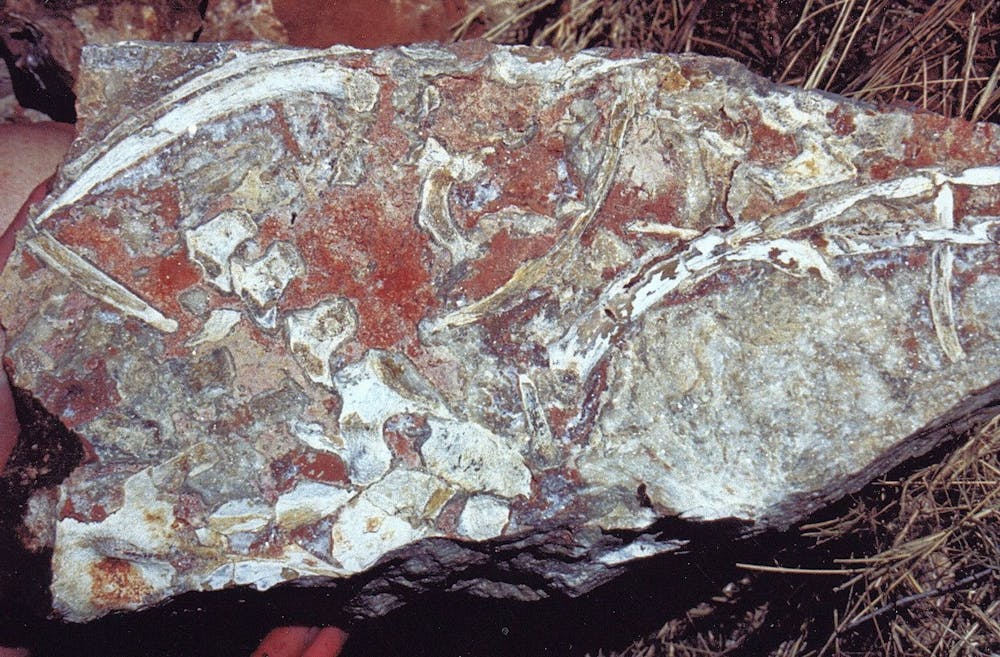 Articulated fossilised Nimbadon skeletons in a large slab of limestone recovered from a 15 million year old fossil cave deposit in the Riversleigh World Heritage Area, northwestern Queensland.
Anna Gillespie, Author provided
Articulated fossilised Nimbadon skeletons in a large slab of limestone recovered from a 15 million year old fossil cave deposit in the Riversleigh World Heritage Area, northwestern Queensland.
Anna Gillespie, Author provided
We began by removing a section from the shaft of the bone, and embedded it in resin. Using a diamond-edged blade, we cut our samples into thin sections and polished them further until light could pass through them. These thinned sections were mounted on glass microscope slides to be studied.
Remarkably, even after millions of years of fossilisation, the microscopic structure of the fossil bones had remained intact. We were amazed to discover that Nimbadon grew in periodic spurts. Individuals had fast growth periods, each followed by a slow growth period, often associated with a band of arrested growth.
Seasonal growers
Cyclical growth patterns have previously been documented for marsupials such as in the living western grey kangaroo. However, our results indicate that, overall, the limbs of Nimbadon had a much slower, more extenuated growth than kangaroo limbs.
One individual recorded at least seven to eight growth cycles, which suggests this arboreal giant needed at least this amount of time – and probably more – to become a fully-grown, sexually mature adult.
Based on these alternating cycles of fast and slow growth, Nimbadon may have been affected by seasonal conditions such as food availability. However, exactly how long it took for eight growth cycles to develop remains a mystery. If indeed they represent annual cycles, it would be at least eight years until sexual maturity, which is unusual in the modern marsupial world.
For example, kangaroos are sexually mature at one to two years. That being said, Nimbadon is an unusual beast and a very large one at that, so an extended developmental period (and lifespan) is not unlikely.
Real-life drop bears
We have come to think about these strange arboreal marsupials as real versions of the legendary “drop bears” of Australian folklore – mysterious tree-dwelling creatures that would drop down on unsuspecting animals below.
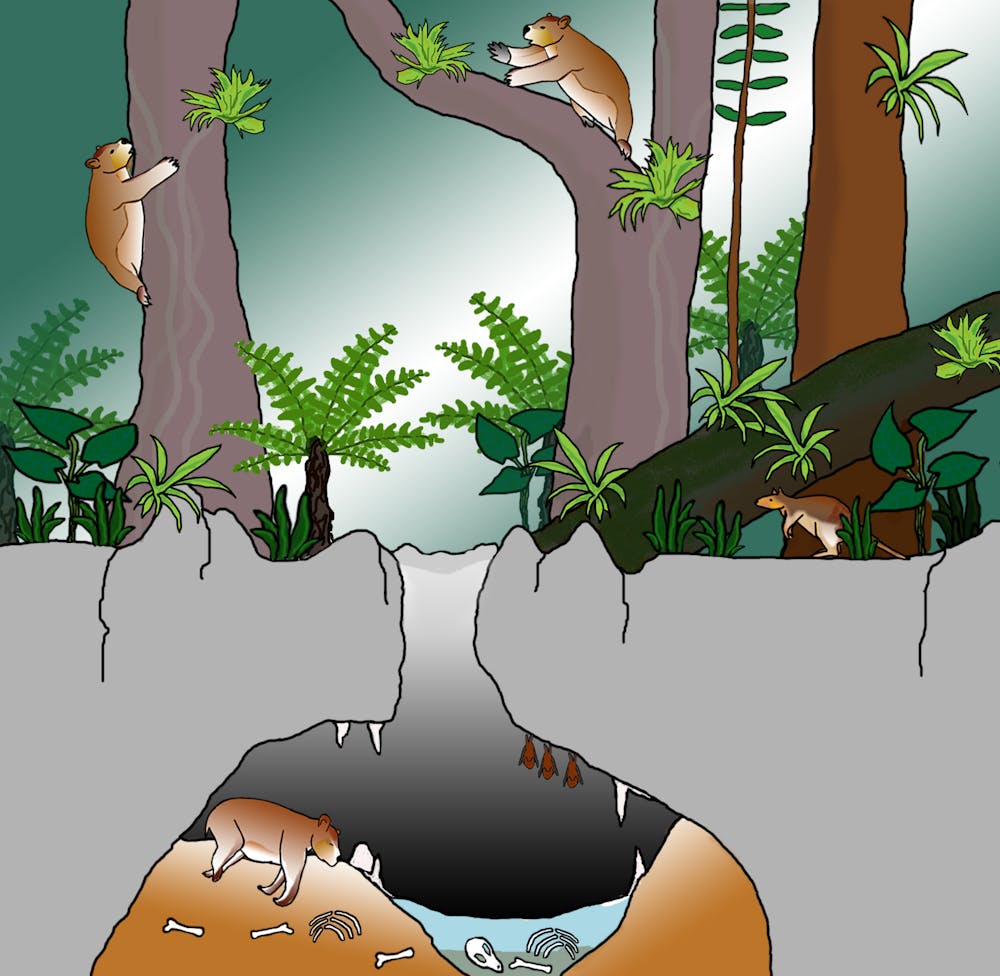 Reconstruction of Nimbadon’s palaeoenvironment of lush rainforest with underground caves.
Karen Black, Author provided
Reconstruction of Nimbadon’s palaeoenvironment of lush rainforest with underground caves.
Karen Black, Author provided
While moving in herds through the rainforest canopy, both young and adult Nimbadon would have occasionally lost their grip before dropping down from the treetops. Sometimes they would end up in forest floor caves, which is where we have been finding their still-articulated skeletons.
Given the constant surprises that research into this extraordinary, extinct Riversleigh mammal has already produced, we are eager and prepared for still more.
Currently we are looking into wear in the enamel microstructure of Nimbadon’s teeth to determine this legendary drop bear’s diet. We expect that what we find down the track will continue to upend our naïve first presumptions about the lifestyles of this and many of the other strange inhabitants of the ancient inland rainforests of Riversleigh.
Authors: Anusuya Chinsamy-Turan, Professor, Biological Sciences Department, University of Cape Town