Ableism and disablism – how to spot them and how we can all do better
- Written by Kelsey Chapman, Research Fellow Dignity Project, Griffith University

When the 2022 Australian of the Year was announced, Dylan Alcott wheeled onto the stage. Australian audiences are tuning in to watch TV shows featuring people with disability: You Can’t Ask That, Love on the Spectrum and Employable Me.
The Disability Pride movement is gaining momentum and people with disability are becoming part of the diversity conversation.
On the surface, it would appear we have come a long way in our collective attitudes towards disability. But two of society’s biggest “-isms” still go largely unnoticed and unaddressed: ableism and disablism.
What do these terms mean? And how can we all do better to dismantle them?
Two types of discrimination
Ableism and disablism both refer to types of disability discrimination. The nuance between the two words can cause confusion but are important for acknowledging, detecting, and dismantling the types of barriers people with disability encounter.
Ableism is discrimination that favours “able-bodied” people, or people without disability. Ableism prioritises the needs of people without disability. A building designed without a ramp or a lift for people who require them, a lack of captions for a meeting, and stadiums without low-sensory spaces are all examples of ableism.
Disablism is the inherent belief that people with disability are inferior to those without disability. It is discrimination against people with disability, like those shared in the Royal Commission into Violence, Abuse, Neglect and Exploitation of People with Disability. Disablism can be a more direct, conscious act of discrimination and abuse. Using disability slurs, ignoring someone, or speaking in a patronising way are common examples.
Read more: Disability and dignity – 4 things to think about if you want to 'help'
Ingrained and everywhere
If we are honest, we can acknowledge ableism and disablism are ubiquitous in our language, our homes, children’s stories, media, at work and in our daily social interactions. Indeed, ableism and disablism can be so ingrained in our daily lives that most people are unaware of them.
Both forms of discrimination can be subtle and insidious, making them difficult to detect and address. They often operate at systemic levels and are not identified as discrimination.
A good example of systemic ableism is the forced segregation of people with disability into “special” schools or “sheltered” workplaces through limited choice and structural support of these options. Although the process of forcing people into these options no longer occurs in such blatantly disrespectful ways, the result is the same.
Ableist and disablist attitudes are frequently encountered in daily conversation. Subtle ableism manifests in the use of well-intended “empathetic” comments, like “I can’t imagine losing my eyesight. That would be the worst.” These remarks, even when intended to prompt a connection between two people, reveal deep-seated beliefs and create a greater divide.
People with disability, along with other marginalised communities, categorise these types of interactions as “microaggressions”.
Disablist attitudes are more overt. Comments like “If you are unable to walk down the ramp then you shouldn’t have gotten tickets to this concert” demonstrate the low expectations and damaging beliefs that impact on people’s opportunities for education, employment and social interaction.
Read more: What are microaggressions? And how can they affect our health?
Challenging but worth it
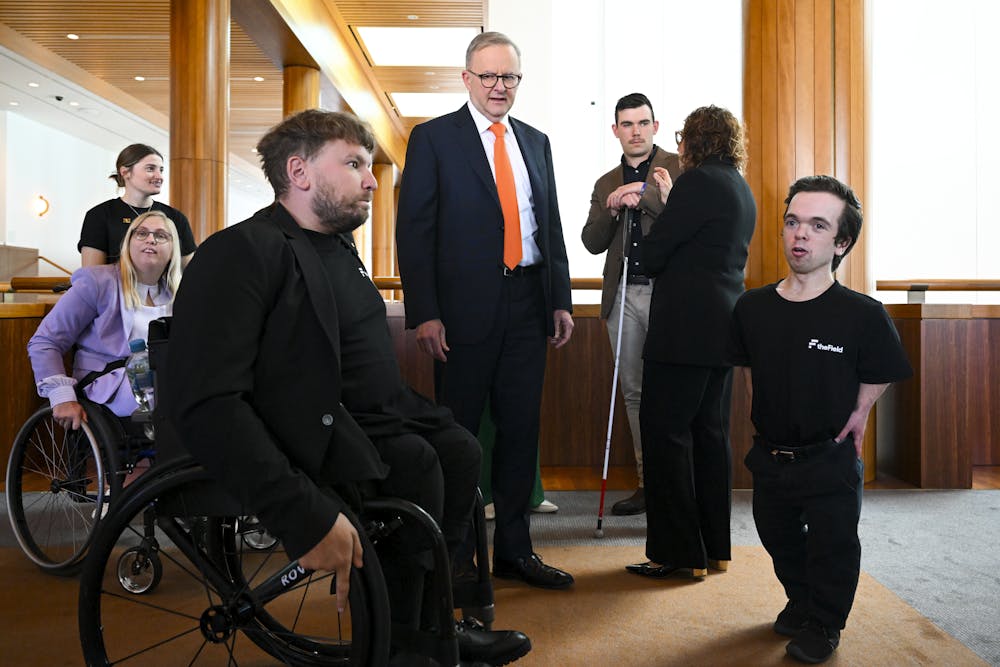
Combating disablism and ableism is a great challenge but one that is worthwhile. A broad spectrum of challenges is at play: confronting and disrupting the status quo, valuing diverse types of knowledge and experience and acknowledging the unconscious biases we all have.
At a systemic and societal level, the way we design and deliver systems, polices, virtual and physical environments, products and experiences need to be co-designed in partnership with people with disability – or better yet, through disability-led initiatives.
Generating new ideas and better ways of working will contribute to improvements in daily life for all people – just like ramps benefit parents pushing prams and people using mobility aids.
The emphasis on co-design and engagement with people with disability is increasingly prevalent. However, it is critical to conduct co-design in ways that are not tokenistic and don’t merely validate current practice. Frameworks like the Dignity Project Framework, which includes principles of importance for engaging with people with disability, can better support a dignified process of co-design and citizen partnership.
‘Not yet disabled’
At an individual level, we all have a part to play in creating an inclusive future.
Disability has been called the world’s largest minority and is a group any person can join at any time in their life.
The late disability rights activist Judith Heumann preferred to use the term “not yet disabled” to emphasise that we will all experience impairment and disability at some stage. Thus, we may all confront ableism and disablism at some point. The way to prepare for that time is to actively acknowledge and challenge personal biases, learn about and advocate for accessibility and inclusion in the spaces where you live, work and play and amplify the voices of people with disability at every opportunity.
As advocate Sinead Burke from Tilting the Lens says in British Vogue’s May issue,
Accessibility and disability inclusion is everyone’s responsibility and opportunity. This is a movement, not a moment. And it involves all of us.
Read more: Inclusion means everyone: 5 disability attitude shifts to end violence, abuse and neglect
Authors: Kelsey Chapman, Research Fellow Dignity Project, Griffith University