After a brutal presidential election campaign, Turkey is headed to a run-off contest. Here's why
- Written by Mehmet Ozalp, Associate Professor in Islamic Studies, Director of The Centre for Islamic Studies and Civilisation and Executive Member of Public and Contextual Theology, Charles Sturt University
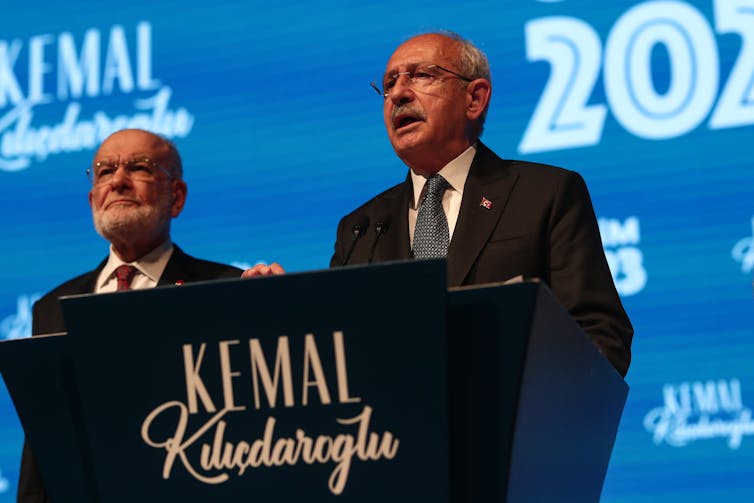
Last weekend, Turkey held a historic election that will be crucial in deciding in the way the country is heading. Although almost all pre-election polls were predicting a narrow win for the main opposition candidate, the results are inconclusive, and the country will go to a runoff election in two weeks’ time.
The new constitution voted in 2017 stipulates the parliament and presidential elections must be held at the same time. To win the presidential component of the election, a candidate must garner more than 50% of the votes. If none of the candidates receives greater than 50% of the votes, the election goes to a runoff election between the two candidates with the highest votes.
This is precisely the situation Turkey faces now. Incumbent President Recep Tayyib Erdogan and his closest rival, Kemal Kilicdaroglu, will face each other in a runoff election on May 28.
Who is Erdogan’s opposition and what were their arguments?
There are two main blocks that fought to win in a bitter and ruthless campaign.
The broad opposition National Alliance is made up of six political parties, spearheaded by the Kilicdaroglu-led Republican People’s Party (CHP) party. CHP is known for its pro-secularist policies, and for this reason have been fiercely opposed by the religious segment of Turkish voters.
To turn this image around, Kilicdaroglu promised a broad reconciliation policy to unite the country and heal the wounds of the past. He also followed an appeasement strategy by drawing under the National Alliance the national and conservative leaning Good Party (IP) and three minor religious parties, the conservative Happiness Party (SP), Future Party (GP) and Solution Party (DEVA).
The last two parties’ inclusion in the alliance are significant, as they are respectively led by Ahmet Davudoglu, a former prime minister and Erdogan’s former foreign minister, and Ali Babacan, who served as the minister of economy until 2019 under successive Erdogan governments.
Holding the alliance together was important, as a key criticism against the opposition was its fragmented nature, which some argued would make it impossible to form a concerted front against Erdogan. The National Alliance successfully overcame this hurdle.
The next problem was who would be the collective candidate of the National Alliance. The polls consistently showed mayors of Ankara and Istanbul ahead of Kilicdaroglu as candidates. Turkish voters tend to prefer politicians with proven public office track record – two of the mayors had this but Kilicdaroglu did not.
In a decision some argue was politically motivated, Imamoglu was charged and sentenced to three years for insulting the Electoral Council (YSK). This took him out of contention.
Another spanner in the works for the National Alliance was the self-nomination of Muharrem Ince for the presidential election. Ince was CHP’s nominee in the 2018 election where he lost to Erdogan.
The National Alliance was fearful Ince’s candidacy would split opposition votes, which would in turn take the election to a second round that would advantage Erdogan. Ince announced his withdrawal from the race two days before the election, after several images were circulated on internet alleging him having an affair.
Battered and bruised, Kilicdaroglu remained as the main opposition candidate in the last stretch. He had three main arguments in his campaign.
The first was the failure of the ruling Justice and Development Party (AKP)’s 2023 goals and objectives. Turkey was supposed to enter the top 10 economies in the world. Turkey barely stays within the top 20, at 19th.
What is worse, the economy has been on a downturn for the past three years. The Turkish lira has plummeted in value and inflation has reached as high as 85.5%.
Read more: Will the Turkish earthquakes affect how the country is governed?
Kilicdaroglu has pointed to the high price of onion and potatoes as a symbol of economic crisis and worsening cost of living for many Turks.
The second is the increasing reputation of nepotism, corruption and wasteful government spending, which has been long criticised by many segments of Turkish society. Mismanagement of the government were widely criticised immediately after the February 2023 earthquake, delivering further a blow to Erdogan and his government.
Finally, Kilictaroglu tried to present a new vision for the electorate. He announced a four-step reform program that would make Turkey
- more democratic
- more productive, with investment in agriculture and industry
- a social state with services
- able to sustain these reforms.
What was Erdogan’s election strategy?
Unfortunately for Kilicdaroglu, his message could not be heard by all voters, especially those in small towns and rural areas who primarily rely on conventional media of TV and newspapers.
As a result, he won the majority vote in major cities such as Istanbul, Ankara and Izmir, but Erdogan was in front in inland areas and smaller cities.
A key strategy for Erdogan is controlling the Turkish media. Turkey has one of the highest rates of detained and jailed journalists in the world – in fact, it is second only to China. During April, Erdogan received more than 33 hours of airtime on the state-run TRT channel. Kilicdaroglu had just 32 minutes.
The incumbent government’s job was relatively easier. Erdogan was the natural candidate for the Justice and Development Party (AKP)-led People’s Alliance. Ultra nationalist MHP (Nationalist Movement Party) has been supporting the AKP government since 2015. The alliance also included several minor religious and nationalist parties.
Read more: Secondary crises after the Turkey-Syria earthquakes are now the greatest threat to life
The ruling block had three main arguments against the opposition. First was the secular history of CHP, established by Turkey’s founder Mustafa Kemal Ataturk and now led by Kilicdaroglu. In the 1990’s, CHP was the leading defender of the headscarf (hijab) ban for women.
Erdogan argued if Kilicdaroglu became president, religious Muslims in Turkey would lose their freedoms gained in the past two decades under his rule.
Second was Kilicdaroglu’s Alevi religious identity. Alevism is a branch of Shi’a Islam followed by about 5-10% of Turks within a largely Sunni nation. The Erdogan camp was hoping the Sunni majority would not relate to Kilicdaroglu’s Alevi orientation.
Third was the accusation that Kilicdaroglu would collude with the Kurdistan Workers’ Party or PKK, the Kurdish separatist organisation that was responsible for many terrorist activities in Turkey. The extreme implication was that Kilicdaroglu would divide the country along Turkish and Kurdish lines, a charge vehemently denied by Kilicdaroglu.
It seems the fear mongering strategy against Kilicdaroglu worked, and Erdogan will go to the runoff election ahead of his rival.
What is likely to happen next?
Erdogan, nevertheless, has been wounded. If 50+% gives political legitimacy, and Erdogan is the incumbent president, he lost some legitimacy by receiving less than 50% of the votes last weekend.
The Turkish media will play a key role in the next two weeks. They are in a conundrum. They cannot be too critical of Erdogan and support Kilicdaroglu for fear of a post-election crackdown if Erdogan wins. But they would also not want to be seen as too supportive of the Erdogan government in case Kilicdaroglu wins the election.
Erdogan will have no qualms about putting excessive pressure on the media, and that may be sufficient to tip the election in his favour.
Kilicdaroglu will have a chance to face Erdogan, with no other opposition candidate, in an electoral duel. If he is able to appeal to people who did not vote for Erdogan, he may pull off a narrow win. His strategy will be to call for all voters to turn up and vote if they do not want another five year’s of Erdogan rule and economic hardship.
Authors: Mehmet Ozalp, Associate Professor in Islamic Studies, Director of The Centre for Islamic Studies and Civilisation and Executive Member of Public and Contextual Theology, Charles Sturt University