Modern Australian
The Times

a new 'family tree' traces their 100-million-year journey across the globe

  • Written by Michael F. Braby, Associate Professor, Australian National University
a new 'family tree' traces their 100-million-year journey across the globe

How old are butterflies, and where did they evolve? And perhaps more importantly, how and when did they reach the isolated continent of Australia?

Answers to these simple questions have baffled scientists for decades. Until recently we had very little idea when butterflies evolved, and hypotheses concerning their place of origin were largely educated guesses.

In recent years, however, several studies have indicated butterflies most likely arose sometime during the Cretaceous period, when dinosaurs dominated the Earth. Now, an international collaboration (of which I am a member) has placed the time of origin much more precisely: 101.4 million years ago, give or take 1.2 million years.

These early butterflies were different from nocturnal moths, their ancestors. They flew during the day, rather than at night, and were attracted to brightly coloured flowers for their rich nectar.

A 100-million-year history

To reach this conclusion, researchers from dozens of countries needed to construct the world’s largest “family tree” of butterfly species. This tree of life was assembled with DNA from 2,244 species representing all butterfly families and 92% of genera.
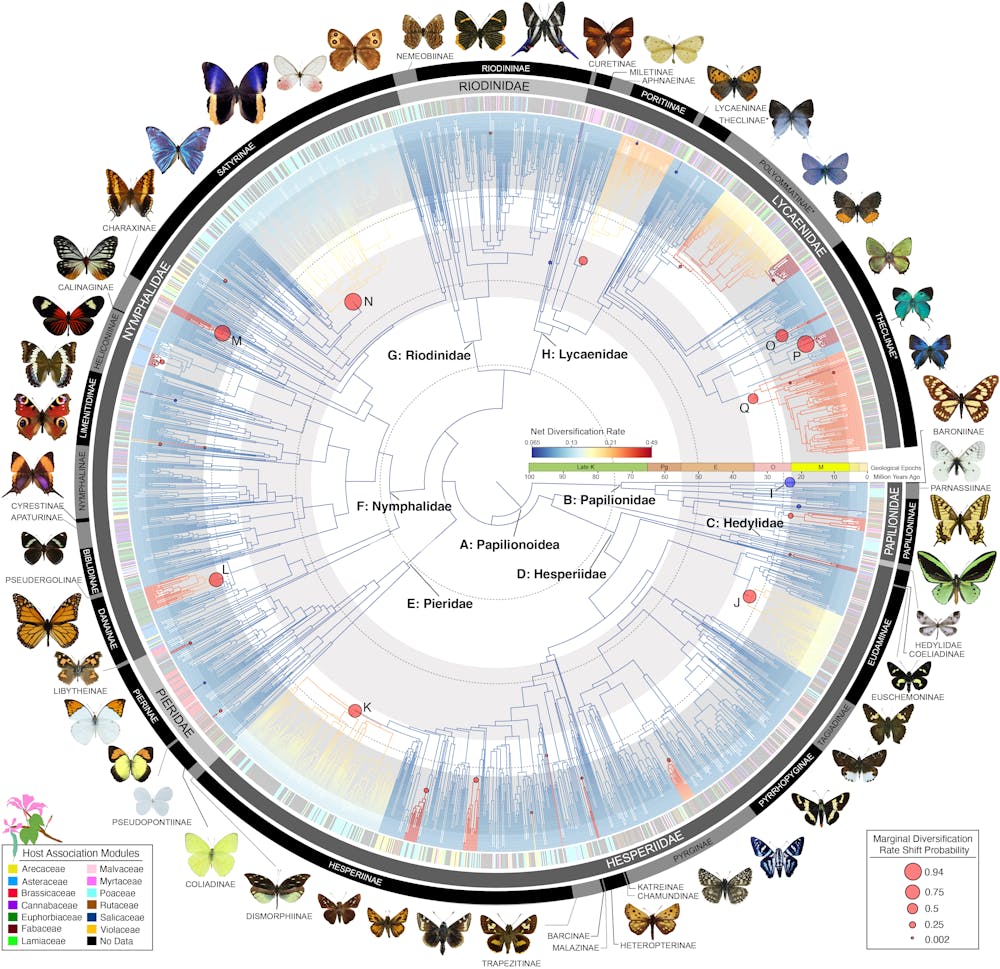
The ‘family tree’ of butterfly species was pieced together using DNA from 2,244 species. Kawahara et al. / Nature Ecology & Evolution, CC BY

There are roughly 19,000 butterfly species in the world, and piecing together the 100-million-year history of the group required assembling the world’s largest dataset of butterfly DNA sequences, geographical distributions and larval host plants.

Underlying the analysis were 11 rare butterfly fossils, without which the analysis would have been impossible. Butterflies are rarely preserved in the fossil record, and those that are preserved are frequently difficult to identify.

These fossils served as calibration points on the evolutionary tree. Once the tree was calibrated researchers could then estimate the timing of key events in butterfly evolution, starting with their origin.

North American origins

Not only did this latest study determine the age of butterflies, it also discovered where the butterflies first originated. By assembling a database of the distributions of all modern species and the plants on which they lay their eggs, the scientists were able to trace the movements of butterflies through time and space.

The study tells a dynamic story – one rife with rapid diversifications, faltering advances, and improbable dispersals. Some groups travelled over what seem impossibly vast distances, and others seem to have stayed in one place while continents, mountains and rivers moved around them.
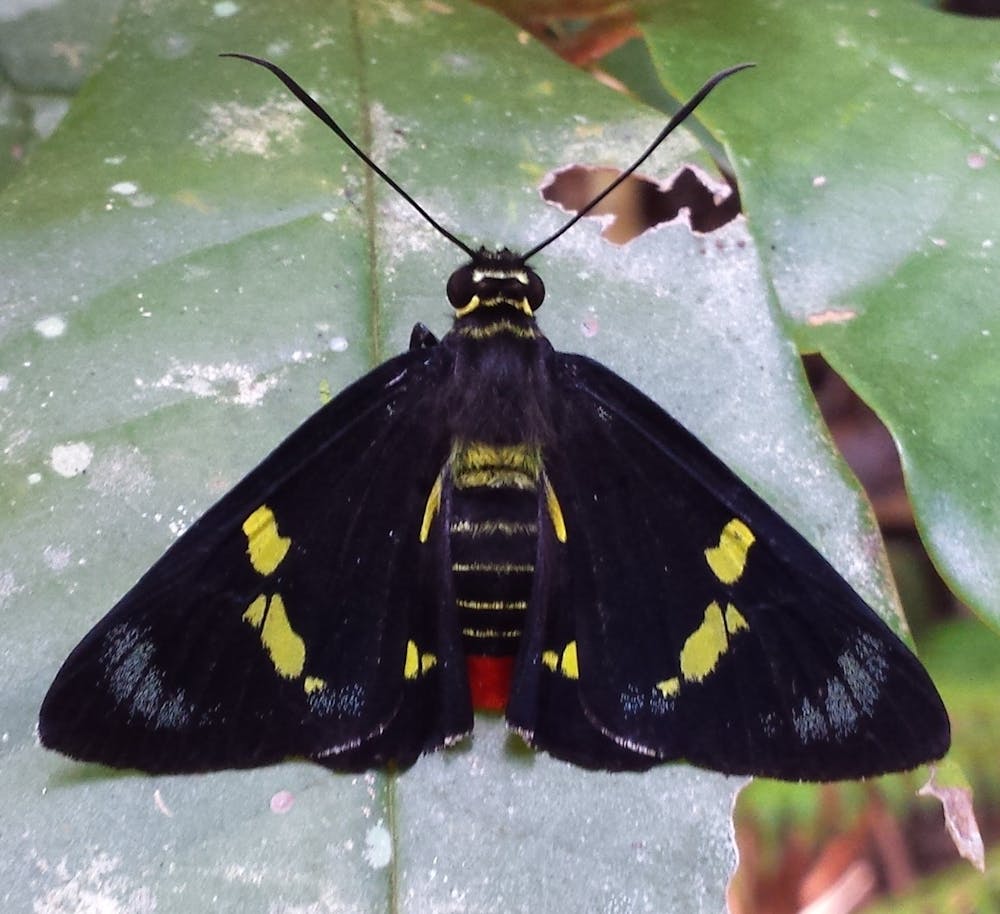
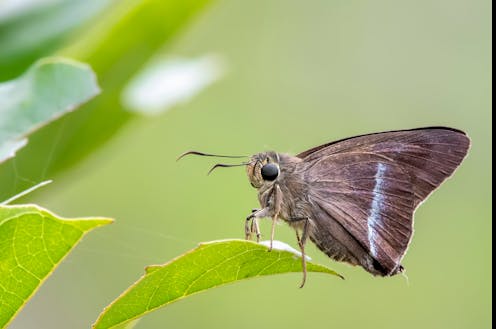
A photo of a black butterfly with yellow markings sitting on a green leaf. The Regent Skipper butterfly (Euschemon rafflesia), found only in the rainforests of Australia’s east coast, is the last remaining species of the Euschemoniinae subfamily. MF Braby, Author provided

According to this latest research, butterflies first appeared somewhere in Central and western North America.

At that time in the mid-Cretaceous, the continent of North America was part of eastern Laurasia, and it was bisected by an expansive seaway that split the continent in two. Present-day Mexico was joined in a long arc with what is now the United States, Canada and Russia.

North and South America had not yet joined via the isthmus of Panama, but butterflies seem to have had little difficulty crossing the water gap into the Southern Hemisphere. Once they reached South America, the early butterflies diversified to an astonishing degree.


From there, many groups not only moved back into North America, but they also dispersed to Australia via Antarctica. At the time, the three continents were still connected to form Southern Gondwana, a remnant of the supercontinent Gondwana. The path to Australia – and the rest of the world Two of the earliest butterfly lineages to reach Australia via Antarctica were the subfamilies Coeliadinae (awl skipper butterflies) (around 72 million years ago) and Euschemoniinae (around 65 million years ago). The Euschemoniinae are a group of butterflies found only in Australia, containing just a single remaining species – the spectacular regent skipper (Euschemon rafflesia) – restricted to the rainforests along the east coast. To reach Australia, butterflies must have once lived in Antarctica in the Late Cretaceous and Early Paleogene periods when global temperatures were considerably warmer than today. They would have made their way across the continent to Australia before the two landmasses separated some 34 million years ago. A photo of a butterfly with black wings and iridescent blue-green markings. The greater peacock awl butterfly (Allora major) is descended from the first butterflies to reach Australia some 72 million years ago. CSIRO Publishing, Author provided Other groups of butterflies entered Australia much later via the islands of South-East Asia. They had earlier reached Asia from North America across the Bering land bridge. From there, they quickly covered ground, spreading and diversifying across Southeast Asia, the Middle East and the Horn of Africa. They even made their way to India, which was then an isolated island, separated by kilometres of open sea on all sides. Once butterflies had become established in Central and North America approximately 101 million years ago, they quickly diversified alongside their plant hosts over the next 25 million years, with the last two families (Riodinidae and Lycaenidae) evolving around 76 million years ago. By the time dinosaurs were wiped out 66 million years ago, all six modern butterfly families had arrived on the scene. Authors: Michael F. Braby, Associate Professor, Australian National University

Read more https://theconversation.com/how-butterflies-conquered-the-world-a-new-family-tree-traces-their-100-million-year-journey-across-the-globe-205487

Diesel Shortage to Impact Trades and Contractors

Strait of Hormuz blockage affecting all major parts of trades and construction Trades and construction across residential, commercial and industria...

Why Holiday Home Owners Turn to Rental Management Agents

The Allure — and the Reality — of Renting Out Your Property Owning a holiday home is a dream for many Australians. Whether it's a beachside sha...

Why Finding Reliable Doctors In Bundoora Is Important For Long-Term Health

Access to quality healthcare plays an important role in maintaining overall wellbeing and managing health concerns early. Trusted Doctors in Bundoor...

Understanding the Different Types of Car Services: Minor vs Major

When it comes to car maintenance, one of the most important things every vehicle owner should understand is the difference between a minor and a maj...

How Superannuation and TPD Insurance Work Together

Superannuation is an essential part of financial planning in Australia. It is designed to provide individuals with income during retirement, helping...

Tiny Towns funding granted for Mt Hotham and Mt Buller upgrades

Alpine Resorts Victoria (ARV) has welcomed funding support from the Victorian Government’s  Tiny Towns Fund, with both Mt Hotham and Mt Buller se...

Locksmith Services: Why Professional Security Solutions Matter More Than Ever

Security is a critical concern for homeowners, businesses, and vehicle owners alike. Whether it involves protecting a property, replacing damaged lo...

Why Tooth Fillings Are Important For Protecting Damaged Teeth

Cavities and minor tooth damage are common dental problems that can worsen if left untreated. Professional tooth fillings help restore damaged teeth, ...

The Connection Between Visibility and Driver Confidence

Operating a vehicle safely requires an immediate, uncompromised stream of visual information from the surrounding road environment. A driver's decis...

Important Things To Know Before Starting An SMSF Setup

Planning for retirement requires careful financial decisions, and many Australians are now looking for more direct control over how their superannua...

Why Retail Cleaning Plays a Key Role in Customer Experience and Business Success

Professional retail cleaning services are an essential part of maintaining a welcoming, safe, and professional environment for customers and staff...

Simple Ways to Make a Commercial Property More Appealing to Buyers

Selling or leasing a commercial property isn’t just about listing the square metres, taking a few photos and waiting for the right person to appea...

What Café Owners Should Know Before Upgrading Their Display Setup

A café display fridge does a lot more than keep cakes cold and sandwiches fresh. It quietly shapes the way customers browse, the way staff move beh...

Creating a Backyard That Feels Comfortable All Year Round

A great backyard doesn’t need to be huge, expensive or perfectly styled. Most of the time, the spaces people actually use are the ones that feel e...

How Homeowners Can Make Smarter Energy Decisions Before Upgrading

Energy upgrades used to feel like something you only looked into after a power bill gave you a nasty surprise. These days, though, more homeowners a...

Why Retail CX Breaks During Peak Sales Events and How to Prevent It

Retail customer experience has become one of the most important drivers of revenue growth, especially during high-intensity sales periods. However, ev...

15 South Indian Dishes Everyone Should Try

If your only experience of "Indian food" is butter chicken and garlic naan, South Indian cuisine is going to feel like discovering an entirely new c...

What Every Homeowner Should Know About Roof and Drainage Maintenance

A home's roof and drainage system work together every day to protect the property from water damage. While many homeowners focus on visible areas such...