There’s a buzz about ‘sustainable’ fuels – but they cannot solve aviation's colossal climate woes
- Written by Susanne Becken, Professor of Sustainable Tourism, Griffith Institute for Tourism, Griffith University
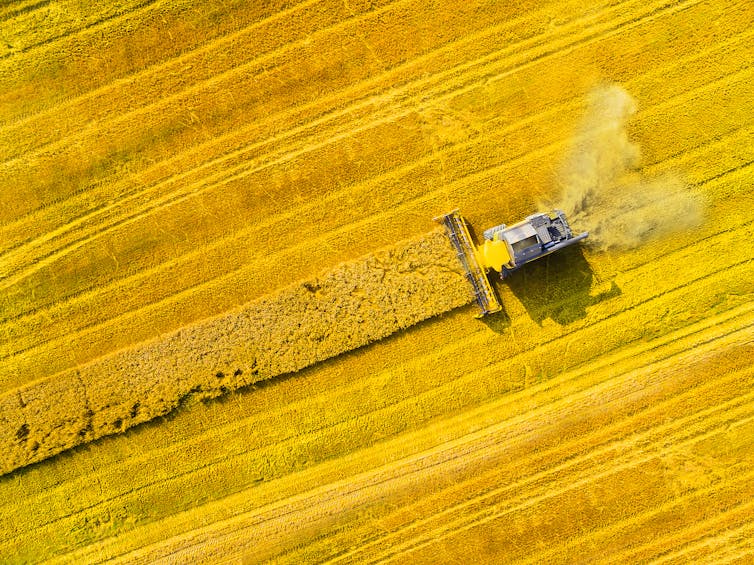
The global airline industry is fast recovering from the unprecedented pause to flying imposed by COVID-19. In some parts of the world, such as the Middle East, airlines are even expanding rapidly – well beyond pre-pandemic levels.
But how will the industry continue to grow while doing its fair share on climate change? Unless global aviation changes tack, its greenhouse gas emissions are projected to cause about 0.1℃ of total global warming by 2050.
So-called “sustainable aviation fuels” are being promoted by the aviation and energy industries as the preferred solution. These fuels can be made from organic matter such as plants (also known as biomass), waste such as used cooking oil, and synthetic kerosene.
However, as our new research shows, sustainable aviation fuel is not a silver bullet. Even if the industry could make the shift, there’s not enough land or renewable energy potential on Earth to produce all the sustainable fuels airlines need.
A tough ask
In 2021, the International Air Transport Association released a plan for airlines to achieve net-zero carbon by 2050.
Individual airlines have made similar commitments, including American Airlines, Qantas and Air New Zealand.
But there are very few low-carbon alternatives to traditional fossil jet fuel. That makes reducing emissions from the aviation sector extremely difficult.
Two options – batteries and liquid hydrogen – face significant challenges. For example, neither are suitable for long-haul flights. That’s why industry is turning to sustainable aviation fuels.
These fuels effectively perform in the same way as their fossil fuel-derived counterparts. They are suitable for long flights and can be used in existing planes so airlines wouldn’t have to replace whole fleets.
But at the moment, very little sustainable aviation fuel is being produced – and it’s much more expensive than fossil jet fuel.
Sustainable aviation fuel also raises serious environmental concerns. So is the transition actually feasible? Our new research set out to answer this question.
Read more: Green hydrogen funding is a step forward – but a step doesn't win the race
What we found
Our study involved analysing 12 “roadmaps” or plans for decarbonising the global aviation industry. They were published by the industry, outside organisations and academics.
We found the plans rely heavily on biofuels in the medium-term and synthetic e-kerosene in the longer term.
Currently, all sustainable aviation fuels used commercially are produced from food waste such as cooking oil or animal fat. Energy crops (such as soy and willow), agricultural residues (husks, bagasse), and forest biomass (such as logging residue and manufacturing waste) provide larger volumes of raw materials, but chemical engineering processes to turn them into fuel are still developing.
If e-kerosene is to be produced cleanly, it requires electricity produced from renewable energy sources to “split” the water (a process called electrolysis) and produce hydrogen. This hydrogen is then combined with carbon dioxide.
Our research found the roadmaps largely omitted a number of fundamental problems with sustainable aviation fuels.
The first is the huge amount of biomass and clean energy needed. On average across the roadmaps, producing sustainable aviation fuels would require about 9% of global renewable electricity and 30% of available biomass in 2050. Even then, about 30% of fuel used by airlines in 2050 would be fossil-derived.
Read more: The future of flight in a net-zero-carbon world: 9 scenarios, lots of sustainable aviation fuel
Other industries also use biomass resources. For example, the cosmetics industry uses tallow in skincare products. Bagasse – the pulp left after sugar cane juice is extracted – is used for heat in sugar mills. So demand for sustainable aviation fuels risks displacing other industries.
Second, the process of converting raw materials into sustainable aviation fuels leads to a major loss of energy, in the form of heat. In the case of e-kerosene, only about 15% of the primary renewable electricity remains to power the aircraft.
Not only is this inefficient, it leaves less clean energy for other industries wanting to decarbonise.
Third, producing sustainable aviation fuels creates greenhouse gas emissions. Growing bio-crops, for instance, requires the use of emissions-intensive fertiliser, harvest machinery and transport.
And already, vast tracts of rainforest are being razed to make way for crops used in biofuels. If sustainable aviation fuels were produced in this way, they’d be considerably worse for the climate than fossil fuels.
Finally, carbon dioxide is not the only aviation emission that contributes to climate change. Others include nitrogen oxides, water vapour and soot. Research to date is inconclusive about whether sustainable aviation fuels will improve this problem.
‘Unrealistic and irresponsible’
The above is not an exhaustive list of the potential climate damage caused by sustainable aviation fuels. But clearly, while the fuels will play a useful role to some extent, the industry’s growth plans are unrealistic and irresponsible.
Private and government investment should instead be directed to lower-carbon forms of transport, such as rail. And for the travelling public, a shift in mindset is required, involving how often and how far we need to travel.
Aviation is not the only industry that must rapidly decarbonise in coming decades. The whole global energy system needs to transition.
That means airlines must not take more than their fair share of finite resources to claim the label of “sustainable”.
Read more: Tourism desperately wants a return to the 'old normal' but that would be a disaster
Authors: Susanne Becken, Professor of Sustainable Tourism, Griffith Institute for Tourism, Griffith University