Global warming to bring record hot year by 2028 – probably our first above 1.5°C limit
- Written by Andrew King, Senior Lecturer in Climate Science, The University of Melbourne
One year in the next five will almost certainly be the hottest on record and there’s a two-in-three chance a single year will cross the crucial 1.5℃ global warming threshold, an alarming new report by the World Meteorological Organization predicts.
The report, known as the Global Annual to Decadal Climate Update, warns if humanity fails to reduce greenhouse gas emissions to net zero, increasingly worse heat records will tumble beyond this decade.
So what is driving the bleak outlook for the next five years? An expected El Niño, on top of the overall global warming trend, will likely push the global temperature to record levels.
Has the Paris Agreement already failed if the global average temperature exceeds the 1.5℃ threshold in one of the next five years? No, but it will be a stark warning of what’s in store if we don’t quickly reduce emissions to net zero.
Warming makes record heat inevitable
The World Meteorological Organization update says there is a 98% chance at least one of the next five years will be the hottest on record. And there’s a 66% chance of at least one year over the 1.5℃ threshold.
There’s also a 32% chance the average temperature over the next five years will exceed the 1.5℃ threshold. The chance of temporarily exceeding 1.5℃ has risen steadily since 2015, when it was close to zero. For the years between 2017 and 2021, it was a 10% chance.
Human-caused greenhouse gas emissions have already driven up global average temperatures by more than 1℃ since the late 19th century. The update notes the 2022 average global temperature was about 1.15℃ above the 1850-1900 average, despite the cooling influence of La Niña conditions. Temperatures are now rising by about 0.2℃ per decade.
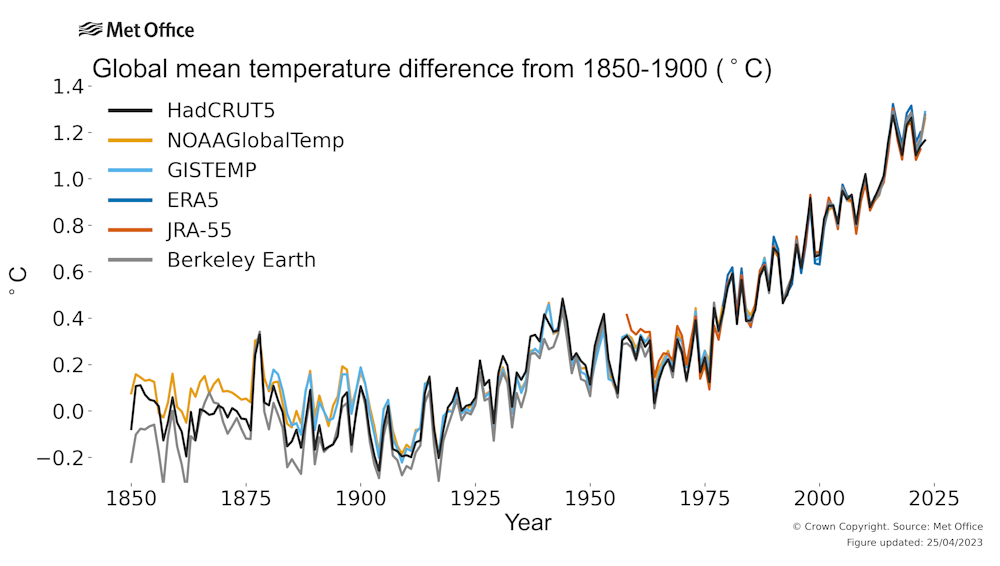
We now have more than a century of global mean temperature data. That means it should be getting harder, not easier, to achieve new records. If there was no trend, we would expect to see fewer records as time passes and the data we’ve collected better captures the full range of natural climate variability.
Instead, because we are warming the world so quickly, more heat records are being set globally and at the local level. The human influence on the climate is pushing temperatures to unprecedented highs with alarming frequency.
Add El Niño, then extreme highs are likely
The current record global average temperature dates back to 2016. A major El Niño event early that year pushed up the global average temperature.
Read more: 2016 crowned hottest year on record: Australia needs to get heat smart
El Niño events are associated with warmer-than-normal seas over much of the central and eastern Pacific. This helps warm the lower atmosphere and raise global temperatures by about 0.1℃. This might not sound like much, but with rapid background warming it’s often enough to break the previous record.
In the seven years since the current global temperature record, humanity has continued to intensify the greenhouse effect. This is making a new record ever more likely.
El Niño conditions are starting to form in the Pacific and are looking increasingly likely to take hold in June and July. This could be the first significant El Niño since 2016. An El Niño would greatly increase the chance of breaking that year’s record high global average temperature, particularly in 2024.
Does this mean the Paris Agreement has already failed?
Almost all nations around the world have signed the Paris Agreement. The aim is to limit global warming to well below 2℃ and preferably below 1.5℃ above pre-industrial levels.
The prediction that an individual year above 1.5℃ global warming is more likely than not is alarming. But it doesn’t mean we have failed to achieve the Paris Agreement’s goals. The agreement aims to limit long-term global warming to a level that avoids major climate impacts, including ecosystem loss. One or two years that pop over the 1.5℃ level don’t constitute failure.
However, the world is getting closer to the 1.5℃ global warming level due to our continuing high greenhouse gas emissions. The forecast of a probable year that exceeds that level should serve as a warning.
Yet another sign of humanity’s damage to the climate
Past inaction on reducing emissions and tackling climate change means we have already warmed the world by more than 1.2℃. Global emissions remain at near-record high levels, so we are continuing to intensify the greenhouse effect and warm the planet.
If we are to limit global warming to well below 2℃, then we must act so future generations don’t suffer a much less hospitable planet.
We have understood the solution for decades. We must reduce emissions to net zero to stop warming Earth. Countries such as Australia, with high historical emissions, have a leading role to play by decarbonising electricity supply and ramping down coal, oil and gas production in line with goals laid out by the United Nations.
Read more: Australia's 116 new coal, oil and gas projects equate to 215 new coal power stations
Failure to act should not be considered an option. Otherwise we are locking in more record hot years and much worse climate change impacts for decades and centuries to come.
Authors: Andrew King, Senior Lecturer in Climate Science, The University of Melbourne