Babies crawl, scoot and shuffle when learning to move. Here's what to watch for if you're worried
- Written by Charmaine Bernie, Senior Research Fellow, Early Years Research Lab, Southern Cross University
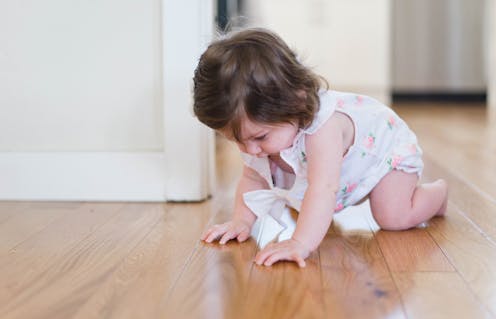
Early gross motor (or whole body) movements such as crawling and walking are exciting developments and clear markers for parents watching their child’s development. But what happens when a milestone isn’t reached, or the movement itself isn’t what a parent is expecting?
Babies arrive in the world with inborn movements, including reflexes. Other motor skills – such as sitting up or rolling towards a toy on a playmat – are learned as they grow.
Most babies begin moving towards people or objects much further away from them in the second half of their first year. This marks a change for parents and carers too, because they can no longer walk away for a moment and come back to find baby in the same spot. Time to think about child proofing your living spaces if you haven’t already!
But how can a parent or carer decide when to worry, when to get professional advice, or when to accept things are moving along just fine?
Crawling, cruising, walking
Commonly babies will crawl “on all fours” with bellies above the floor and hands and knees moving forward in a diagonal pattern, where right arm and left leg move together and left arm and right leg move together. This stage can last weeks or months before infants rise up to cruise on their feet while holding on to the furniture. Cruising and walking is usually observed between eight and 18 months of age.
Some children, however, move differently, and some seem to skip the crawling stage altogether. Just as there is no specific day in the first year that all babies move off their play mat to explore, there is no one way of moving across the room.
Some babies bottom-shuffle along while keeping their hands off the floor. Others commando crawl on their tummy, like soldiers staying low. Some babies move hands first with their bent knees to follow like they are playing game of leapfrog. Many use combinations of any or all of the above in addition to crawling before they turn one.
Quality and variety might be significant
Researchers and child development professionals used to think when traditional movement sequences were not observed, there was a definite problem with the way a child’s brain or body was developing.
While there are some schools of thought that suggest crawling is a critical part of child development, newer theories place more emphasis on the quality and variety of movements individual babies use to move. Some research has suggested variable crawling patterns can occur in children with, and without, later developmental delay. Earlier research found while 90% of children achieved motor milestones by age two following a common sequence, 4.3% did not show hands-and-knees crawling at all.
Differences are not always cause for concern, but tuning in to your child’s movement pattern may be important if you are noticing something unexpected at this stage. Unusual, absent or delayed crawling patterns have been associated with cerebral palsy, Down syndrome, autism, developmental coordination disorder and other neurological, learning or developmental disorders.
Children with known neurological or physical issues, or adverse events before or at birth may also experience gross motor difficulties and delays.
For each of these groups, early assessment and intervention are important, as they carry greater potential benefit for children and families, compared with waiting until later to address concerns.
Read more: Talking to babies may contribute to brain development – here's how to do it
A few things to watch for and investigate
So, what are the signs that help parents know it is time to seek professional advice?
Not trying to move
By about 9–11 months there should be some regular attempts from babies to move in and out of still positions and explore the room around them. It is common for babies at this stage to use their arms and legs effectively together to direct themselves forward.
Asymmetry
When the left of the body is doing something quite different from the right (or vice versa) it is a sign further assessment may be needed.
Noticeable weakness, stiffness or discomfort
When babies seems to be struggling with movement strength or range, particularly in the neck, arms, hands, or legs, this should be explored further by a health professional. Babies showing regular and ongoing signs of discomfort with their movements (such as grimacing or crying) should also be reviewed.
Read more: What is 'early intervention' for infants with signs of autism? And how valuable could it be?
Get the right advice
If parents or carers notice these things, it is important they raise it with a care provider, such as a maternal child and family health nurse or general practitioner. An appointment with one of these providers is usually the first step parents take when there are concerns or they want extra observation or screening.
Some families may already have access to a paediatric occupational therapist, physiotherapist or paediatrician. Each can complete further assessments and offer advice as needed.
In the vast majority of cases, parents have a good sense of when to worry. If you are concerned, seek out a healthcare professional who can help answer questions and provide advice. Neither you, nor your baby need to move through this stage alone.
Read more: Toilet training from birth? It is possible
Authors: Charmaine Bernie, Senior Research Fellow, Early Years Research Lab, Southern Cross University