observations reveal deep ocean currents are slowing earlier than predicted
- Written by Kathy Gunn, CSIRO
Antarctica sets the stage for the world’s greatest waterfall. The action takes place beneath the surface of the ocean. Here, trillions of tonnes of cold, dense, oxygen-rich water cascade off the continental shelf and sink to great depths. This Antarctic “bottom water” then spreads north along the sea floor in deep ocean currents, before slowly rising, thousands of kilometres away.
In this way, Antarctica drives a global network of ocean currents called the “overturning circulation” that redistributes heat, carbon and nutrients around the globe. The overturning is crucial to keeping Earth’s climate stable. It’s also the main way oxygen reaches the deep ocean.
But there are signs this circulation is slowing down and it’s happening decades earlier than predicted. This slowdown has the potential to disrupt the connection between the Antarctic coasts and the deep ocean, with profound consequences for Earth’s climate, sea level and marine life.
Our new research, published today in the journal Nature Climate Change, uses real-world observations to decipher how and why the deep ocean around Antarctica has changed over the past three decades. Our measurements show the overturning circulation has slowed by almost a third (30%) and deep ocean oxygen levels are declining. This is happening even earlier than climate models predicted.
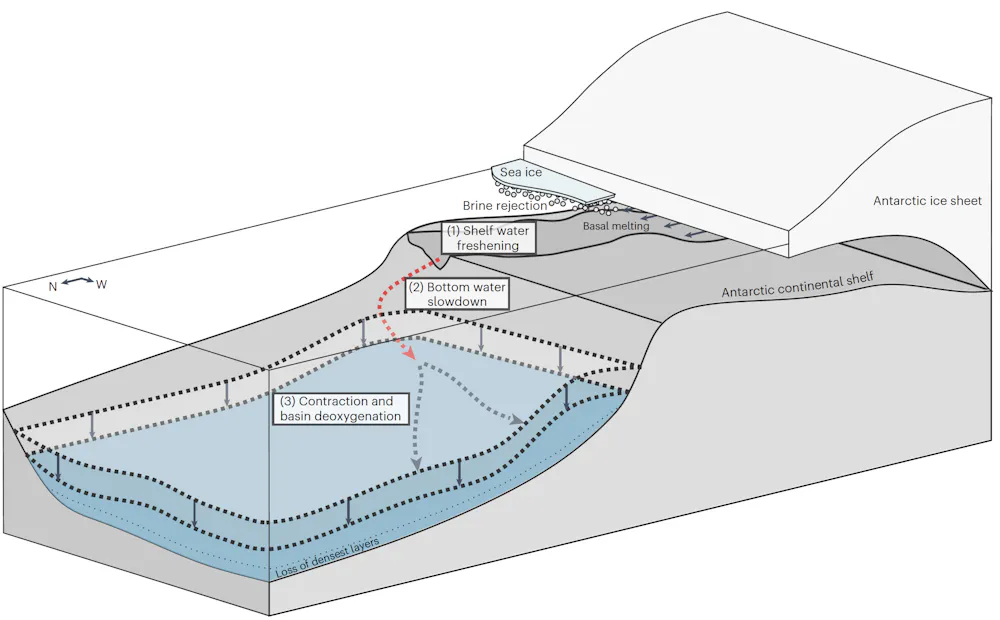
We found melting of Antarctic ice is disrupting the formation of Antarctic bottom water. The meltwater makes Antarctic surface waters fresher, less dense, and therefore less likely to sink. This puts the brakes on the overturning circulation.
Now that’s a waterfall: dense water flowing from the continental shelf into the deep ocean in the Ross Sea. Consortium for Ocean-Sea Ice Modelling in Australia (COSIMA) and National Computational Infrastructure.Why does this matter?
As the flow of bottom water slows, the supply of oxygen to the deep ocean declines. The shrinking oxygen-rich bottom water layer is then replaced by warmer waters that are lower in oxygen, further reducing oxygen levels.
Ocean animals, large and small, respond to even small changes in oxygen. Deep-ocean animals are adapted to low oxygen conditions but still have to breathe. Losses of oxygen may cause them to seek refuge in other regions or adapt their behaviour. Models suggest we are locked in to a contraction of the “viable” environment available to these animals with an expected decline of up to 25%.
Slowdown of the overturning may also intensify global warming. The overturning circulation carries carbon dioxide and heat to the deep ocean, where it is stored and hidden from the atmosphere. As the ocean storage capacity is reduced, more carbon dioxide and heat are left in the atmosphere. This feedback accelerates global warming.
Reductions in the amount of Antarctic bottom water reaching the ocean floor also increases sea levels because the warmer water that replaces it takes up more space (thermal expansion).
Signs of a worrying change
Making observations of bottom water is challenging. The Southern Ocean is remote and home to the strongest winds and biggest waves on the planet. Access is also restricted by sea ice during winter, when bottom water forms.
This means observations of the deep Southern Ocean are sparse. Nevertheless, repeated full-depth measurements taken from ship voyages have provided glimpses into the changes underway in the deep ocean. The bottom water layer is getting warmer, less dense and thinner.
Satellite data shows the Antarctic ice sheet is shrinking. Ocean measurements taken downstream of regions of rapid melt show the meltwater is reducing the salinity (and density) of coastal waters.
Antarctic ice mass loss over the last few decades based on satellite data, showing that between 2002 and 2020, Antarctica shed an average of ~150 billion metric tonnes of ice per year, adding meltwater to the ocean and raising sea-levels (Source: NASA).Read more: Antarctica's heart of ice has skipped a beat. Time to take our medicine
These signs point to a worrying change, but there are still no direct observations of the deep overturning circulation.
What did we do?
We combined different types of observations in a new way, taking advantage of each of their strengths.
The full-depth measurements collected by ships provide snapshots of ocean density, but are usually repeated about once a decade. Moored instruments, on the other hand, provide continuous measurements of density and speed, but only for a limited time at a particular location.
We developed a new approach that combines ship data, mooring records, and a high resolution numerical simulation to calculate the strength of Antarctic bottom water flow and how much oxygen it transports to the deep ocean.
Our study focused on a deep basin south of Australia that receives bottom water from several sources. These sources lie downstream of large meltwater inputs, so this region is likely to provide an early warning of climate-induced deep ocean changes.
The findings are striking. Over three decades, between 1992 and 2017, the overturning circulation of this region slowed by almost a third (30%) causing less oxygen to reach the deep. This slowing was caused by freshening close to Antarctica.
We found this freshening reduces the density and volume of Antarctic bottom water formed, as well as the speed at which it flows.
The observed slowdown would have been even greater if not for a short-lived climate event that drove a partial and temporary recovery of bottom water formation. The recovery, driven by increased salinity, further illustrates the sensitivity of bottom water formation to salinity changes on the Antarctic continental shelf.
Worryingly, these observations show that changes predicted to occur by 2050 are already underway.
Abyssal ocean warming driven by Antarctic overturning slowdown, Credit: Matthew England and Qian Li.What next?
Ice loss from Antarctica is expected to continue, even accelerate, as the world warms. We are almost certain to cross the 1.5℃ global warming threshold by 2027.
More ice loss will mean more freshening, so we can anticipate the slowdown in circulation and deep oxygen losses will continue.
The consequences of a slowdown will not be limited to Antarctica. The overturning circulation extends throughout the global ocean and influences the pace of climate change and sea level rise. It will also be disruptive and damaging for marine life.
Our research provides yet another reason to work harder – and faster – to reduce greenhouse gas emissions.
Authors: Kathy Gunn, CSIRO