what mungee, the world's largest mistletoe, can teach us about treading lightly
- Written by Alison Lullfitz, Research Associate, The University of Western Australia
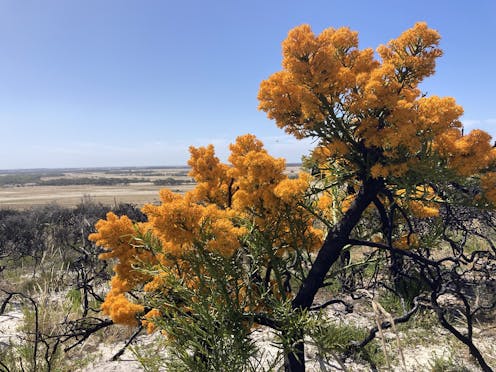
Noongar Country of southwestern Australia is home to the world’s largest parasitic plant, a mighty mistletoe that blooms every December. That’s why it’s commonly known as WA’s Christmas Tree. But it also goes by other names, mungee and moodjar. And it holds great significance for Noongar people including the Merningar people of the south coast.
While the unique biology and charisma of the species (Nuytsia floribunda) has been recognised by Traditional Owners for millennia, such rich Indigenous knowledge is barely known to Western science. Our research team includes three generations of Merningar alongside non-Indigenous scientists. In our new research, we set out to explore mungee’s physiology, ecology and evolution from both Indigenous and Western science perspectives.
The plant’s ability to access a wide array of resources is remarkable, enabling it to prosper in the hostile, infertile, but biologically rich landscapes of southwestern Australia. This is also the case for Noongar people, whose traditional diet reflects the biological richness of their Country.
Mungee is a revered teacher to Noongar people, with lessons for us all about living sustainably and in harmony with one another.
A sand-loving parasite
Nuytsia floribunda is widespread across Noongar Country (Boodja) and known to most Noongar as moodjar. But it’s also called mungee by Merningar and other southern Noongar groups. Being mostly Merningar, we call it mungee and use that term here.
Mungee is a mistletoe tree that grows up to 10m tall in sandy soils. It’s endemic to southwestern Australia, but widespread throughout. The parasitic capability of the plant comes from highly modified, ring-shaped roots (haustoria) that act like secateurs to mine other plants for water and nutrients.
We used “two way science” (cross-cultural ecology) methods – including a literature review, shared recording of visits on Country, and an author workshop – to investigate mungee more thoroughly than would be possible through Western science alone.
Read more: To address the ecological crisis, Aboriginal peoples must be restored as custodians of Country
A revered teacher offering divine guidance
Like other Indigenous Australian knowledge systems, Merningar lore is place-based. It inextricably links people, specific places, other organisms and non-living entities of Country. Mungee tells specific stories through where it lives, the plants it lives with, and when it flowers.
The species is widely held as sacred among Noongar peoples. For Merningar, it has the highest status of all plants. Mungee holds important lore about how we as humans relate to each other and with the world around us, similar to a cornerstone religious text such as the Christian Bible.
For Merningar, mungee is a powerful medium that helps restless spirits move on to the afterlife, known to us as Kuuranup. This enables those of us still living to be untroubled by their presence.
Senior elder Lynette describes mungee as her teacher, providing guidance on how to exist in Merningar Boodja. The annual summer flowers represent her ancestors returning to their Country, reminding her to cherish and respect both her old people and her Boodja.
Lynette calls the ring-shaped haustoria of mungee her “bush lolly”. Under Merningar lore, digging for these sweet treats is not allowed when mungee is flowering. This is when bush lollies are scarce, so the rule is about living within seasonal constraints.
An example of living sustainably
Mungee primarily reproduces by cloning, sending out suckers up to 100m from the parent plant to produce identical copies. This results in patches of mungee clones gathered together in tight-knit populations.
We saw parallels between patches of mungee and the communal kinship structures of Noongar society, where family is more important than individuals.
Before European settlement, extended Noongar families lived in largely separate groups, interconnected with other family groups as part of a wider geopolitical system. We see mungee as a botanical exemplar of putting community before individuals, for the greater good.
Mungee accesses water and nutrients by tapping into a wide range of host plants. This diversity of hosts enables mungee to live in many different landscapes. This parallels with the sophisticated, but often place-specific knowledge of Noongar peoples across their botanically rich Boodja, which has enabled use of a wide range of traditional plants.
Living a prosperous life within environmental boundaries is achieved by conservatively drawing upon a wide range of resources. It provides a lesson for all who live in dry and infertile regions such as southwestern Australia.
A tree to be celebrated
Mungee’s bright orange flowers bring joy to all who witness their display during the celebratory summer months in southwestern Australia. The plant’s unique biology, ingenuity and charisma has long been recognised by Noongar peoples and their lore.
Prolific annual flowers are a memorial to the many old people who have cared for their Boodja through millennia. They also remind us to protect the old peoples’ legacy.
To Merningar, mungee is a valuable teacher and exemplar of prosperous biological (including human) existence in the southwest Australian global biodiversity hotspot. It has much to teach the rest of us, too.
Read more: Connecting to culture: here's what happened when elders gifted totemic species to school kids
Authors: Alison Lullfitz, Research Associate, The University of Western Australia