Australian shelters and pounds kill 50,000 mostly healthy cats and kittens in a year. There's a way to prevent this pointless killing
- Written by Jacquie Rand, Emeritus Professor of Companion Animal Health, The University of Queensland
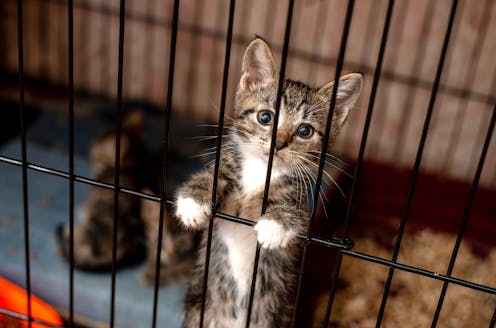
Stray cats are a longstanding problem in Australian towns and cities. Common complaints about roaming cats include nuisance (fighting and urinating), disease risks to humans and other animals, and predation of native wildlife. The huge numbers of cats and kittens taken in by animal shelters and council pounds are a challenge to manage, leading to an estimated 50,000 being killed each year – most of them young and healthy.
Our newly published research reveals Australian council pounds, rescue groups and animal welfare shelters took in 179,615 cats and kittens in 2018-2019. Of these animals, 5% were reclaimed by owners, 65% rehomed and 28% killed.
Council-operated pounds killed 46% of all cats and kittens admitted. Shelters killed 25%. One in four council pounds in New South Wales and Victoria killed a staggering 67-100%.
Despite the scale of this killing, Australia’s stray cat numbers are not decreasing. The evidence shows an urgent need for proactive community cat programs offering free desexing of cats in targeted problem areas.
Killing so many cats is bad for people too
High cat-killing rates also have a significant human cost. Many council, shelter and veterinary staff suffer devastating psychological impacts when required to kill large numbers of healthy cats and kittens, often repeatedly. These impacts include trauma, depression, substance abuse and increased suicide risk.
Members of the public can also be traumatised when the stray cats they are feeding are trapped and killed.
Current approaches are failing
To make matters worse, trapping and killing stray cats and kittens is costly and has not worked. This reactive approach has not reduced the stray cat population over the decades it has been applied. Therefore, the potential nuisance, disease risks and native wildlife predation have not been reduced.
Our research shows cat intakes actually increased at municipal pounds in NSW from 2016-17 to 2018-19 (pre-COVID data are most accurate). Attempts to adopt and kill our way out of the stray cat problem have failed.
Read more: Cats that are allowed to roam can spread diseases to humans and wildlife
Australian councils are increasingly adopting mandatory cat containment (curfews). It seems like a logical solution, but based on the evidence it is not effective. It doesn’t reduce stray cat numbers in the short or long term, as shown by the experience of councils such as Casey and Yarra Ranges in Victoria.
RSPCA Australia acknowledges:
Overall, councils with cat containment regulations have not been able to demonstrate any measurable reduction in cat complaints or cats wandering at large.
In contrast, Hume, Hobsons Bay and Merri-bek councils in Victoria have rejected mandatory containment. Their decisions cited reasons such as it is ineffective and unenforceable because most stray cats don’t have an owner to contain them.
Cats may be owned, semi-owned (people feed them intentionally) or (uncommonly) unowned. In the latter case they get food unintentionally provided by people, such as from bins.
Even for owned cats, containment is sometimes not achievable due to factors such as housing limitations, cost – containment systems typically cost $700-$2,000 – and concerns about the welfare of confined cats. Mandatory containment creates a barrier to semi-owners adopting the stray cat they are feeding and also potentially criminalises cat ownership for disadvantaged families, particularly those in rental properties.
Containment to their owners’ properties should be strongly encouraged where cats’ physical and mental needs can be met. But mandatory containment should be rejected. It will not protect native wildlife, the commonly cited justification, because it does not measurably reduce the number of free-roaming cats.
Read more: Research reveals why pet owners keep their cats indoors – and it's not to protect wildlife
Stray cats are not feral cats
Based on RSPCA and government definitions, stray cats in urban and urban fringe areas are all domestic cats.
They are not feral cats. Feral cats live and breed in the wild, not in cities or towns or near people, are not the subject of nuisance complaints and are not admitted to shelters or pounds. Stray cats are sometimes mislabelled as feral cats, which prevents effective solutions to the stray cat problem.
Stray cats account for 80-100% of admissions to council pounds and 60-80% to animal welfare agencies. The rest are mostly cats given up by their owners.
Most stray cats entering pounds and shelters are from poorer areas and are likely semi-owned cats. The people who feed them do not see themselves as owners of the stray cat but have an emotional bond with the cat.
Read more: Why do our dogs and cats bring us dead animals?
So what’s the long-term solution?
Assisting semi-owners and owners in disadvantaged areas to desex their cats is the best long-term solution to the stray cat problem. The Community Cat Program is an evidence-based approach that supports cat owners and semi-owners with free desexing and microchipping of the cats they are caring for. These efforts should be focused on areas of high cat intakes and complaints.
Proactive community cat programs are scientifically proven to reduce the number of stray cats and unwanted kittens in targeted areas. They thereby reduce nuisance complaints, cat intake and killing, trauma to people, costs, disease risks and wildlife predation.
Banyule in Victoria set up a free program to desex, microchip and register owned and semi-owned cats, with a focus on suburbs with high cat-related calls. In just three years, the council reduced impoundments by 61% and numbers killed by 74%. In contrast, after Yarra Ranges Council implemented mandatory containment in 2017, there was a 68% increase in impoundments in the third year.
The 2022 NSW Rehoming Practices Review recommended community cat programs, consistent with a “One Welfare” approach. The aim is to optimise and balance the wellbeing of people, animals and their social and physical environment. Earlier this year, the NSW government announced $8.3 million in funding for community cat programs and facilities.
At least 50% of cats entering pounds and shelters are kittens less than six months old. These figures highlight why community cat programs are urgently needed across Australia to protect cats, native wildlife and people.
Authors: Jacquie Rand, Emeritus Professor of Companion Animal Health, The University of Queensland