How Erdogan held onto power in Turkey, and what this means for the country's future
- Written by Mehmet Ozalp, Associate Professor in Islamic Studies, Director of The Centre for Islamic Studies and Civilisation and Executive Member of Public and Contextual Theology, Charles Sturt University
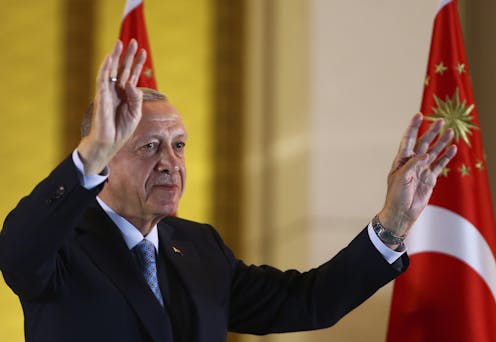
Recep Tayyib Erdogan will remain president of Turkey for another five years after winning Sunday’s run-off election over his long-time rival, Kemal Kilicdaroglu. If he serves the full five-year term, he will have held power for 26 years – almost the entire history of Turkey in the 21st century.
What is astonishing is how the majority of Turkish people elected Erdogan despite a worsening economy and now chronic hyperinflation that would likely bring down any government in a democratic country.
So, how did Erdogan win the election and, more significantly, what is likely to happen in the country in the foreseeable future?
Read more: How Erdoğan framed his science and tech 'great achievements' as part of election campaign
Free but far from fair
The election was free in that political parties could put forth nominees on their own and carry out campaigns. Parties also had the right to have representatives in every polling station to ensure the votes were counted correctly. And voters were free to vote.
However, the election was far from fair.
First, a potential leading rival in the race, Ekrem Imamoglu, was sentenced in December to more than two years in prison on a charge of “insulting public figures”.
Imamoglu, the popular mayor of Istanbul, dealt Erdogan’s party a rare defeat in the 2019 Istanbul elections. Polls had shown he could win against Erdogan in the presidential election by a comfortable margin.
Some argue the court ruling was politically motivated. With Imamoglu out of the picture, the opposition had to coalesce behind Kilicdaroglu, the weakest of all possible high-profile candidates.
Erdogan also has an almost ubiquitous grip over the Turkish media, engineered through Fahrettin Altun, the head of media and communication at the presidential palace.
Turkish media are either directly owned by Erdogan’s relatives, such as the popular Sabah newspaper managed by Sedat Albayrak, or controlled through managing editors appointed and monitored by Altun. Some independent internet news sites such as T24 practice self-censorship in order to remain operational.
With this massive media control, Erdogan and his men ensured he had the most television airtime. Erdogan was depicted in the media as a world leader advancing Turkey by building airports, roads and bridges. He was put in front of dozens of journalists on TV, but all the questions were prepared in advance and Erdogan read his answers through a prompter.
Altun also orchestrated a massive smear campaign against Kilicdaroglu. The opposition leader received minimal airtime, and when he was in the media, he was depicted as an inept leader unfit to rule the country.
Altun not only controlled the conventional TV channels and print media, but also social media. On Twitter, a very influential platform in Turkey, Altun used bots and an army of paid trolls and influencers to seek to control the dialogue.
And it worked. Sufficient number of voters were swayed through confusion and fear that the country would be far worse if Kilicdaroglu was elected.
Lastly, there was the potential for fraud due to the non-transparent way the election results are processed. Once each ballot box is counted, the ballot and result sheet are transported by police in cities and the military in regional areas to the electoral commission. Both the police and military are under Erdogan’s tight control.
The results are then reported only through the state-owned Anadolu Agency, while in the past they were reported by multiple independent agencies.
Even if no evidence of fraud emerges in this election, the spectre could put in doubt the integrity of the entire electoral process.
Staunch support from religious voters
There are two other factors that were decisive in the elections.
The first is the support Erdogan received from Sinan Ogan, who was third in the first round of the presidential election two weeks ago, with 5.2% of the votes. Erdogan persuaded Ogan to throw his support to him.
The second and most important factor was the way Erdogan was viewed in an almost mythical fashion by conservative and religious voters. For them, Erdogan is a religious hero and saviour.
The religious population in Turkey has long suffered persecution in the name of secularism. For them, Kilicdaroglu and his Republican People’s Party symbolised that persecution. Although Kilicdaroglu abandoned the party’s previous strict secular policies, these voters never forgave it for preventing Muslim women from wearing the head scarf in educational and state institutions and keeping religion out of public life and politics for decades.
The conservative and religious right in Turkey sees Erdogan as a world leader and a hero who struggled against ill-intentioned forces, both internally and externally, to make Turkey great again.
What is likely to happen in Turkey post-election?
Turkey desperately needed a change of government and a breath of fresh air. Now the social, political and economic suffocation is likely to get worse.
Erdogan had promised a Turkish revival by 2023, which is the 100th anniversary of the republic’s founding. Turkey was supposed to enter the top 10 economies in the world by then. However, Turkey barely sits in the top 20, at 19th.
The economy has experienced a significant downturn in the past three years. The Turkish lira has plummeted in value, leading to a dollar-based economy.
But dollars are hard to come by. The Turkish Central Bank kept the economy afloat by emptying its reserves in the last few months for the elections. The Central Bank has been running a current account deficit of US$8-10 billion dollars every month, and its reserves last week fell into the negative for the first time since 2002.
Now Erdogan has to find money. He will resort to high interest foreign loans and embark on a diplomatic spree of the oil-rich Muslim countries to draw some of their funds to Turkey. The uncertainty around how successful these endeavours will be and their likely short-term gain may throw the Turkish economy into recession.
For the people of Turkey, this could mean massive unemployment and a reduced cost of living. The inflation rate had reached a 24-year high of 85.5% last year, and may go even higher, as the cash-strapped government continues to print digital money to pay for its large bureaucratic workforce.
On foreign policy, Erdogan will continue to try to become a regional power independent of NATO, the European Union and the US. He will likely continue to strengthen Turkey’s ties with Russian President Vladimir Putin, which has been a worry for Turkey’s Western allies.
What does the future hold?
This will be Erdogan’s absolute last term in office, according to the Turkish constitution, and it could possibly be cut short.
The 69-year-old president has many health problems. He is becoming increasingly physically frail, finding it hard to walk, and his speech often slurs. In coming years, his health may get worse and he may have to hand over his presidency to a trusted deputy.
The other possibility is that potential leaders in his party could decide to carry out a party coup to topple Erdogan before his term is up, so they can garner public support ahead of the 2028 presidential election.
While there may be some political stability in post-election Turkey for now, the country will be in economic, social and political turmoil for the foreseeable future.
Authors: Mehmet Ozalp, Associate Professor in Islamic Studies, Director of The Centre for Islamic Studies and Civilisation and Executive Member of Public and Contextual Theology, Charles Sturt University