New DNA testing shatters 'wild dog' myth: most dingoes are pure
- Written by Kylie M Cairns, Research fellow, UNSW Sydney
For decades, crossbreeding between dingoes and dogs has been considered the greatest threat to dingo conservation. Previous DNA studies suggested pure dingoes were virtually extinct in Victoria and New South Wales.
Reinforcing this belief, the term “wild dog” has replaced the word dingo in most legislation and policy across Australia. “Wild dog” is a coverall term defined as “any dog living in the wild, including feral dogs, dingoes and their hybrids”. It’s the term used on signs in National Parks and other lands advertising the target and presence of meat baits impregnated with the poison 1080. These baits are laid to reduce the risk of wild dogs preying on livestock.
Our new research used the latest genetic testing methods to establish the ancestry of wild dogs across Australia. Most of the 307 wild animals we tested were pure dingoes. Only a small proportion of wild dingoes had dog ancestry, probably from a great- or great-great-grandparent. There were no “first-cross” (50/50) hybrids or feral dogs in our wild-caught sample.
Essentially, all the “wild dogs” were dingoes. The results challenge public perceptions and call into question well established management practices. We argue the term “wild dog” should be removed from public language and legislation. Dingo and feral dog should be used instead. And the role of the dingo as Australia’s apex predator should be restored, for we are the greatest threat to their existence.
Read more: Why dingoes should be considered native to mainland Australia – even though humans introduced them
Better results from better tests
The dingo (Canis dingo) has been in Australia for 5,000 to 11,000 years. But while dingoes are genetically distinct from domestic dogs, they can breed with them.
Scientific support for the idea that few pure dingoes remain in eastern Australia came from skull measurement tests developed in the 1980s and a DNA test developed in the 1990s.
Applying these approaches, Victoria listed dingoes as a threatened species after finding just 1% of animals killed in pest control programs were pure dingoes. Similarly in NSW “predation and hybridisation by feral dogs (Canis familiaris)” was listed as a key threatening process in 2009.
But DNA testing methods have improved since then. When we compared old and new DNA testing methods in our study, we found the original method frequently misidentified pure dingoes as hybrids. This is because the technique used a relatively small number of DNA markers, only 23. We used 195,000 DNA markers.
A DNA marker is a genetic change that can be used to study differences between species, populations or individuals. This is the same sort of technology used for human ancestry or family tree testing. In general, more DNA markers means more information about an individual and more accurate DNA test results.
The older method was also unable to account for geographic variation in dingoes. We found evidence of at least four populations or varieties of dingo in Australia, which we call: West, East, South and Big Desert.
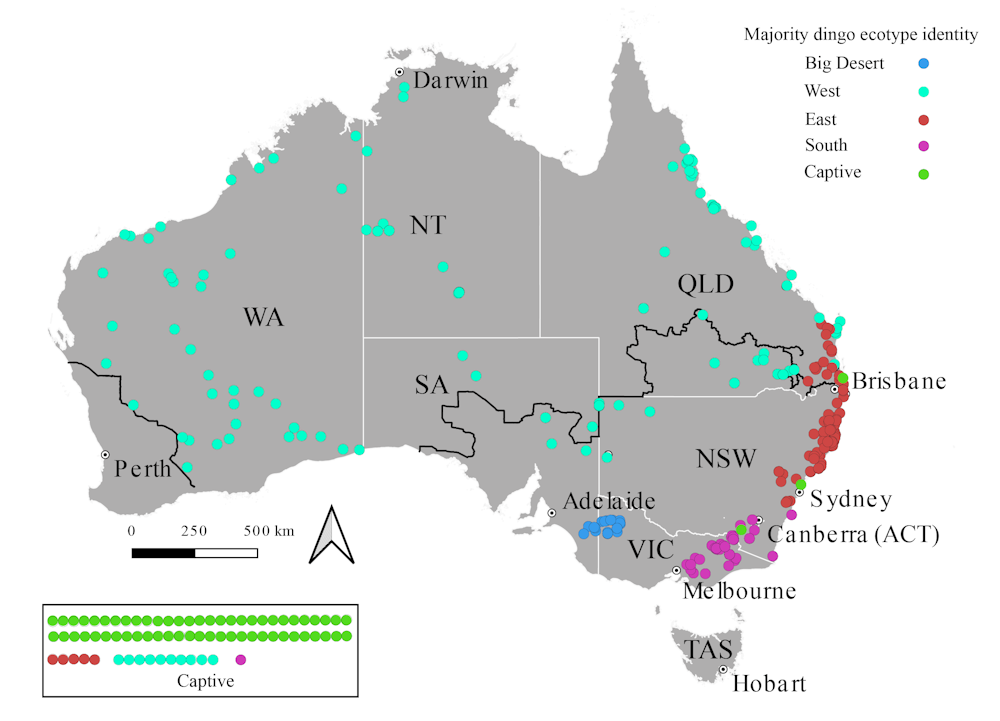
So when we looked at Victorian dingoes, nearly 90% of the animals we tested were pure dingoes. In NSW, over 60% of the animals we tested were pure dingoes and only two animals had less than 70% dingo DNA.
Dog ancestry was more common in NSW and Queensland dingo populations where there were intensive lethal control programs, such as aerial 1080 poison baiting, along with higher numbers of pet domestic dogs. One explanation is that lethal control programs carried out during the dingo breeding season may increase the risk of dingo-dog hybrids, as it does for wolves and coyotes in North America. Australian aerial baiting programs can kill up to 90% of the dingoes in an area, reducing the availability of mates for any remaining dingoes.
These findings have important implications for our knowledge of dingoes and how they are managed. We need to ensure public policy is built on robust, up-to-date knowledge of dingo identity and ancestry.
Wildlife managers and scientists should ensure that the DNA testing methods they use are accurate and fit for purpose. It is crucial that updated genetic surveys be carried out on dingoes, using the latest DNA methods to inform local dingo management plans.
Dingo conservation plans should consider the presence of geographic variation and the differing threats the four dingo populations may be facing.
Currently, dingoes fall into a grey area: because they are both a native animal and agricultural pest; and because their identity has become ambiguous due to the widespread adoption of the term wild dog.
Lethal control programs have been extended into conservation areas, including national parks, with the primary purpose of minimising livestock losses on neighbouring lands.
During 2020-2021, NSW dropped more than 200,000 1080 poisoned meat-baits from planes and helicopters to suppress “wild dogs”.
This year Victoria renewed its “wild dog bounty” program. It pays landholders A$120 per wild dog body part. Under the scheme, about 4,600 “wild dog” body parts have reportedly been redeemed since 2011.
Read more: Killing dingoes is the only way to protect livestock, right? Nope
Restoring an apex predator
Our study shows the term “wild dog” is a misnomer. The animals being targeted for eradication as an “invasive” pest are native dingoes.
The threat of dingo-dog hybrids has also been exaggerated. While dingoes can pose a threat to some livestock, as apex predators they play an essential role in maintaining healthy ecosystems. The dingo keeps natural systems in balance by preying on large herbivores and excluding invasive predators such as feral cats and foxes. This in turn benefits small marsupials, birds and reptiles. We need to balance managing dingo impacts on agriculture against ensuring they can perform their vital environmental functions.
The term “wild dog” should be removed from public language and legislation. Dingo and feral dog should be used instead. This change in terminology would accurately reflect the fact that a vast majority of the wild canines in Australia are pure dingoes – and the hybrids are predominantly dingo in their genetic make-up.
A name change would also align with calls from Australia’s First Nations people to respect and acknowledge the dingo as a native and culturally significant species.
Read more: From the dingo to the Tasmanian devil - why we should be rewilding carnivores
Authors: Kylie M Cairns, Research fellow, UNSW Sydney
Read more https://theconversation.com/new-dna-testing-shatters-wild-dog-myth-most-dingoes-are-pure-206397