Does the Fight Transphobia UniMelb campaign against a feminist philosopher violate academic freedom?
- Written by Hugh Breakey, Deputy Director, Institute for Ethics, Governance & Law. President, Australian Association for Professional & Applied Ethics., Griffith University
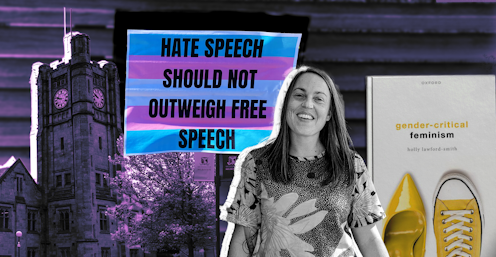
A campaign by the activist group Fight Transphobia UniMelb against feminist philosopher Holly Lawford-Smith escalated recently. There have been calls to boycott her course on feminism at the University of Melbourne. Posters and stickers around the campus and its environs have declared “Our demands: Transphobes and Nazis off campus” and that: “Only a Fascist takes ‘Feminism’”.
In response, Lawford-Smith has lodged a formal complaint with WorkSafe Victoria. She accuses the university of failing to provide her with a safe work environment, and to uphold academic freedom.
Fight Transphobia UniMelb has since stated it will revise some of its stickers, but the activism continues.
Melbourne University, meanwhile, is reportedly preparing to deploy security guards outside Lawford-Smith’s second-year feminism class.
University provost Nicola Phillips told The Age it has a “resolute commitment” to academic freedom, which extends to gender-critical perspectives being debated on campus and Lawford-Smith teaching her course. It also has a “positive obligation” to ensure transgender or gender diverse students can “participate fully in the life of the university”.
The campaign raises a host of challenging ethical questions.
Read more: What is essentialism? And how does it shape attitudes to transgender people and sexual diversity?
What’s all the fuss about?
Lawford-Smith is a “gender critical feminist”. (The term usually used by her opponents is “terf”: trans-exclusionary radical feminist.) Lawford-Smith’s scholarly research and public engagements are critical of gender identity, arguing for the significance of biological sex.
Lawford-Smith is no stranger to controversy. In 2021 she launched a website collecting anonymous stories from women about their safety in women’s spaces opened to trans women. The website was condemned by more than 1400 staff and students. In particular, sustained critiques were raised against the website’s scholarly standards, challenging whether it warranted protection on the basis of academic freedom.
More recently, Lawford-Smith spoke at the controversial “Let Women Speak Rally” in Melbourne, attended by far-right extremists – complete with Nazi salutes. In response, the activism against her intensified, linking her (and, it seems, her students) to fascism.
The case bears striking similarity to that of UK philosopher Kathleen Stock. A long-running campaign from trans activists made Stock fear for her safety, driving her to resign.
What’s academic freedom? Why is it important?
A key concern in considering the case is academic freedom. As Carolyn Evans and Adrienne Stone argue in Open Minds: Academic Freedom and Freedom of Speech in Australia, academic freedom differs from the more general notion of free speech.

 Students have a right to protest – as in this recent demonstration over university fees.
Mick Tsikas/AAP
Is this campaign consistent with academic freedom?
A campaign spokesperson told The Age that the activists believed in academic freedom, but that universities only had the right to “propagate unpopular ideas, not bigoted ones”.
The problem is that determining what speech counts as bigoted or harmful – outside of the most obvious cases of (say) racial slurs or incitements to violence – is acutely informed by a person’s beliefs, values and politics.
It is common for groups (on all sides of politics, and throughout history) to believe that those speaking out against their cause are not only mistaken, but morally wrong and actively harmful.
It’s hard to see what is left of academic freedom if small groups of students can, through tactics of targeted attacks on individual scholars, deliberately impose their views on what counts as prohibited research ideas and harmful speech.
After all, if the campaign is successful, there’s no guarantee that the practice would not continue and even expand. The present activism aims to remove Lawford-Smith from teaching one course. However, the arguments presented, and the rhetoric accompanying them (“Transphobes and Nazis off campus!”), could potentially be used to have her, and others who share her views, removed entirely.
Even if existing gender critical theorists were not systematically purged from universities, aspiring academics nevertheless would be well-warned to steer clear of research that could get them cancelled. Some argue this process of chilling gender-critical research has already begun.
Read more:
There are differences between free speech, hate speech and academic freedom – and they matter
Should courses be taught by controversial public speakers?
It has also been argued that, while perhaps gender-critical ideas can be taught, they should not be taught by someone who publicly holds such contentious views. Trans or gender-questioning students in Lawford-Smith’s courses might feel personally attacked and marginalised by her public statements.
This is an important concern. Universities should foster respectful relations between teachers and students. However, the argument in this context looks inconsistent.
After all, scholars supporting trans rights also take clear, public positions on controversial issues. Sometimes they can use extremely strong moral language to condemn opposing thinkers as bigoted, hateful, or phobic. This is the language of contempt, and it attacks not only the idea but the character of the person who holds it.
Yet there is every reason to believe those same scholars might teach students who have gender-critical sympathies, and even identities, who feel excluded and morally attacked for their beliefs.
Should students have academic freedom?
Some of the most valuable university learning occurs when students discuss their own controversial ideas, and engage with other students’ opposing arguments. To this end, students can deserve academic freedom (as they are granted in New Zealand).
Unfortunately, international evidence suggests that many students suppress their views out of fear of repercussions. (Australia’s current situation seems somewhat better.)
Fight Transphobia UniMelb has said:
We in no way seek to intimidate those who take Holly Lawford-Smith’s subject, and we apologise to anyone who has felt this way. We do hope however to equip students with the knowledge required to make appropriate enrolment decisions.
One of the worries with this anonymous boycott campaign is the way it targets students, and might intimidate them from taking controversial courses or airing unpopular views. If it did, then the students’ academic freedom would be imperilled.
Still, there are no easy solutions here, as these freedoms apply equally to those supporting, and those questioning, the boycott. It’s been alleged that Lawford-Smith has shut down contrary views in her classes (a claim she strongly denies).
Perhaps the best policy for universities in this space is to engage in pro-active, deliberate and sustained efforts to “enlighten up”, developing students’ capabilities to disagree well, and stressing the need for tolerance of opposing views.
Read more:
Feel free to disagree on campus ... by learning to do it well
A self-defeating success?
A final concern is that successfully silencing gender-critical feminist thought through these forms of protest and targeting might ultimately prove counter-productive to trans rights.
In some US states, Republican governments have recently pushed through extreme anti-trans legislation and policy. These policies can be trenchantly critiqued on the basis that they are out of step with the medical science. But that critique can only be levelled if the science is itself trustworthy.
Students have a right to protest – as in this recent demonstration over university fees.
Mick Tsikas/AAP
Is this campaign consistent with academic freedom?
A campaign spokesperson told The Age that the activists believed in academic freedom, but that universities only had the right to “propagate unpopular ideas, not bigoted ones”.
The problem is that determining what speech counts as bigoted or harmful – outside of the most obvious cases of (say) racial slurs or incitements to violence – is acutely informed by a person’s beliefs, values and politics.
It is common for groups (on all sides of politics, and throughout history) to believe that those speaking out against their cause are not only mistaken, but morally wrong and actively harmful.
It’s hard to see what is left of academic freedom if small groups of students can, through tactics of targeted attacks on individual scholars, deliberately impose their views on what counts as prohibited research ideas and harmful speech.
After all, if the campaign is successful, there’s no guarantee that the practice would not continue and even expand. The present activism aims to remove Lawford-Smith from teaching one course. However, the arguments presented, and the rhetoric accompanying them (“Transphobes and Nazis off campus!”), could potentially be used to have her, and others who share her views, removed entirely.
Even if existing gender critical theorists were not systematically purged from universities, aspiring academics nevertheless would be well-warned to steer clear of research that could get them cancelled. Some argue this process of chilling gender-critical research has already begun.
Read more:
There are differences between free speech, hate speech and academic freedom – and they matter
Should courses be taught by controversial public speakers?
It has also been argued that, while perhaps gender-critical ideas can be taught, they should not be taught by someone who publicly holds such contentious views. Trans or gender-questioning students in Lawford-Smith’s courses might feel personally attacked and marginalised by her public statements.
This is an important concern. Universities should foster respectful relations between teachers and students. However, the argument in this context looks inconsistent.
After all, scholars supporting trans rights also take clear, public positions on controversial issues. Sometimes they can use extremely strong moral language to condemn opposing thinkers as bigoted, hateful, or phobic. This is the language of contempt, and it attacks not only the idea but the character of the person who holds it.
Yet there is every reason to believe those same scholars might teach students who have gender-critical sympathies, and even identities, who feel excluded and morally attacked for their beliefs.
Should students have academic freedom?
Some of the most valuable university learning occurs when students discuss their own controversial ideas, and engage with other students’ opposing arguments. To this end, students can deserve academic freedom (as they are granted in New Zealand).
Unfortunately, international evidence suggests that many students suppress their views out of fear of repercussions. (Australia’s current situation seems somewhat better.)
Fight Transphobia UniMelb has said:
We in no way seek to intimidate those who take Holly Lawford-Smith’s subject, and we apologise to anyone who has felt this way. We do hope however to equip students with the knowledge required to make appropriate enrolment decisions.
One of the worries with this anonymous boycott campaign is the way it targets students, and might intimidate them from taking controversial courses or airing unpopular views. If it did, then the students’ academic freedom would be imperilled.
Still, there are no easy solutions here, as these freedoms apply equally to those supporting, and those questioning, the boycott. It’s been alleged that Lawford-Smith has shut down contrary views in her classes (a claim she strongly denies).
Perhaps the best policy for universities in this space is to engage in pro-active, deliberate and sustained efforts to “enlighten up”, developing students’ capabilities to disagree well, and stressing the need for tolerance of opposing views.
Read more:
Feel free to disagree on campus ... by learning to do it well
A self-defeating success?
A final concern is that successfully silencing gender-critical feminist thought through these forms of protest and targeting might ultimately prove counter-productive to trans rights.
In some US states, Republican governments have recently pushed through extreme anti-trans legislation and policy. These policies can be trenchantly critiqued on the basis that they are out of step with the medical science. But that critique can only be levelled if the science is itself trustworthy.
 Opponents of a Texas bill banning gender-affirming medical care for transgender children protest at the Texas Capitol.
Mikala Compton/AAP
If the universities that produce the science have silenced rather than refuted gender critical scholars and other opposing viewpoints, then universities will not – and, indeed, should not – be trusted as a reliable source of knowledge.
Ultimately, the student campaign raises serious and challenging ethical issues. Students must be allowed to give voice to their social justice values, and to publicly criticise their own universities when they transgress those values. But at the same time, protesters need to be sensitive to when their actions slip into the territory of bullying, intimidating and threatening individuals.
More fundamentally – if the above arguments on academic freedom are correct – were universities to allow protesters to effectively determine what standpoints scholarly researchers could take and disseminate, they would betray their social role as universities.
An earlier version of this article stated Lawford-Smith has been critiqued for shutting down contrary views in her classes. This sentence has now been amended to reflect the fact she has denied these allegations.
Authors: Hugh Breakey, Deputy Director, Institute for Ethics, Governance & Law. President, Australian Association for Professional & Applied Ethics., Griffith University
Opponents of a Texas bill banning gender-affirming medical care for transgender children protest at the Texas Capitol.
Mikala Compton/AAP
If the universities that produce the science have silenced rather than refuted gender critical scholars and other opposing viewpoints, then universities will not – and, indeed, should not – be trusted as a reliable source of knowledge.
Ultimately, the student campaign raises serious and challenging ethical issues. Students must be allowed to give voice to their social justice values, and to publicly criticise their own universities when they transgress those values. But at the same time, protesters need to be sensitive to when their actions slip into the territory of bullying, intimidating and threatening individuals.
More fundamentally – if the above arguments on academic freedom are correct – were universities to allow protesters to effectively determine what standpoints scholarly researchers could take and disseminate, they would betray their social role as universities.
An earlier version of this article stated Lawford-Smith has been critiqued for shutting down contrary views in her classes. This sentence has now been amended to reflect the fact she has denied these allegations.
Authors: Hugh Breakey, Deputy Director, Institute for Ethics, Governance & Law. President, Australian Association for Professional & Applied Ethics., Griffith University