Newly described enormous marsupial wandered great distances across Australia 3.5 million years ago
- Written by Jacob van Zoelen, PhD Candidate, Flinders University
Today, 80% of Australia is arid, but it was not always that way. In the early Pliocene, 5.4 to 3.6 million years ago, Australia had a greenhouse climate, widespread forests and diverse marsupial animals.
As the climate dried out in the late Pliocene, open woodland, grassland and shrubland spread across Australia. How did large marsupials cope with these changes?
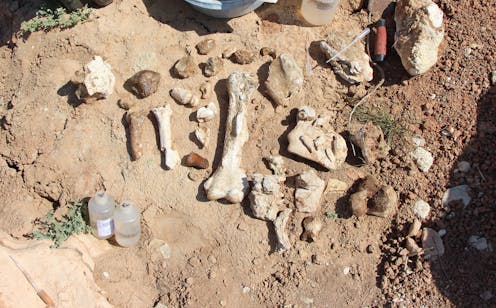
In 2017, Flinders University researchers uncovered a skeleton eroding from a cliff face on the Warburton River, at the Australian Wildlife Conservancy’s Kalamurina Station in northern South Australia.
The skeleton belongs to a species in the family Diprotodontidae – a group of four-legged herbivores that were the largest marsupials to ever exist.
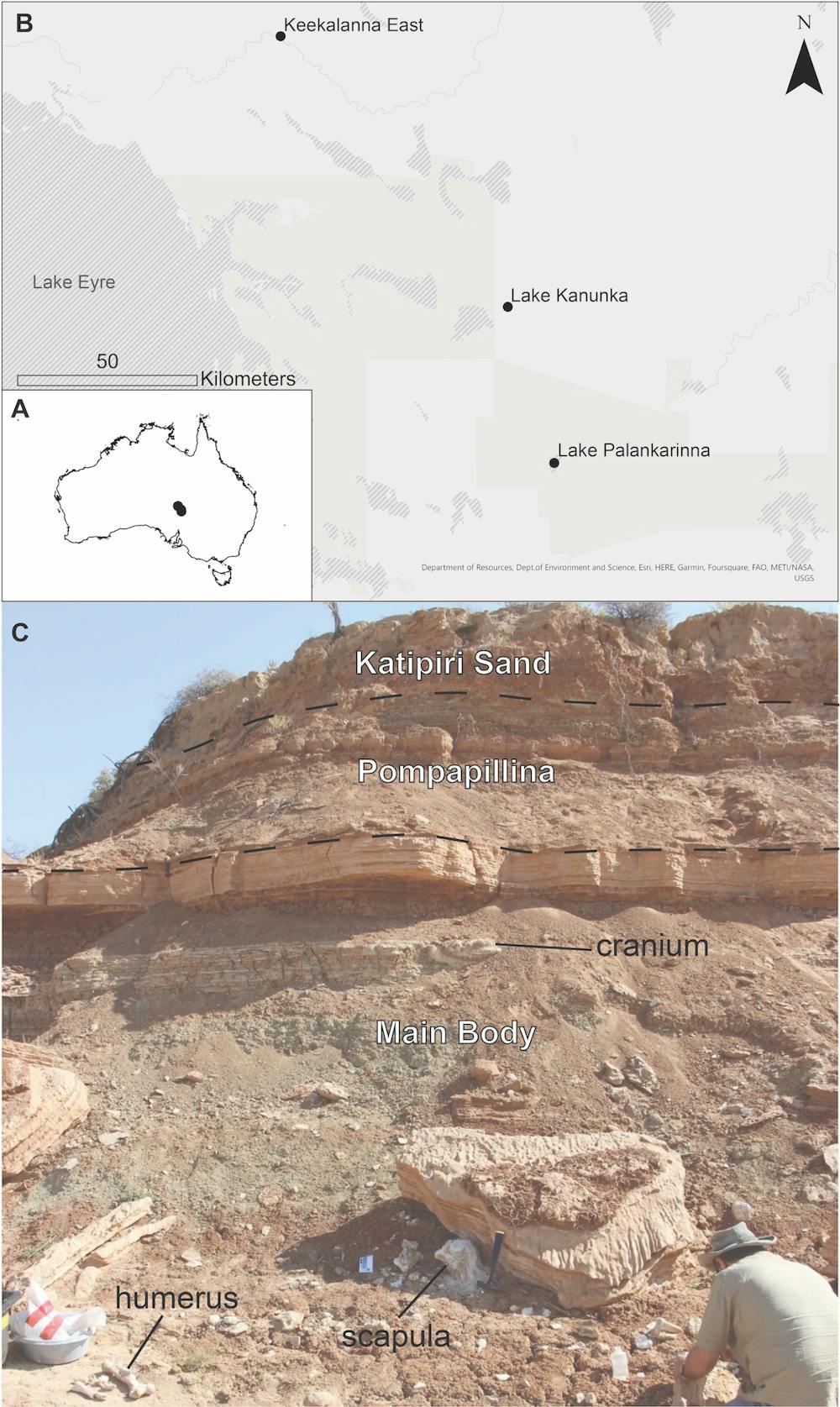
In a new study published in Royal Society Open Science today, we describe this fossil finding in detail, providing new insights into how the animal lived and moved.
Exceptional preservation
Wombats are the closest living relatives of diprotodontids, but the two are as distantly related as kangaroos are to possums. As a result, palaeontologists have had a hard time reconstructing these large, long-gone animals, especially since most diprotodontid species have been described mainly from jaws and teeth.
But the common, widespread nature of diprotodontid remains indicates they were an integral part of Australian ecosystems until the last species, including the rhino-sized Diprotodon optatum, became extinct about 40,000 years ago.
It is rare to find multiple bones belonging to a single skeleton in the fossil record. Only a handful of studies have described parts of the limbs of a post-Miocene diprotodontid. As such, the newly described skeleton is of great importance and is even more special, as it is the first to be found with associated soft tissue structures.
We also compared the specimen to more than 2,000 diprotodontid elements from museums across the globe, making this the most comprehensive appraisal of a diprotodontid skeleton to date.
Our comparisons revealed the skeleton belongs to a new genus we named Ambulator, meaning walker or wanderer. We chose this name because the locomotory adaptations of the legs and feet of this quarter-tonne animal would have made it well suited to roaming long distances in search of food and water, especially when compared to earlier relatives.
We 3D-scanned the specimen, and the files are freely available for anyone to download and look at online.
 Reassembled partial skeleton of Ambulator keanei, with a silhouette demonstrating advanced adaptations for its style of walking.
Jacob van Zoelen, Author provided
Reassembled partial skeleton of Ambulator keanei, with a silhouette demonstrating advanced adaptations for its style of walking.
Jacob van Zoelen, Author provided
Read more: Giant marsupials once migrated across an Australian Ice Age landscape
Walking marsupials
We don’t often think of walking as a special skill – but when you’re big, any movement can be energetically costly, so efficiency is key.
Most large herbivores today, such as elephants and rhinoceroses, are unguligrade, meaning they walk on the tips of their toes, with their wrists or ankles not touching the ground.
Diprotodontids are what we call plantigrade, meaning their heel-bone contacts the ground when they walk – similar to human feet. This stance helps distribute weight and reduces energy loss when walking, but uses more energy for other activities such as running.
Many diprotodontids also have so-called extreme plantigrady in their hands – a wrist bone modified into a secondary heel. This “heeled hand” made early reconstructions of these animals look bizarre and awkward.
Development of the wrist and ankle for weight-bearing meant the digits became essentially functionless and likely did not make contact with the ground while walking. This may be why no finger or toe impressions are observed in the trackways of diprotodontids.
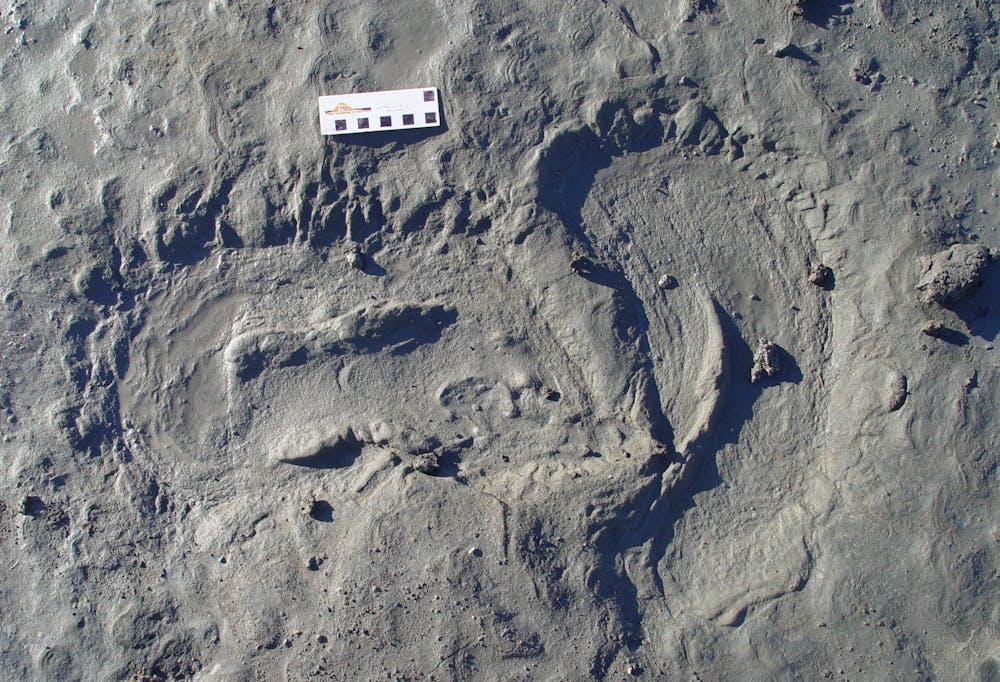 Hand and foot impression of Diprotodon optatum – with no sign of digits.
Aaron Camens, Author provided
Hand and foot impression of Diprotodon optatum – with no sign of digits.
Aaron Camens, Author provided
Climbers, walkers and grabbers
Diprotodontids have limb-bone shapes that can be grouped into three main types. There are those adapted to tree climbing, such as Nimbadon lavarackorum and Ngapakaldia tedfordi; and those adapted to more efficient locomotion and travelling great distances, such as Diprotodon optatum and Ambulator keanei (we call these “walkers”).
There are also diprotodontids that were terrestrial and probably could not climb. However, unlike the walkers, their forelimbs were not as specialised for walking and were able to perform a range of functions. These were “grabbers” such as Neohelos stirtoni, and likely Kolopsis torus and Plaisiodon centralis.
Walkers do not show up in the fossil record until we get to the Pliocene (3.5 million years ago). In fact, A. keanei is the earliest diprotodontid we know of that had these specialised walking adaptations.
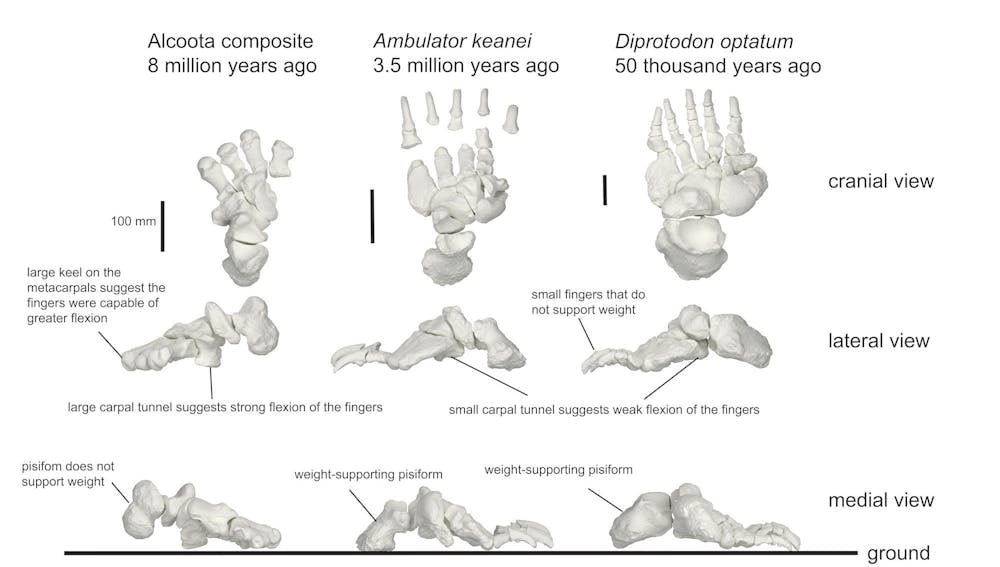 Comparisons of the left hand of three diprotodontids. From left to right a composite hand of: 8 million-year-old Alcoota diprotodontid, a grabber; 3.5 million-year-old A. keanei, a walker; and 50 thousand-year-old Diprotodon optatum, also a walker.
Jacob van Zoelen, Author provided
Comparisons of the left hand of three diprotodontids. From left to right a composite hand of: 8 million-year-old Alcoota diprotodontid, a grabber; 3.5 million-year-old A. keanei, a walker; and 50 thousand-year-old Diprotodon optatum, also a walker.
Jacob van Zoelen, Author provided
During the Pliocene, when A. keanei was around, there was an increase in grasslands and open habitat as Australia became drier. Diprotodontids likely had to travel much greater distances to obtain enough water and their preferred food, which was the soft leaves of shrubs and trees, not grass.
Animals such as Ambulator may have evolved to traverse great distances more efficiently. This may also have allowed diprotodontids to get bigger and support more weight. This would eventually lead to the evolution of the giant and relatively well-known 2.7 tonne Diprotodon.
Unfortunately, we will never get to see great migrating mobs of diprotodontids. But it’s amazing to know such a thing may have once been commonplace across the continent.
Authors: Jacob van Zoelen, PhD Candidate, Flinders University